How AI for Vacation Rentals Reduces Operational Burnout


AI for Rentals
Automate comms and cut burnout
Property managers juggle guest communications, booking confirmations, and maintenance requests around the clock, often fielding messages about broken amenities at 2 AM while other inquiries pile up unanswered. This relentless cycle leaves operators reactive rather than proactive, struggling to maintain quality service without burning out. The evolution of AI Communications For Hotels has opened new possibilities for vacation rental operators seeking sustainable solutions to communication overload.
Intelligent automation now handles guest conversations around the clock, answering common questions instantly and routing complex issues to human staff only when necessary. The technology learns property-specific details, from WiFi passwords to local restaurant recommendations, delivering consistent responses while maintaining the personal touch guests expect. Property managers gain time to focus on business growth rather than repetitive tasks through AI for hospitality.
Table of Contents
- Why Vacation Rental Operations Become Harder to Scale Than Expected
- Why Generic AI Tools Often Fail Vacation Rental, Teams
- What Vacation Rental Operators Actually Need AI to Handle
- Why Reactive Guest Support Limits Vacation Rental Growth
- What Effective AI for Vacation Rentals Actually Looks Like
- How Conduit Helps Vacation Rental Teams Scale Operations
- Book a Demo to See Conduit's AI for Hospitality Customer Service in Action
Summary
- Vacation rental operators responding within one hour achieve 25% more bookings, and improving response rates from 89% to 100% can increase bookings by up to 116%, according to Enso Connect's research. This pressure compounds across Airbnb, Vrbo, SMS, email, and direct booking channels, creating an always-on operational environment in which teams fragment their attention across multiple platforms rather than focusing on revenue-generating work.
- Coordination dependencies grow faster than headcount can absorb as vacation rental portfolios scale. Adding more staff doesn't solve the core problem because cleaners need updates, maintenance teams need routing, guests need responses across time zones, and operational issues need clear escalation paths. Without strong communication systems, information is scattered in inboxes and text threads that don't talk to each other, creating bottlenecks that compound as properties multiply.
- Generic AI systems respond incorrectly with complete confidence because they generate answers based on language patterns rather than verified reservation data. Stanford University's research documents how large language models produce convincing but inaccurate information, and in hospitality, those hallucinations cascade into longer delays, access problems, and support calls that consume more time than the automation was supposed to save. A wrong answer about check-in timing doesn't just annoy a guest; it creates operational failures across multiple teams.
- Reactive support leads to 35% more negative reviews compared to proactive communication, according to Hostaway's 2025 analysis. By the time a guest asks where the WiFi password is or why the lockbox code doesn't work, they've already experienced frustration that even a fast response cannot undo. Those small moments of friction accumulate into review comments about poor communication that directly impact booking conversion and platform visibility.
- Properties using AI chatbots see a 25% reduction in response time, but speed without accuracy creates new problems when systems lack dynamic awareness of reservation status, cleaning schedules, and maintenance issues. Effective AI must know whether the lockbox code changed this morning or whether the guest already contacted support through a different channel. Without that operational visibility, automation generates confident responses built on outdated assumptions that teams must manually correct.
- AI for hospitality addresses this by integrating directly with property management systems to maintain operational awareness across departments, routing maintenance requests and guest communications through unified workflows rather than through disconnected tools that shift coordination work rather than eliminate it.
Why Vacation Rental Operations Become Harder to Scale Than Expected
Growing a vacation rental business creates more communication touchpoints, coordination dependencies, and operational exceptions faster than it generates revenue. What runs smoothly with three properties becomes chaotic at ten because each new listing adds layers of guest conversations, maintenance scheduling, cleaner coordination, and platform-specific messaging that accumulate faster than most operators anticipate.
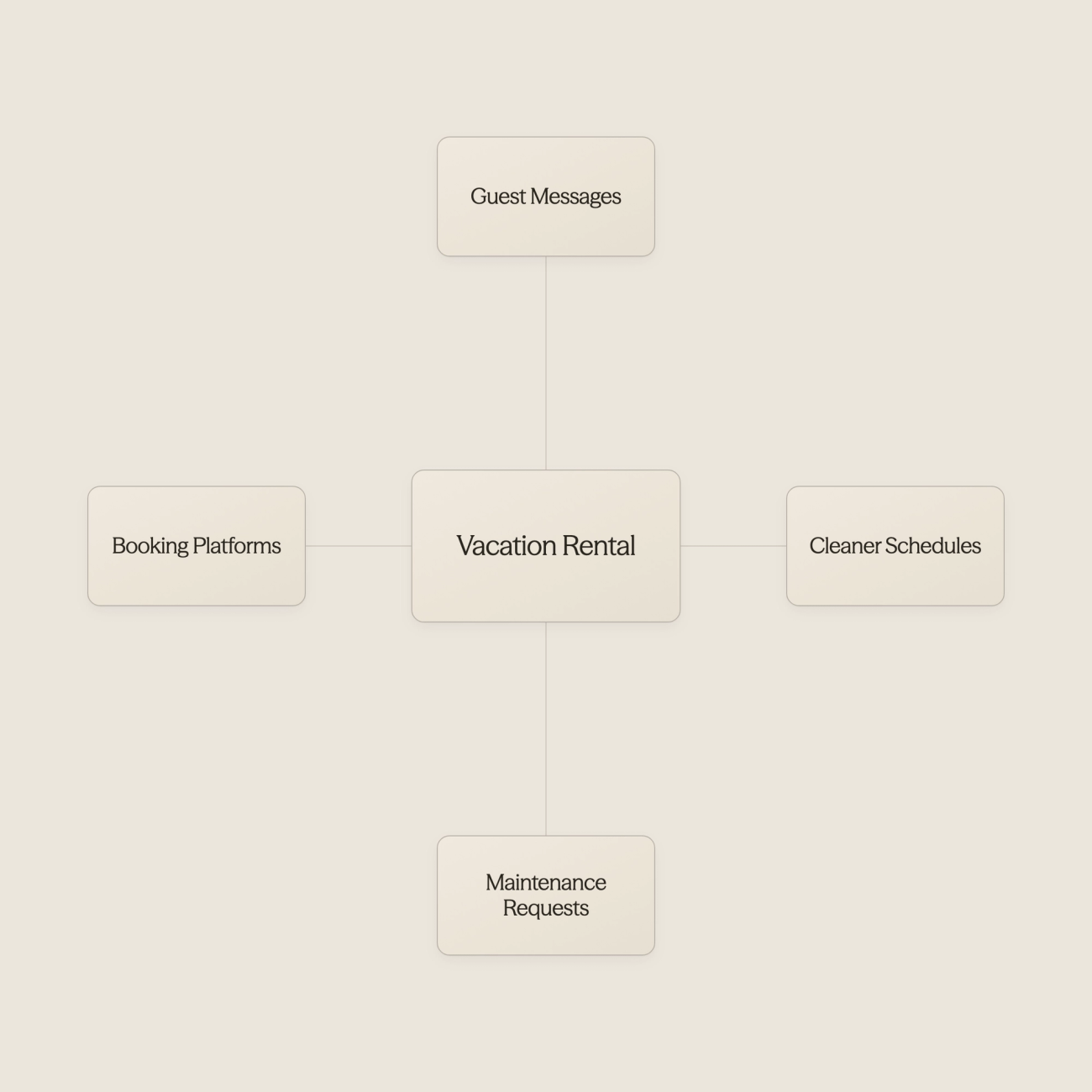
🎯 Key Point: The operational complexity of vacation rental management grows exponentially, not linearly, with each additional property due to the interconnected nature of guest services and maintenance coordination.
"Every new listing adds layers of guest conversations, maintenance scheduling, cleaner coordination, and platform-specific messaging that pile up faster than revenue grows." — Vacation Rental Operations Research, 2023

🔑 Takeaway: Understanding this complexity curve is essential for vacation rental operators who want to scale successfully without getting trapped in an operational nightmare that consumes all their profit margins.
The communication fragmentation problem
Guest expectations have shifted to align with the rapid responses from Uber and Amazon, rather than those of traditional hospitality competitors. Research from Enso Connect shows that Airbnb hosts who respond within 1 hour receive 25% more bookings, while improving response rates from 89% to 100% can increase bookings by up to 116%. This pressure intensifies across Airbnb, Vrbo, SMS, email, direct booking channels, and voice support simultaneously, trapping teams in an always-on environment where notifications, guest requests, and after-hours issues fragment attention across multiple platforms.
Why adding staff doesn't solve the core problem
Most operators assume that more properties require more people. Coordination dependencies grow faster than headcount can absorb. Cleaners need updates, maintenance teams need routing, guests need responses across time zones, internal teams need visibility into booking changes, and operational issues need clear escalation paths.
Without strong communication systems, bottlenecks compound as information scatters across inboxes, text threads, and unintegrated dashboards.
How do AI communication systems address these challenges?
Platforms like AI for hospitality consolidate guest communication from multiple channels into unified workflows, where AI agents address routine questions, route complex issues to appropriate staff, and maintain fast response times without requiring teams to monitor multiple inboxes.
Teams using these systems report automation rates between 70% and 90%, freeing staff to focus on revenue-generating activities rather than repetitive coordination tasks.
The seasonality spike nobody prepares for
Busy seasons create operational surges where booking volume, guest turnover, pricing adjustments, support requests, and maintenance coordination accelerate simultaneously. Every operational system gets stress-tested at once, exposing gaps in the communication infrastructure that seemed manageable during slower periods.
Most scaling problems in vacation rentals aren't property problems—they're coordination and communication problems disguised as capacity issues. What happens when teams address these challenges with generic AI tools built for other industries?
Related Reading
- AI Communications For Hotels
- AI For Airbnb Hosts
- AI Use Cases In Hospitality
- Best Hotel Chatbot
- AI Chatbot For Hotels
- Hotel Chatbot
Why Generic AI Tools Often Fail Vacation Rental, Teams
Generic AI tools don't work well for vacation rentals because they treat hospitality communication like standard customer support when it's operational coordination. A guest asking about check-in initiates a workflow dependent on reservation status, cleaning schedules, access codes, property-specific instructions, and real-time availability—all of which must align for an accurate answer. Most AI systems can't access this information, so they respond with confidence while operating in the dark.
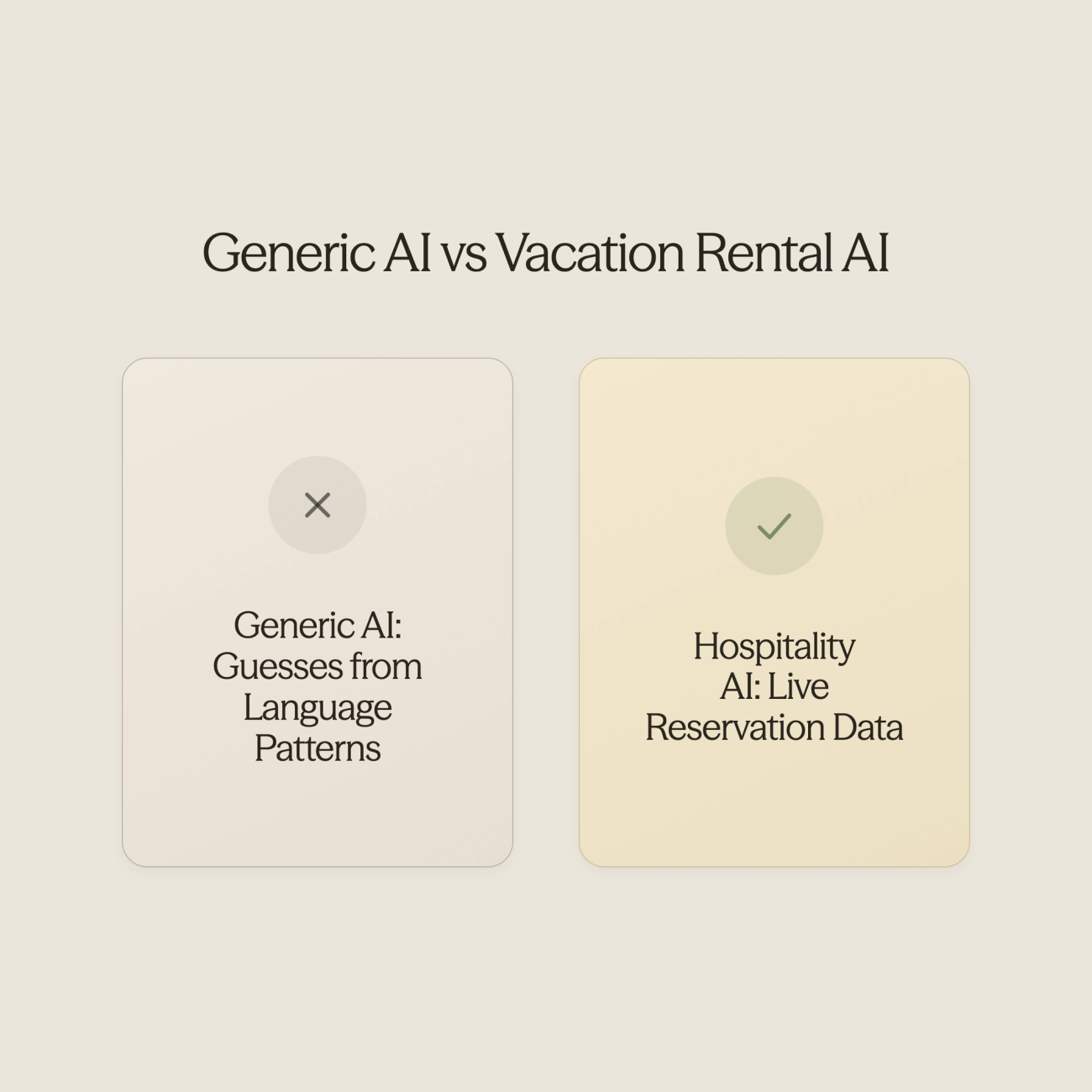
🎯 Key Point: Vacation rental operations require contextual awareness that generic AI tools simply cannot provide without deep integration into your property management systems.
"Generic AI responds with confidence while operating blind to the complex operational workflows that drive successful vacation rental guest experiences."
⚠️ Warning: Using disconnected AI tools for guest communication can lead to incorrect information, frustrated guests, and operational chaos when promises don't align with actual property availability and logistics.
The Inaccuracy Problem
The biggest operational risk isn't that AI fails to respond—it's that AI responds incorrectly with complete confidence. A generic chatbot might tell a guest that early check-in is available when the cleaner hasn't finished, provide outdated parking instructions, or misunderstand cancellation terms because it generates responses based on language patterns rather than verified reservation data.
In vacation rentals, errors lead to late arrivals, lockouts, conflicts with cleaners, and frustrated guests before they even see the property.
How do AI hallucinations impact hospitality operations?
Research from Stanford University's Human-Centered AI Institute shows that large language models generate plausible but inaccurate information, particularly when they lack access to verified sources.
In the hospitality industry, these mistakes become operational problems. An incorrect check-in time can delay cleaners, create access issues, and generate support calls that consume more time than the automation was meant to save.
Disconnected Communication Channels
Vacation rental teams manage Airbnb messaging, Vrbo inbox, SMS, email, direct booking platforms, and internal tools simultaneously. Generic AI systems operate within a single messaging layer without understanding the broader guest journey or sharing information across channels. This fragmentation forces teams to manually reconnect conversations, shifting coordination work rather than eliminating it. Conduit bridges these channels by maintaining context across your entire guest journey, enabling your team to focus on what matters.
Property management system awareness is critical. Hospitality communication requires understanding the guest, their booked property, check-in status, housekeeping completion, and recent reservation changes. Without operational awareness, automation becomes unreliable: the AI may seem helpful but provide outdated or irrelevant information. Our platform integrates directly with your PMS to ensure every message draws from real-time operational data.
When Exceptions Break Automation
Vacation rentals create unusual situations requiring human judgment: last-minute booking changes, maintenance emergencies, lockouts, weather disruptions, delayed cleaners, or extension requests. Generic AI systems lack smart routing logic and persist with automated responses long after human intervention is needed, forcing teams to manually rebuild situations and resolve guest frustration that has escalated unnecessarily.
Why do manual corrections become hidden operational costs?
This manual correction work becomes a hidden operational cost. According to IBM research, 42% of large companies using AI report concerns about the accuracy and reliability of generative AI outputs.
In hospitality, reliability matters more than in most industries because communication directly shapes operations and guest experience. A wrong answer doesn't create a support ticket; it creates a guest experience failure that affects reviews, repeat bookings, and reputation on platforms where trust drives conversion.
How do specialized platforms solve routing problems?
Platforms like AI for hospitality solve this problem by connecting directly with property management systems and reservation data. Rather than generating responses based solely on language patterns, our platform accesses live reservation information, property details, communication history, and internal workflows, then routes exceptions to human team members with full context included.
Operational awareness transforms AI from a conversational tool into a coordination tool that reduces workload rather than shifting it elsewhere. The real question is what vacation rental operators need AI to handle when every interaction matters for their business.
What Vacation Rental Operators Actually Need AI to Handle
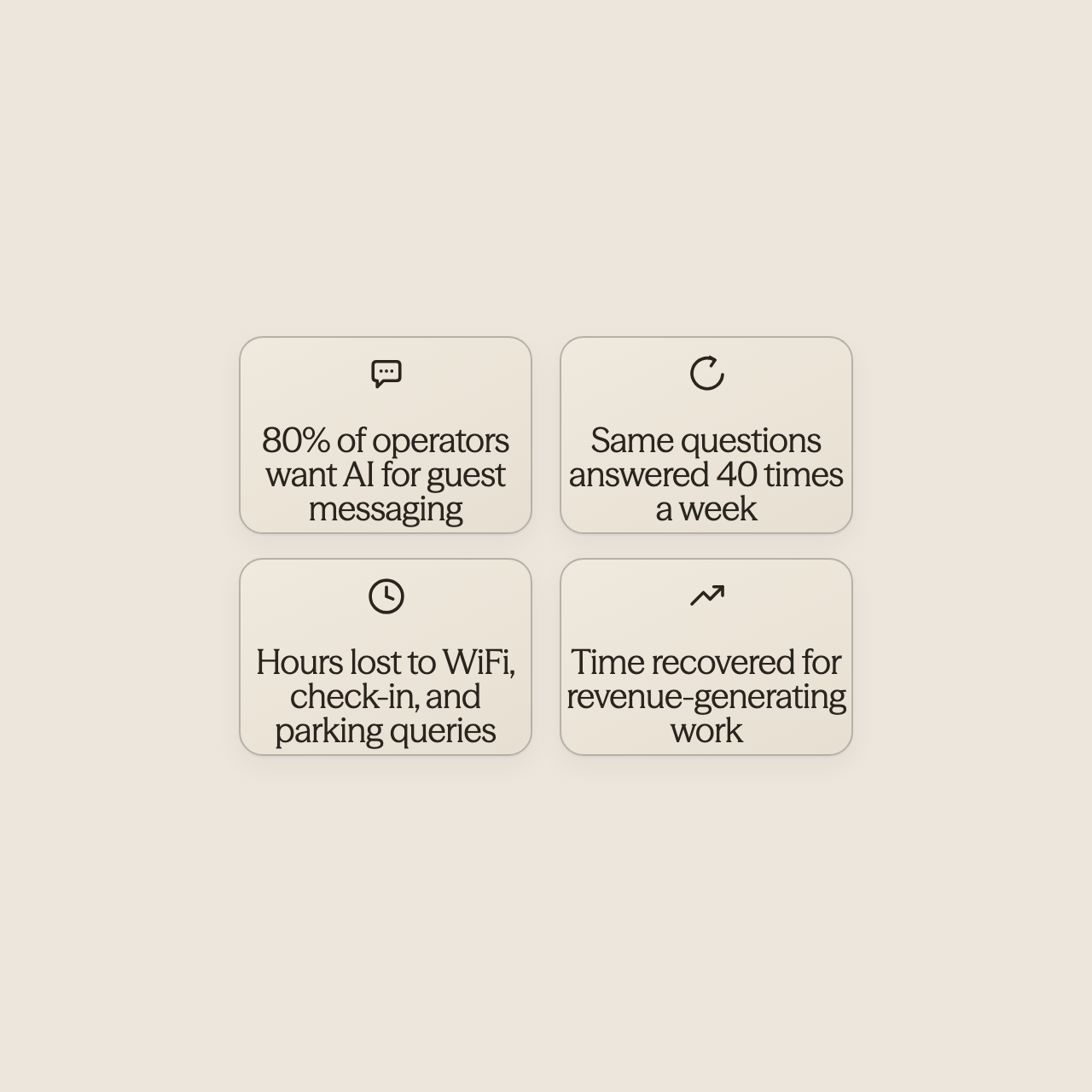
Vacation rental operators aren't eliminating hospitality from their business. They're reclaiming operational capacity lost to repetitive coordination work that grows faster than revenue. The bottleneck isn't complexity—it's volume. Teams don't collapse under difficult guest situations; they collapse under answering the same question forty times a week while coordinating cleaner schedules, routing maintenance requests, and monitoring after-hours messages across four platforms.
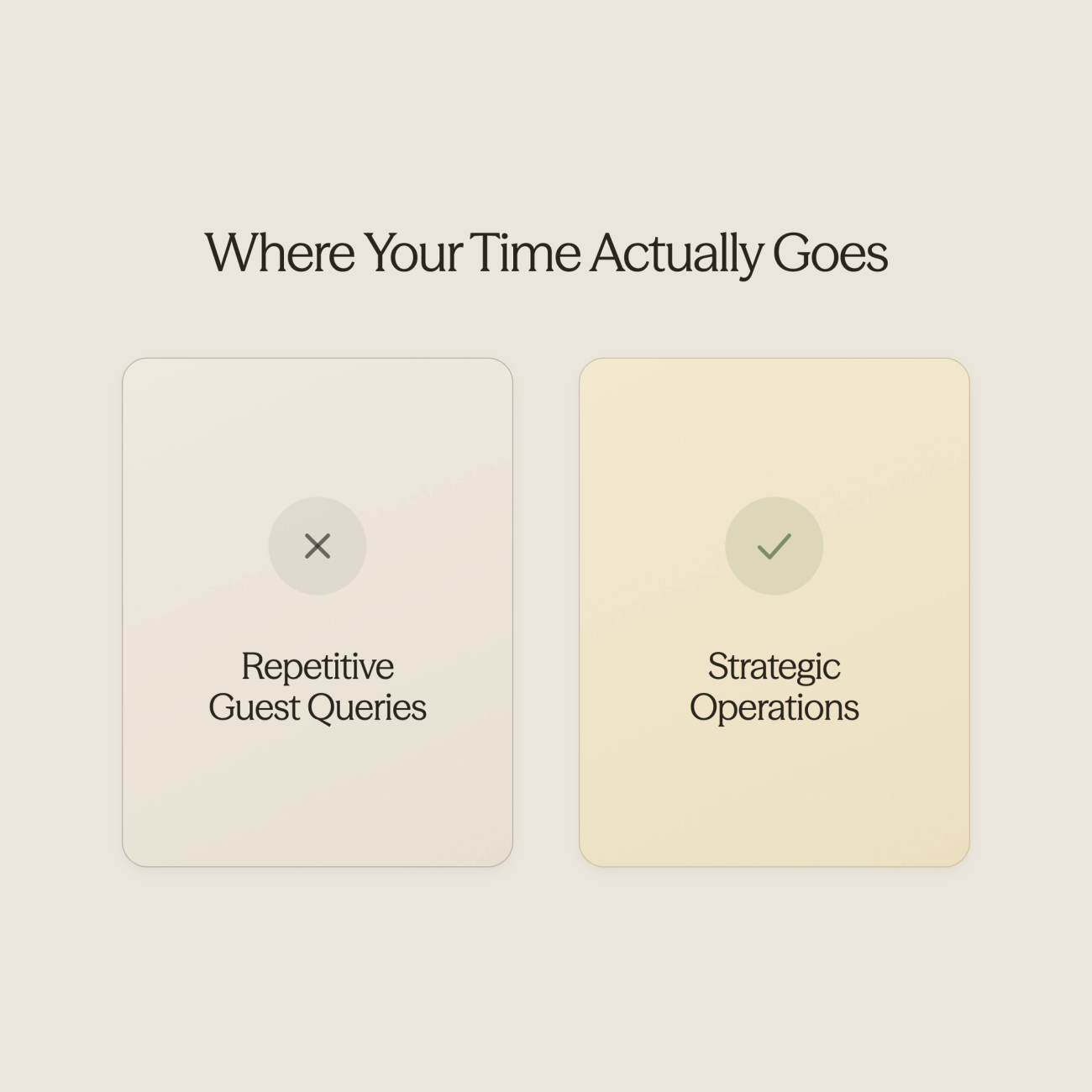
🎯 Key Point: The real challenge isn't handling complex guest needs—it's managing the overwhelming volume of repetitive tasks that consume valuable time and resources.
"Teams don't collapse under difficult guest situations; they collapse under answering the same question forty times a week while juggling multiple operational demands."
⚠️ Warning: Without proper AI automation, your team will continue spending 80% of their time on routine coordination instead of delivering exceptional guest experiences.
Guest Messaging That Repeats Endlessly
The same questions keep coming up: "How do I get in?" "What's the WiFi password?" "Can we check out late?" "Where do I park?" Each interaction takes two minutes. Across fifty active reservations, those two-minute responses consume hours of daily interruptions. According to StayFi's 2024 industry research, 80% of vacation rental operators want AI to handle guest communication because repetitive messaging diverts time from important work. When a property manager spends the afternoon answering WiFi questions instead of analyzing booking patterns or improving the listing, the business suffers.
Check-In Coordination Across Active Reservations
Arrival instructions, access codes, property readiness confirmations, and last-minute schedule changes must happen at precisely the right time across hundreds of simultaneous bookings. A single delayed message about a cleaner running late can trigger guest frustration, negative reviews, and internal scrambling. The challenge isn't managing one check-in well—it's managing thirty simultaneously without any guest feeling their arrival was handled reactively. Manual monitoring of reservation statuses and sending updates based on memory and inbox searches makes this impossible.
After-Hours Support That Never Stops
Guests don't schedule emergencies for business hours. A lockout at midnight, a broken appliance during dinner, or a question about tomorrow's checkout timing all demand immediate responses. Teams monitor messages constantly because ignoring after-hours communication risks reviews mentioning "unresponsive host" or "no support when we needed help." AI that handles routine after-hours questions and escalates genuine emergencies transforms constant monitoring into exception-based oversight, letting teams disconnect from operational demands.
Maintenance Routing That Consumes Disproportionate Time
A guest reports a dripping faucet. The message triggers a chain of actions: notify maintenance, update housekeeping if access timing matters, track repair completion, follow up with the guest, and document the fix internally. Even minor issues create communication chains involving multiple people and platforms. When three maintenance requests arrive simultaneously across different properties, coordination becomes the primary task rather than a supporting function. Platforms like AI for hospitality automate these workflows by routing maintenance requests directly from guest messages, notifying relevant teams, tracking resolution status, and closing the loop with guests without manual coordination at each step.
Guest Lifecycle Workflows That Stay Inconsistent
Follow-ups after checkout, offers to extend your stay before you leave, chances to pay for early check-in or late checkout, pre-arrival messages, and personalized suggestions during your stay all increase revenue and guest satisfaction. Most teams handle them differently because manual processes become unmanageable during peak periods.
What's the real value of consistent guest communication?
The value isn't automation—it's consistency. When every guest receives timely, relevant communication, regardless of operational demands, the experience improves, and revenue opportunities are not missed.
The real opportunity isn't replacing people with software. It's removing the coordination work that prevents teams from doing what matters: improving guest experience, maintaining property quality, and growing strategically.
Why Reactive Guest Support Limits Vacation Rental Growth
Reactive support creates a dangerous scaling trap: as portfolios expand, communication touchpoints multiply faster than revenue or guest satisfaction grows. Reactive workflows treat each interaction as a separate event rather than a predictable pattern that could be automated or prevented. Operational costs grow faster than revenue, consuming margins and limiting expansion speed.
🎯 Key Point: Every reactive interaction represents a missed opportunity for proactive automation that could eliminate the need for that touchpoint entirely.
"Operational costs in reactive support models can grow 2-3x faster than revenue as portfolios scale beyond 10 properties." — Vacation Rental Operations Research, 2024
⚠️ Warning: Property managers who rely on reactive support often hit a growth ceiling where adding new properties becomes unprofitable due to escalating communication overhead.
What happens when vacation rental teams only react to problems?
When teams work reactively, they respond to problems guests have already encountered rather than preventing them. A guest unable to find parking instructions at 9 PM creates an urgent support ticket, diverting staff from other work. A maintenance issue discovered during a stay requires quick coordination between the guest, property manager, and vendor. With fifty properties, overlapping check-ins, and varying guest needs, the operation becomes a constant cycle of crisis management.
How does reactive support impact guest satisfaction and reviews?
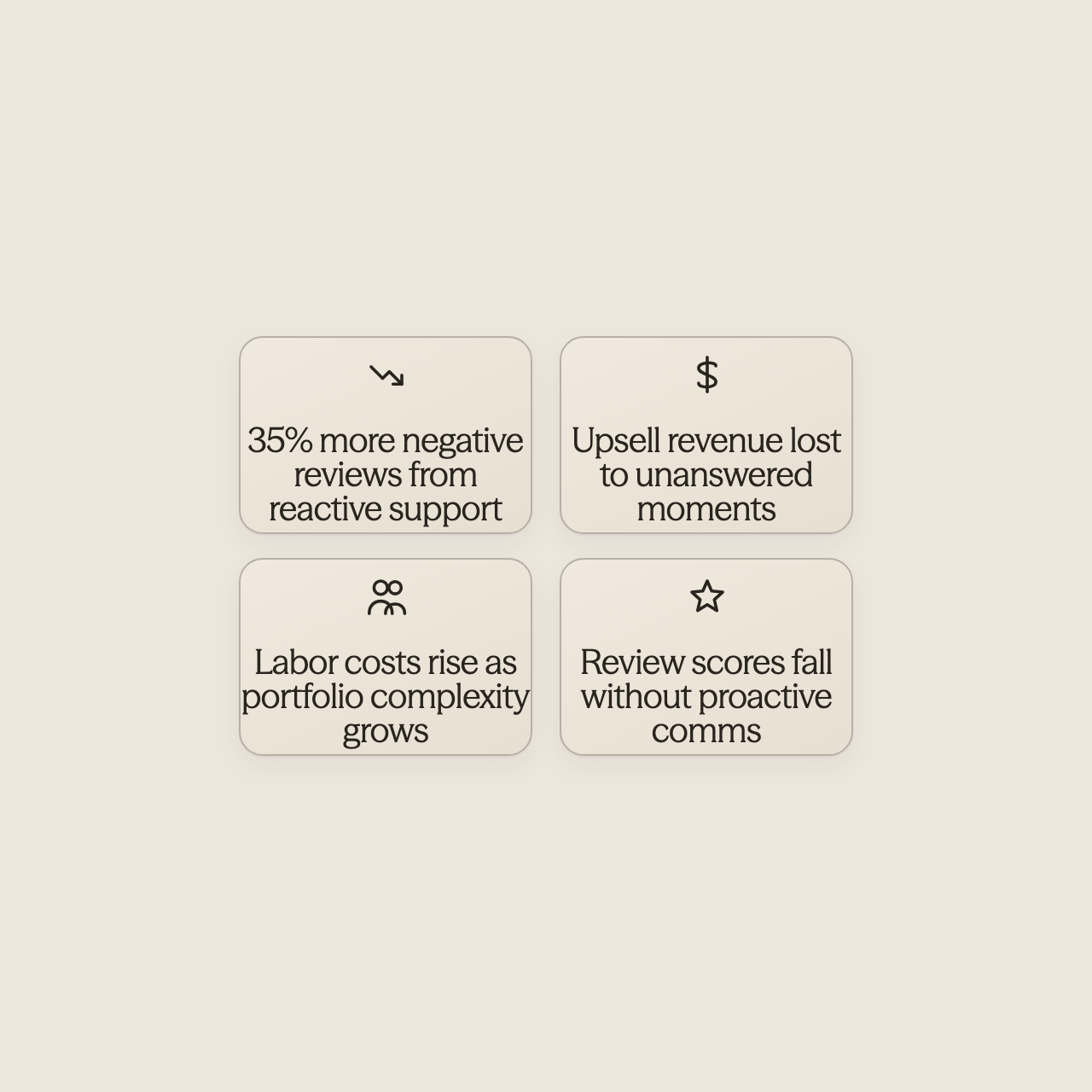
Reactive support leads to 35% more negative reviews compared to proactive communication, according to Hostaway's 2025 vacation rental trends analysis. Reactive models allow problems to reach guests before operations teams can intervene. By the time a guest asks for the WiFi password or lockbox code, frustration has already set in. Even a quick response cannot undo that initial negative impression.
What revenue opportunities do reactive operations miss?
The revenue impact extends beyond reviews. When support lines are filled with repeated questions about parking, checkout procedures, or appliance instructions, teams lose time to revenue-generating activities like upselling local experiences, offering paid early check-ins, or suggesting stay extensions. A property manager spending three hours answering the same WiFi question from different guests cannot simultaneously reach out to arriving guests with personalized recommendations that drive additional revenue.
Why does adding more staff create new problems?
Many operators respond to growing communication volume by hiring additional support staff. That approach addresses capacity but not efficiency. Adding team members means more people answering repetitive questions rather than eliminating those questions altogether.
It also introduces coordination overhead as staff members must align on response consistency, escalation procedures, and access to property-specific information scattered across different systems.
How does team expansion affect costs and guest experience?
Labor costs rise as operational complexity increases. A five-person support team requires internal communication protocols, shift-coverage planning, and quality-assurance processes that a solo operator never needs.
Guest experience becomes inconsistent when different team members provide slightly different answers to the same question, or when critical context lives in one person's email thread rather than a centralized system.
What is the real solution to communication bottlenecks?
The problem is the reactive structure itself, where every guest interaction requires human intervention, regardless of how predictable or repetitive the question might be.
Platforms like Conduit handle high-volume repetitive communication automatically while routing complex or sensitive issues to human staff with full context already gathered. This separation allows teams to focus on situations that require judgment, empathy, or creative problem-solving rather than typing the same parking instructions into different message threads.
What does proactive guest communication look like in practice?
Proactive workflows predict guest needs based on booking timing, property characteristics, and common issues. Instead of waiting for guest inquiries, the system sends information in advance. A guest booking a property with complicated parking receives detailed instructions automatically three days before arrival, rather than after contacting support from the driveway. A family checking in during the winter receives heating instructions and emergency contact information without having to search through a welcome binder.
This operational shift reduces inbound communication volume while improving guest satisfaction. When guests receive information before they need it, fewer support tickets are created, and the experience feels seamless rather than reactive. This efficiency compounds across dozens of properties because the same automated workflows handle repetitive scenarios consistently without requiring additional human resources as booking volume increases.
How do proactive operations perform during peak periods?
The difference in how they work becomes clear during busy times. A reactive team handling fifty simultaneous check-ins spends the afternoon answering urgent questions about lockbox codes, WiFi passwords, and parking spots. A proactive operation sends that information days earlier, freeing the team to address actual problems, handle complex requests, and pursue upsell opportunities instead of managing basic logistics.
But knowing what proactive operations look like doesn't explain how to build them without creating new complexity or losing the human touch that makes hospitality work.
Related Reading
- Hotel Automation Tools
- Hotel Chatbot
- Guest Communication Tools
- Ai Agents For Hotels
- Ai Chatbot For Hotels
- Airbnb Automation Tools
- Ai Tools For Hotels
What Effective AI for Vacation Rentals Actually Looks Like
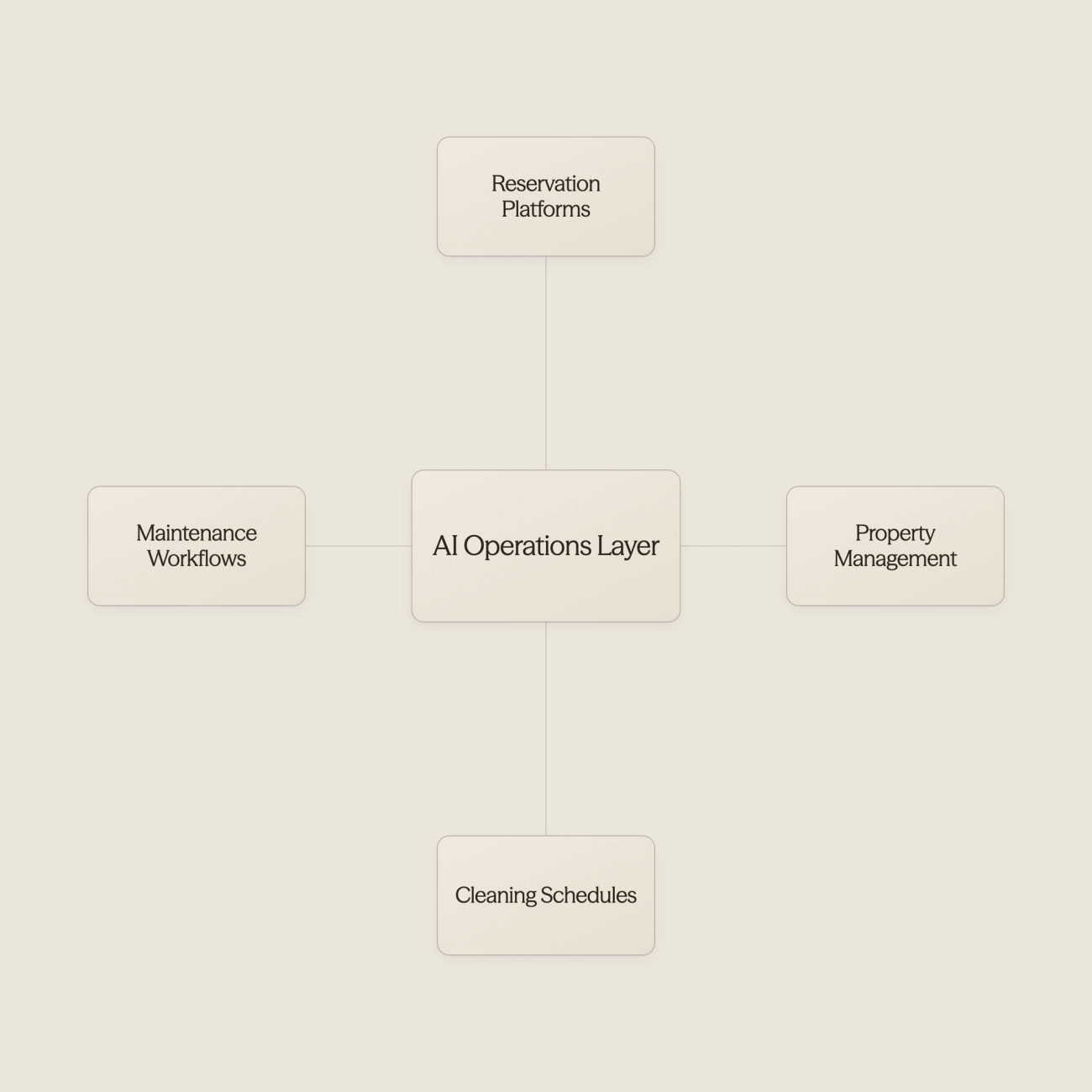
Good AI in vacation rentals functions as an operational coordination layer connecting reservation platforms, property management systems, cleaning schedules, and maintenance workflows into a unified intelligence system. When a guest requests early check-in, the AI knows whether housekeeping has finished turnover, whether the previous guest extended their stay, and whether granting the request creates downstream conflicts.
🎯 Key Point: The most effective AI systems don't just automate individual tasks—they create intelligent connections between all your operational systems to provide real-time decision support that considers the full context of your property operations.
"Effective AI in vacation rentals acts as the central nervous system that processes information from multiple touchpoints simultaneously to enable instant, informed decisions." — Property Management Technology Report, 2024
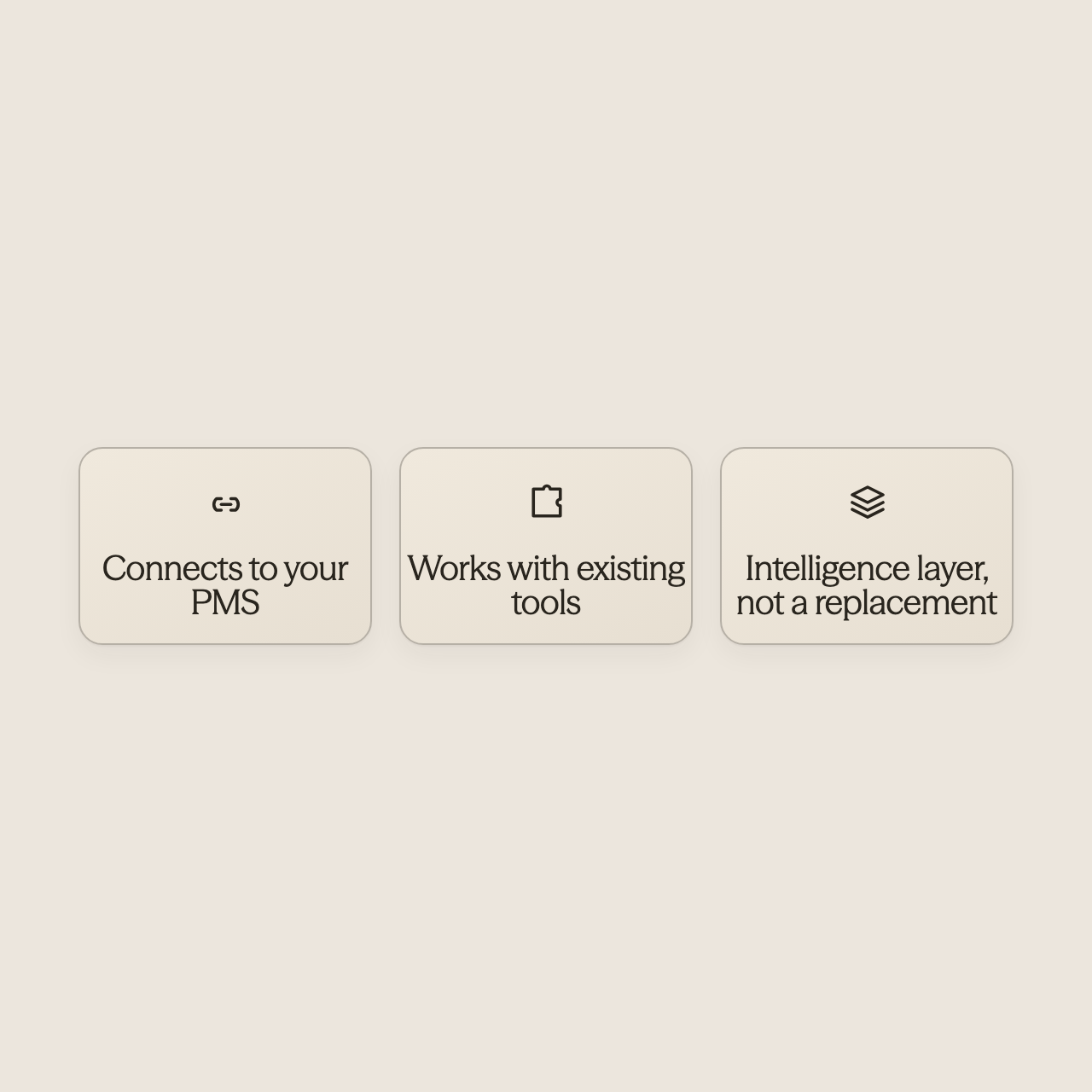
💡 Best Practice: Look for AI solutions that can integrate with your existing tools rather than requiring you to completely replace your current property management stack. The best systems work as an intelligence layer, making your existing tools smarter and more connected.
Live operational context separates hospitality AI from chatbots
Regular conversational tools answer questions based on static information. Hospitality-grade AI needs to know who the guest is, which property they booked, where they are in their stay, and whether unresolved issues exist in the system. According to Rentals United, properties using AI chatbots see a 25% reduction in response time, but speed without accuracy creates problems. The AI must know whether the lockbox code changed this morning, whether maintenance reported a malfunctioning appliance yesterday, or whether the guest already contacted support through another channel. Without that visibility, automation delivers confident responses built on outdated assumptions.
Cross-channel continuity prevents operational fragmentation
Guests move easily between Airbnb messaging, Vrbo inbox, SMS, email, and voice calls. Most teams manually reconnect conversations when guests switch platforms mid-issue, which loses context and forces restarts. Effective AI maintains conversation history and operational context across every touchpoint, preventing reconstruction under time pressure. One guest message about a maintenance concern should trigger categorization, task routing, internal notifications, and status updates automatically, eliminating hours of coordination work currently scattered across text threads and verbal handoffs.
Why does intelligent escalation matter more than automation coverage?
StayFi reports that AI tools can automate up to 80% of routine tasks, but operational value lies in handling the remaining 20%. Maintenance emergencies, upset guests, lockouts, payment disputes, and weather disruptions require human judgment, empathy, and real-time problem-solving.
Effective AI knows when to stop automating and escalates issues to humans with full context, enabling teams to respond immediately without reconstructing what happened. Generic systems continue automating long after a human should intervene, increasing guest frustration and operational risk.
How do AI platforms integrate with existing property management systems?
Platforms like AI for hospitality connect directly with property management systems and reservation platforms to keep teams informed across departments. Our platform enables teams to send maintenance requests, housekeeping updates, and guest communications through a unified workflow, rather than managing separate tools.
The best implementations feel invisible operationally because communication becomes faster, more proactive, and naturally coordinated across the entire guest journey. But understanding what effective AI looks like operationally leaves one critical question unanswered: how does this get built without disrupting existing workflows or requiring teams to abandon systems they already use?
How Conduit Helps Vacation Rental Teams Scale Operations
Conduit connects directly into the hospitality technology stack rather than operating as a standalone chatbot. Our platform maintains real-time visibility into reservation details, property information, guest lifecycle stages, and operational workflows, ensuring responses remain accurate and operationally grounded. This matters because hospitality communication depends on timing and context that generic AI tools cannot access.
🎯 Key Point: Unlike generic chatbots, Conduit's deep integration with your existing property management systems ensures every guest interaction is informed by real-time data and operational context.
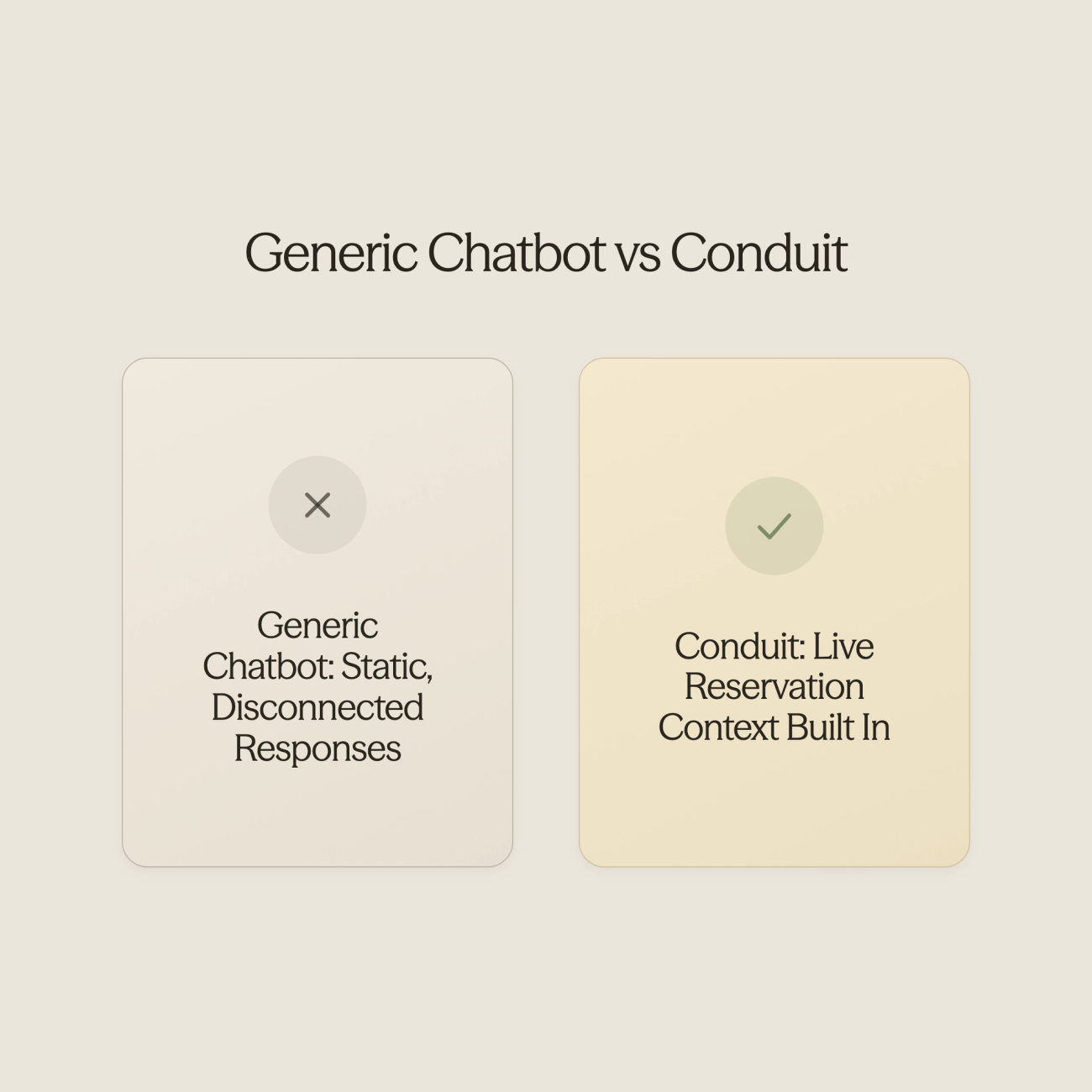
"Real-time visibility into guest lifecycle stages and operational workflows is what separates effective hospitality AI from generic chatbot solutions." — Conduit Platform Analysis, 2024
💡 Best Practice: The integrated approach means your team can scale guest communications without losing the personal touch that drives guest satisfaction and repeat bookings.
Real operational impact at portfolio scale
Haven Vacation Rentals recently doubled property capacity while maintaining service quality through automated guest interaction systems. Of roughly 100 guest issues, only 3 required human intervention. Automation handles large volumes while humans focus on decisions requiring judgment.
Automation enables proactive workflows triggered by guest lifecycle events: bookings, check-ins, purchases, upgrades, extensions, and add-on opportunities. This reduces inbound support volume while creating revenue opportunities throughout the journey, rather than forcing teams to respond to guest requests after they occur.
Operational routing that maintains context
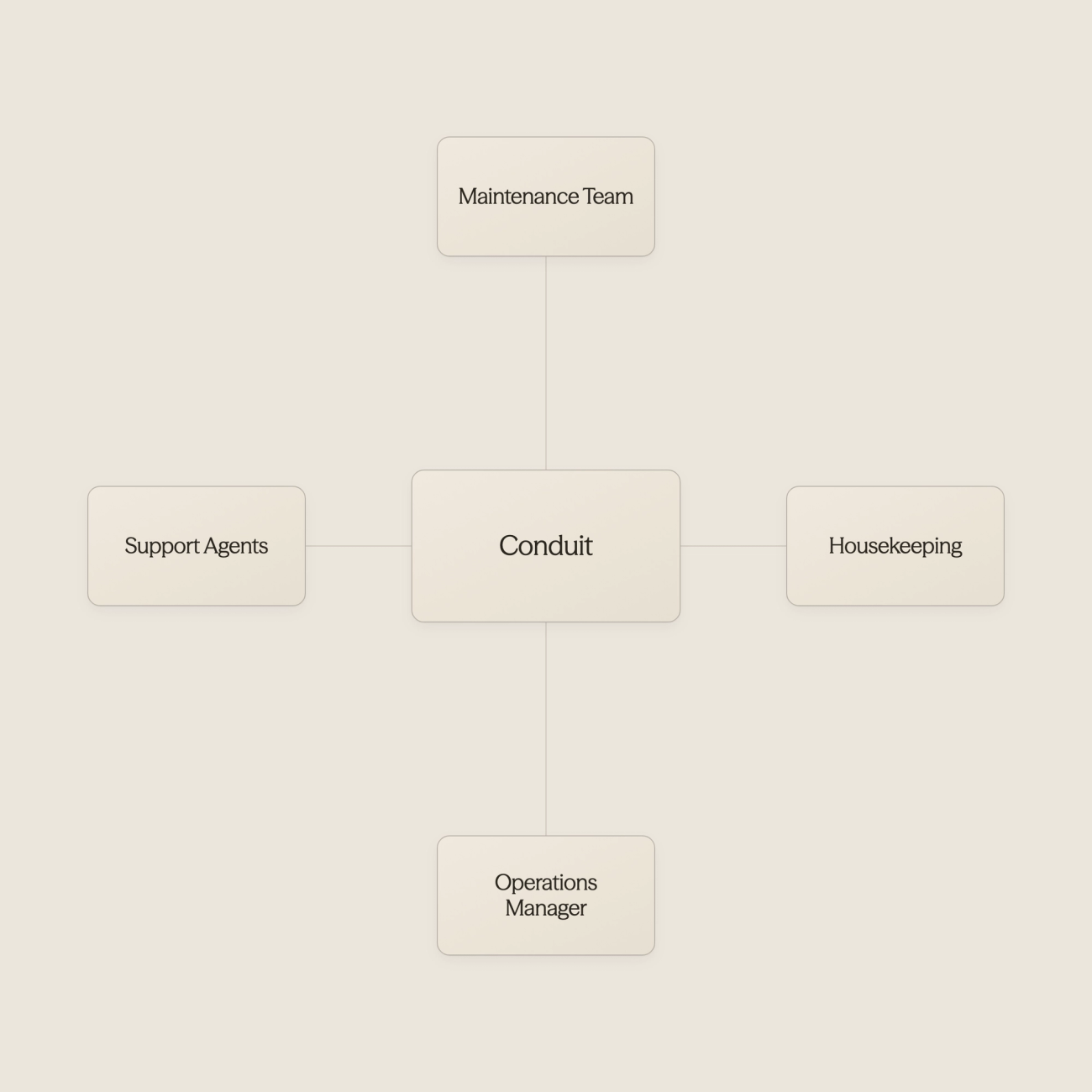
When guests have issues requiring coordination across teams—maintenance, housekeeping, operations managers, or support agents—delays multiply as your property portfolio grows. Platforms like Conduit route operational tasks to the right people with all relevant information included, eliminating manual coordination across systems when problems arise.
How does AI balance automation with human oversight?
Sensitive guest situations and high-impact operational decisions remain under human oversight when judgment and empathy matter most. The goal is to reduce repetitive coordination work so hospitality teams focus on guest experience quality and operational execution. This balance between automation and oversight separates effective AI implementation from blind automation that creates new problems.
What does implementation look like for vacation rental teams?
But what does this look like when a vacation rental team puts this approach into practice?
Related Reading
- Duve Pricing
- Hotel Automation Software
- Enso Connect Pricing
- Airbnb Automated Messages
- Ai Software For Hotels with the Best Reviews
- Best Ai For Hotels
- Hijiffy Pricing
- Property Management Ai Tools
Book a Demo to See Conduit's AI for Hospitality Customer Service in Action
If your team spends more time responding to guest messages than improving operations strategically, AI can help. The question isn't whether it works, but whether your current system can keep up with coordination complexity across properties, platforms, and guest expectations.
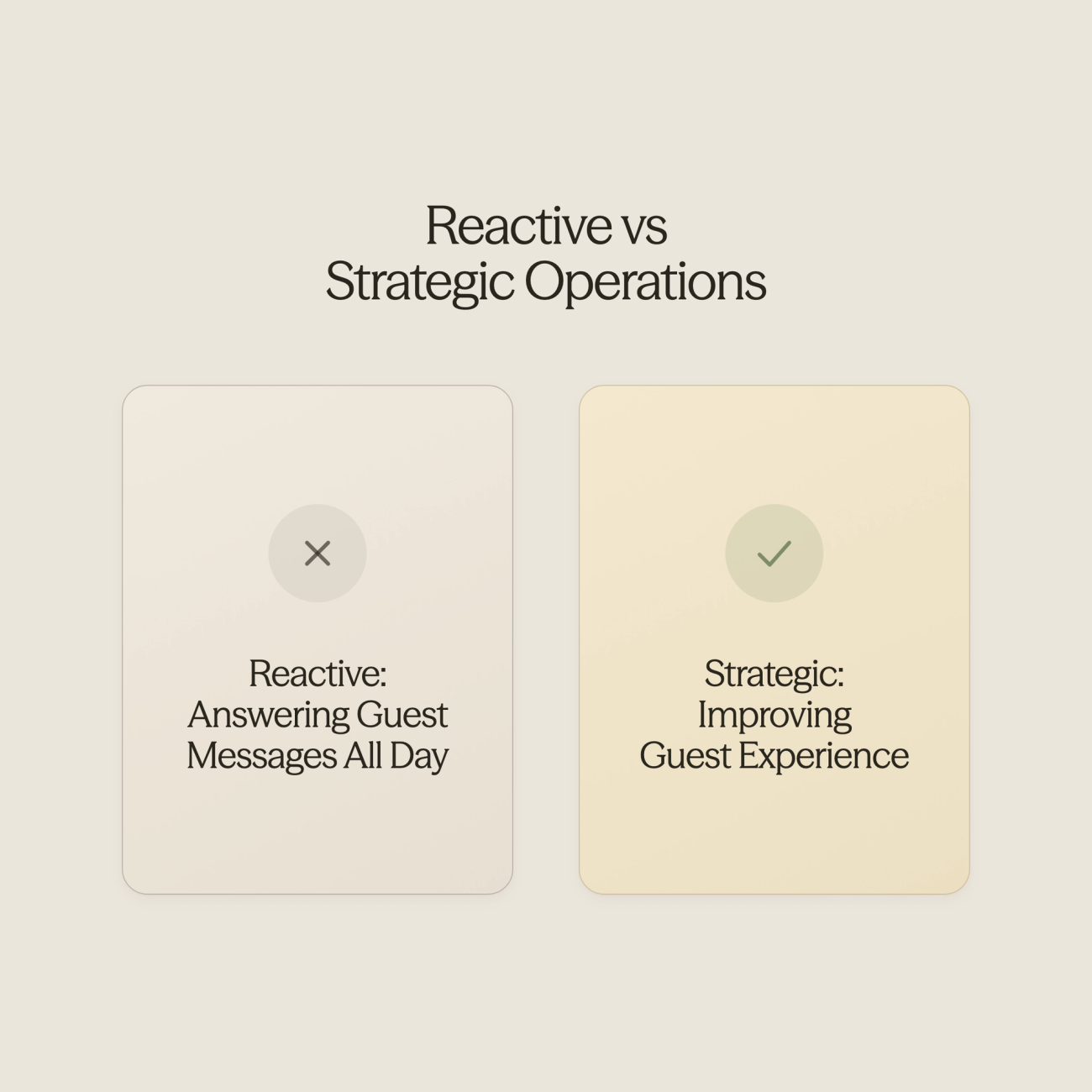
💡 Tip: The most successful hospitality teams use AI to handle routine guest requests while freeing up staff for high-value strategic work that drives revenue growth.
Teams that implement AI-powered guest communication see dramatic shifts from reactive support to proactive revenue optimization.
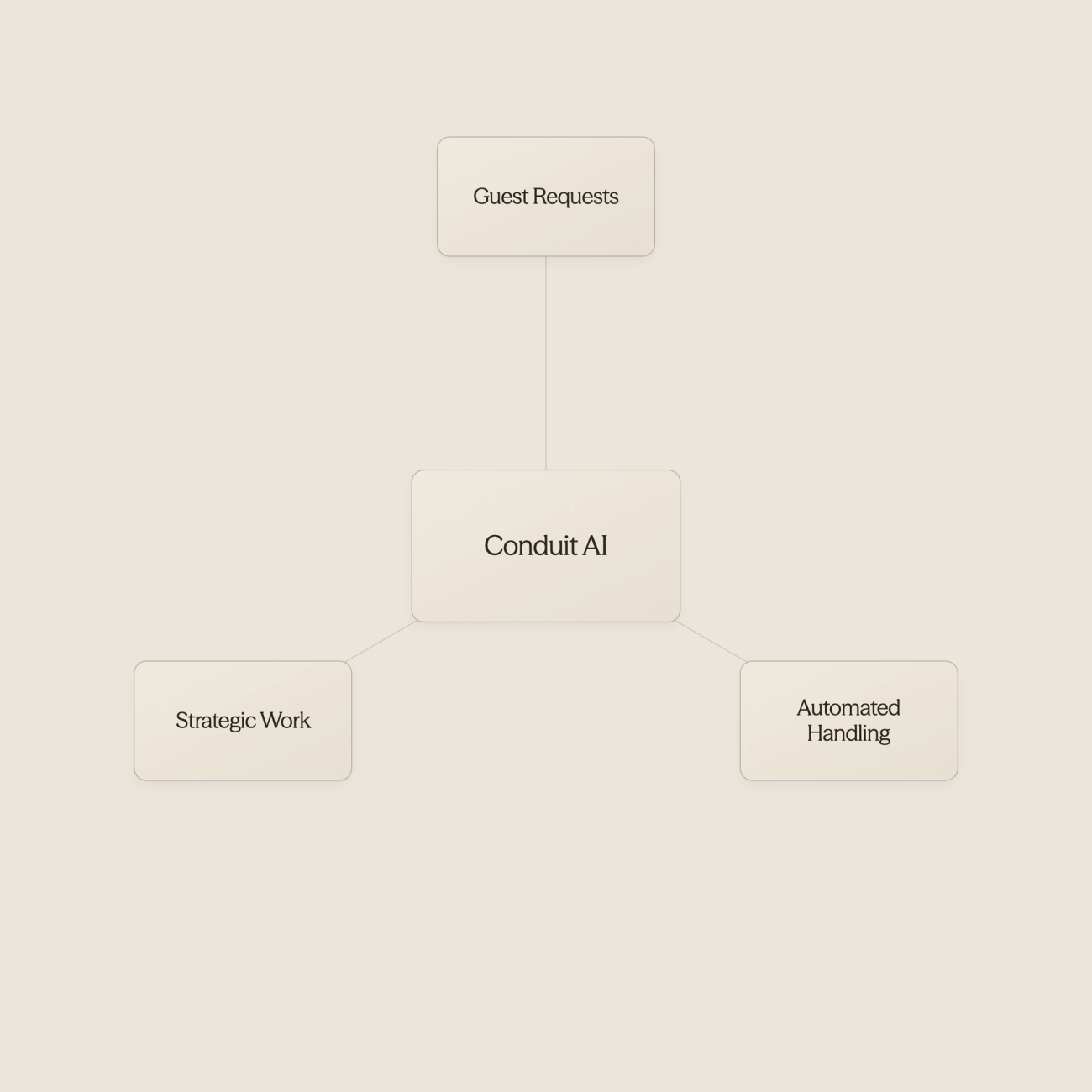
Book a demo with Conduit to see how our platform connects into your hospitality stack, automates repetitive guest requests with reservation context, and launches proactive workflows that reduce support volume while unlocking revenue opportunities. You'll evaluate the system against your property data and specific bottlenecks.
🎯 Key Point: See Conduit's AI in action with your real data to understand exactly how it will transform your guest service operations and drive measurable results.

Stay in the loop
Get the latest on AI automation, product updates, and customer stories.


