Guide on Hospitality Operations Management for Better Guest Stays


Hospitality Operations Guide
Hospitality management with Conduit's AI tools.
Guide on Hospitality Operations Management for Better Guest Stays
When check-ins run late, housekeeping misses rooms, and guests leave dissatisfied, the root cause is rarely a lack of effort from staff. More often, it comes down to disconnected systems that make coordinating front desk operations, scheduling, inventory, and guest communication harder than it needs to be. Strong hospitality operations management ties all of these moving parts together, and the right software can sharpen every stage of the process, from room turnover times to service response rates.
Hotels that close these operational gaps consistently deliver better guest experiences and run leaner teams without sacrificing service quality. Technology plays a growing role in making that possible, particularly tools built to reduce repetitive tasks and keep communication flowing between departments. For hotel teams looking to put those improvements into practice, AI for hospitality offers a practical starting point.
Summary
-
Hospitality operations management tends to break down at the coordination layer rather than the service layer. Hotels with 10 or more properties report three times more coordination failures than single-property operators, according to Keycafe's 2025 recap of operational shifts. When informal channels like morning briefings and shared whiteboards can no longer carry the weight of a growing operation, the gaps show up in delayed responses, missed requests, and guests who feel ignored.
-
The hidden costs of operational drag are rarely captured in a single budget line. Hotel operating costs outpaced revenue growth in 2024, according to the AHLA State of the Industry Report, and Sirma's analysis of fragmented hospitality systems confirms that disconnected platforms generate thousands of wasted hours and measurably higher labor costs. The issue is not effort. Manual handoffs between systems consume time that should be devoted to resolving guest needs.
-
Fragmented guest communication is one of the most consistent pressure points across hospitality operations. Guests now initiate contact through email, SMS, website chat, social media, online travel agencies, and review platforms, and most properties lack a unified system to ensure consistent responses across all channels. Response times suffer not because teams are inattentive, but because the information is scattered across tools that were never designed to work together.
-
Speed functions as a service quality signal, not just an efficiency metric. Hotels that invest in staff training see up to 24% higher guest satisfaction scores, according to EHL Hospitality Insights, which suggests the gap between average and excellent service is more often a process and information gap than a headcount gap. Faster, better-informed teams consistently outperform larger, slower ones.
-
Proactive workflows generate measurable returns in both revenue and satisfaction. According to EHL Hospitality Insights, 73% of hospitality executives identify technology adoption as the top strategy for improving operational efficiency, and the most effective applications are anticipatory rather than reactive. Pre-arrival messaging, mid-stay check-ins, and availability-triggered extension offers reduce inbound request volume while simultaneously creating additional revenue opportunities.
-
Data-driven oversight closes the loop between operational performance and guest outcomes. Hotels implementing structured revenue management systems see up to a 10% increase in RevPAR, according to EHL Hospitality Insights, and properties that regularly track service resolution times and request patterns can identify recurring friction points before they escalate into negative reviews. Measurement, rather than intuition, is what makes operational improvements repeatable.
-
AI for hospitality helps teams route guest requests across all channels through a single operational layer, connecting to existing property management tools so that information moves without manual transfer between departments.
Why Hospitality Operations Management Breaks Down as You Scale
When you grow a hospitality business, it exposes every problem your processes had when you were smaller, and things were easier to handle. Scaling acts as a stress test --- revealing hidden inefficiencies, communication breakdowns, and operational blind spots that were easy to overlook when your team was small and your locations were few.
"Growth doesn't create new problems --- it magnifies the existing ones you never fully solved." --- Hospitality Operations Insight
⚠️ Warning: If your hospitality operations feel manageable now, don't mistake that for scalable. What works at one location will almost certainly crack under the pressure of two, five, or ten.
🎯 Key Point: The real risk of scaling without fixing your operational foundation isn't just inefficiency --- it's guest experience failures, staff burnout, and revenue loss that compound faster than you can react.
| Stage | Common Operational Challenge |
|---|---|
| Small / Single Location | Manageable chaos, owner fills gaps |
| Multi-Location Growth | Communication breaks down across teams |
| Full Scale | Inconsistent standards, rising costs, and high turnover |

Why does coordination collapse when you add more properties?
The failure point is usually coordination. When a single property runs well, information travels through familiar channels: a morning briefing, a shared whiteboard, a quick conversation between departments. Add a second property, a third, a fourth, and those informal channels collapse. According to Keycafe's 2025 recap of operational shifts reshaping hotel management, hotels with 10 or more properties report three times as many coordination failures as single-property operators.
Disconnected systems build operational drag quietly. Reservation data sits on one platform, guest messages arrive across five channels, and housekeeping teams work from a separate system that is invisible to others in real time. Staff spend significant portions of their shifts moving information between systems rather than acting on it. This manual transfer layer manifests in delayed response times, missed requests, and guests who feel unheard.
Why does adding headcount fail to fix the underlying problem?
Most teams respond by adding more people or more meetings. However, Escoffier's 2025 hospitality industry data shows that over 80% of hospitality operators report difficulty maintaining consistent service quality as they expand locations---adding headcount doesn't address the underlying problem. Teams using AI for hospitality to handle guest communication and automate internal workflows are finding a different path: operational intelligence that scales with the business.
Staffing pressure compounds everything. The hospitality industry has one of the highest turnover rates of any sector, meaning operational knowledge regularly walks out the door. When a front desk manager leaves, they take with them institutional knowledge: how a particular guest prefers to be greeted, which maintenance issues recur in room 214, and how the team handles late arrivals during peak season. Without systems that capture and surface that knowledge automatically, every departure becomes a small operational reset.
How does the gap between guest expectations and team capacity create reputation risk?
Guest expectations do not pause while teams work through internal challenges. Travelers continue to arrive expecting fast, personalized responses, regardless of whether a property is operating at full capacity or undergoing a system migration. The gap between guest expectations and what stretched teams can deliver is where reputation damage begins.
The Hidden Costs of Inefficient Hospitality Operations
When you trace inefficiency through a hospitality business, the true cost rarely shows up in a single line item. Most operators scan for obvious waste while hidden operational drag quietly compounds across every department, shift, and quarter.
"The true cost of inefficiency rarely shows up in a single line item: it hides in the gap between what you spent and what you earned."
🚨 Warning: If your cost review only examines surface-level expenses, you are missing the largest sources of margin loss in your operation.

According to the AHLA 2025 State of the Industry Report, hotel operating costs grew faster than revenue in 2024, meaning properties spent more money to deliver the same output while profits got smaller. This is an operational structure problem that gets worse every quarter it stays unaddressed --- and it signals that incremental fixes are no longer enough.
| The Core Problem | The Real Impact |
|---|---|
| Operating costs outpacing revenue | Shrinking profit margins per property |
| Same output, higher spend | Negative return on operational investment |
| Unaddressed structural issues | Compounding losses quarter over quarter |
🔑 Takeaway: When costs grow faster than revenue, you are not facing a spending problem --- you are facing a structural efficiency problem that demands a systemic response, not a budget trim.
💡 Key Point: Every quarter this operational gap goes unaddressed, the cost-to-revenue ratio widens further --- making early intervention the highest-leverage move available to hospitality operators right now.
Where do operational failures actually begin?
The failure point remains invisible until it becomes expensive. A guest message sent through one channel never connects with a follow-up through another. A maintenance request logged in one system never surfaces to the room readiness team. A front desk agent spends eleven minutes tracking down information that should take thirty seconds. Sirma's analysis of fragmented hospitality systems confirms that disconnected platforms generate thousands of wasted hours and measurably higher labor costs across entire organizations.
Most teams respond by adding process layers: another checklist, another briefing, another spreadsheet to bridge systems never designed to talk to each other. This adds weight to an already strained operation, slowing response times and increasing cognitive load on stretched staff. Teams that use AI for hospitality to handle guest communication and automate internal workflows discover that the issue was never a shortage of effort but a shortage of coordination. Replacing manual handoffs with intelligent, integrated agents cuts resolution times without adding headcount.
How much revenue does operational drag silently remove?
The money lost to slow operations is rarely calculated. When a guest calls during busy check-in and no one answers, they book through an online travel site or don't book at all. When offering guests extra services requires accessing information across three separate systems, the opportunity is missed. Operational inefficiency costs money through wasted labor and lost revenue.
Most of these losses are entirely preventable.
Related Reading
Common Hospitality Operations Challenges Teams Face Today
Hospitality teams face predictable challenges clustered around three core pressure points: fragmented guest communication, misaligned internal coordination, and the critical gap between guest expectations and available staffing capacity.
"The most damaging hospitality challenges aren't random --- they're predictable, recurring, and clustered around the same three operational pressure points every time." --- Industry Operations Insight
| Pressure Point | Core Problem | Operational Impact |
|---|---|---|
| Fragmented Guest Communication | Messages scattered across multiple channels | Missed requests, delayed responses, and guest frustration |
| Misaligned Internal Coordination | Teams operating in disconnected silos | Errors, duplicated effort, staff burnout |
| Staffing Capacity Gaps | Expectations outpacing available resources | Inconsistent service, unmet guest needs |
🚨 Warning: Ignoring these three pressure points doesn't make them disappear --- it allows them to compound into systemic service failures that directly damage guest satisfaction scores and repeat bookings.
💡 Tip: The first step to resolving these challenges is recognizing that fragmented communication, coordination breakdowns, and staffing mismatches are interconnected --- solving one in isolation will never deliver the full operational improvement your team needs.

Where communication complexity compounds
Guests now initiate contact through email, SMS, website chat, social media, online travel agencies, and review platforms. Each channel creates a separate stream of questions that staff must monitor, sort, and respond to consistently. According to Hotel Tech Report, guests expect consistent service across all channels, yet most properties lack a unified system to enable that consistency. Response times suffer not from inattention but from information scattered across incompatible tools.
How does fragmented channel management affect guest experience at peak times?
Most teams assign staff to monitor each channel separately, which feels manageable until occupancy climbs or a busy weekend generates three times the usual volume. At that point, requests slip, follow-ups get missed, and the guest experience becomes inconsistent when it matters most. AI for hospitality addresses this by giving teams a single layer that handles guest communication across all channels simultaneously, routing requests, triggering workflows, and escalating when human judgment is genuinely needed rather than when bandwidth runs out.
Where does service quality actually break down?
The failure point is usually not the front-facing interaction. A room issue requires the front desk to notify housekeeping, who may need to loop in maintenance, who may need a part that facilities must source. Each handoff creates a possible delay. When responsibility is unclear and updates travel through informal channels like group chats or verbal check-ins, requests sit in limbo while the guest waits without explanation.
What fills the gap between departments and guest resolution?
This coordination gap is where service quality deteriorates silently. No single team member is failing---the system lacks the connective tissue to move information reliably between departments. Workflow management, task assignment, and real-time status visibility across teams determine whether an issue is resolved or results in a negative review.
Doing more without simply adding headcount
Labor shortages continue to reshape what hospitality operations can deliver. Many properties struggle to fill operational roles despite strong demand, forcing existing teams to handle workloads that were previously distributed among more staff. The pressure to maintain service quality without a proportional increase in staffing costs defines the current operating environment.
What separates teams that scale service quality from those that scale stress?
The teams that manage this best are not working harder. They are working with better information, faster routing, and fewer manual steps between a guest request and its resolution. That shift to proactive workflow execution separates properties that scale their service quality from those that scale their stress.
Once you understand what that shift looks like in practice, the gap between average and excellent operations becomes clear.
What Effective Hospitality Operations Management Looks Like
Good hospitality operations management is the difference between a property that handles 200 rooms with confidence and one that struggles to handle 50 with consistency. It rests on five connected capabilities: centralized visibility, fast resolution workflows, cross-departmental coordination, consistent service delivery, and data-driven oversight. When these work together, the operation anticipates rather than reacts.
"The difference between a high-performing property and a struggling one isn't size --- it's whether five core operational capabilities are working in sync."
| Capability | What It Enables |
|---|---|
| Centralized Visibility | Full oversight across all departments in real time |
| Fast Resolution Workflows | Issues resolved before guests notice them |
| Cross-Department Coordination | Seamless handoffs between housekeeping, front desk, and maintenance |
| Consistent Service Delivery | Every guest receives the same high standard, every time |
| Data-Driven Oversight | Decisions backed by performance metrics, not guesswork |
🎯 Key Point: These five capabilities aren't independent --- they're interconnected. Weakness in one undermines all the others.
✅ Best Practice: Properties that invest in centralized visibility first create the foundation that makes every other capability significantly easier to execute at scale.

What does centralized visibility actually change?
A front desk agent who cannot see a guest's earlier service request must ask again, frustrating the guest and wasting time. When every guest-facing team---housekeeping, maintenance, food and beverage, and reservations---works from a single shared view of the guest journey, requests no longer fall through the cracks between departments, and staff spend less time hunting for context and more time acting on it.
Why do cross-departmental gaps keep forming without a unified system?
Most teams handle cross-departmental communication through radio calls, group chats, and verbal handoffs because it feels immediate. Over time, this creates invisible gaps: a maintenance ticket in one app, a guest complaint in another, and a housekeeping update that never reached the front desk. Teams using AI for hospitality find that a unified system integrated with existing property management tools routes guest requests automatically, reduces resolution time, and keeps every department accountable.
Why is response speed a service quality signal?
Speed is a signal that guests notice. According to EHL Hospitality Insights, hotels that invest in staff training see up to 24% higher guest satisfaction scores. The gap between average and excellent service stems from skills and processes, not staff size. Faster, better-informed teams consistently outperform larger, slower ones.
How does real-time visibility change operational decisions?
Operational leaders who see request volumes, response times, and service resolution rates in real time can make decisions based on current conditions. Escoffier's 2025 hospitality data shows that hotels using data-driven personalization see up to a 20% increase in guest satisfaction scores. When operations are guided by accurate information rather than intuition, the guest experience improves measurably. Properties that get this right run more transparent operations.
Where do most teams discover that the gap is wider than expected?
Knowing what good looks like is one thing. Building and maintaining it as your property grows is where most teams discover the gap is wider than expected.
Related Reading
-
Hotel Revenue Management Strategies
-
Adr Vs Revpar
-
Hotel Upselling
-
Automated Hotel Reservation System
-
How To Increase RevPAR
Strategies to Improve Hospitality Operations Management
Better operations come from removing friction that slows teams down. The most effective strategies reduce the distance between information and action, letting people focus where human judgment matters most.
"The most effective hospitality operations are built on removing friction --- closing the gap between information and the people who need it most." --- Operations Management Insight
💡 Tip: Audit your current workflows to identify where information bottlenecks create delays --- these are your highest-priority targets for operational improvement.
🎯 Key Point: The goal of great hospitality operations management is not just efficiency --- it's creating the conditions where your team can apply human judgment at every critical moment.
| Operational Challenge | Effective Strategy | Expected Outcome |
|---|---|---|
| Slow information flow | Centralized communication tools | Faster decision-making |
| Team friction points | Streamlined workflows | Reduced response times |
| Misaligned priorities | Clear action frameworks | Focused human judgment |

Automate the Repetitive, Protect the Meaningful
The failure point is usually not a lack of effort, but effort applied to the wrong things. When skilled hospitality staff spend their shifts answering the same 12 questions about parking, Wi-Fi, and check-out times, that is a routing problem, not a service delivery problem. Automating routine guest inquiries frees your team to handle situations that require empathy, discretion, and professional judgment: the guest needing a room change at midnight, the family with a complicated dietary request, the business traveler with the wrong reservation. Those moments need a person. The parking question does not.
Why should you connect systems before you add headcount?
Teams move slowly not because they don't work hard, but because they work with disconnected systems. Reservation information lives in one place, housekeeping updates in another, and guest messages in a third. Each time information passes between people, it consumes time and invites errors. Connecting systems so information flows automatically---eliminating manual entry---ranks among the most important changes a property can make. This improvement compounds as guest volume increases.
How does an operational layer replace manual system bridging?
Most teams manually bridge gaps by copying data between platforms or relaying updates over group chats---an approach that fails during peak pressure: full houses on holiday weekends, sudden maintenance issues mid-stay. Our AI for hospitality takes a different approach, serving as an operational layer that integrates with existing systems, learns specific procedures, and handles communication and routing escalations without human intervention. The result is faster responses and more reliable operations that don't degrade under pressure.
Build Proactive Workflows Before Guests Need to Ask
According to EHL Hospitality Insights, 73% of hospitality executives identify technology adoption as the top strategy for improving operational efficiency. The most effective applications are proactive: pre-arrival messages with upgrade options, 48-hour check-ins during stays, or offers to extend bookings when rooms become available. These workflows generate revenue and enhance guest satisfaction while reducing incoming requests, since guests with the information they need don't have to ask for it.
Turn Operational Data Into a Decision-Making Tool
Properties that monitor service resolution times, request volumes, and guest feedback patterns can identify problems before they escalate. A spike in maintenance requests on a specific floor, recurring complaints about a process, or weekend check-in friction are signals, not anomalies. Data-driven decision-making treats these diagnostics as operational levers to adjust workflows, staffing, or communication triggers. Research from EHL Hospitality Insights shows hotels implementing structured revenue management systems see up to a 10% increase in RevPAR: when operations are guided by measurement rather than instinct, performance improves measurably.
The strategies that endure are not the most complex ones, but those your team can execute consistently without heroic effort. Stress-testing these systems at scale reveals what works.
How Conduit Helps Hospitality Teams Streamline Operations
As hospitality businesses grow, operational complexity increases with more guest interactions, communication channels, and systems. Finding ways to improve efficiency without increasing headcount or sacrificing guest experience is critical.
"Finding ways to improve efficiency without increasing headcount or sacrificing guest experience is the defining challenge for growing hospitality operations."
💡 Tip: Invest in operational streamlining early. The sooner you do, the less friction your team faces as guest volume scales---don't wait until complexity becomes a crisis.
Conduit is designed specifically for hospitality operations, helping teams automate customer service, improve coordination, and deliver faster, more accurate support across the entire guest journey.
✅ Best Practice: Leverage purpose-built tools like Conduit rather than generic platforms --- hospitality teams need solutions that understand the unique demands of guest-facing operations.
| Operational Challenge | How Conduit Helps |
|---|---|
| High guest interaction volume | Automates routine customer service responses |
| Multi-channel communication | Centralizes and improves coordination across channels |
| Speed & accuracy of support | Delivers faster, more accurate responses across the guest journey |
🎯 Key Point: Conduit isn't a generic tool --- it's built from the ground up to solve the real operational pain points that hospitality teams face every day.
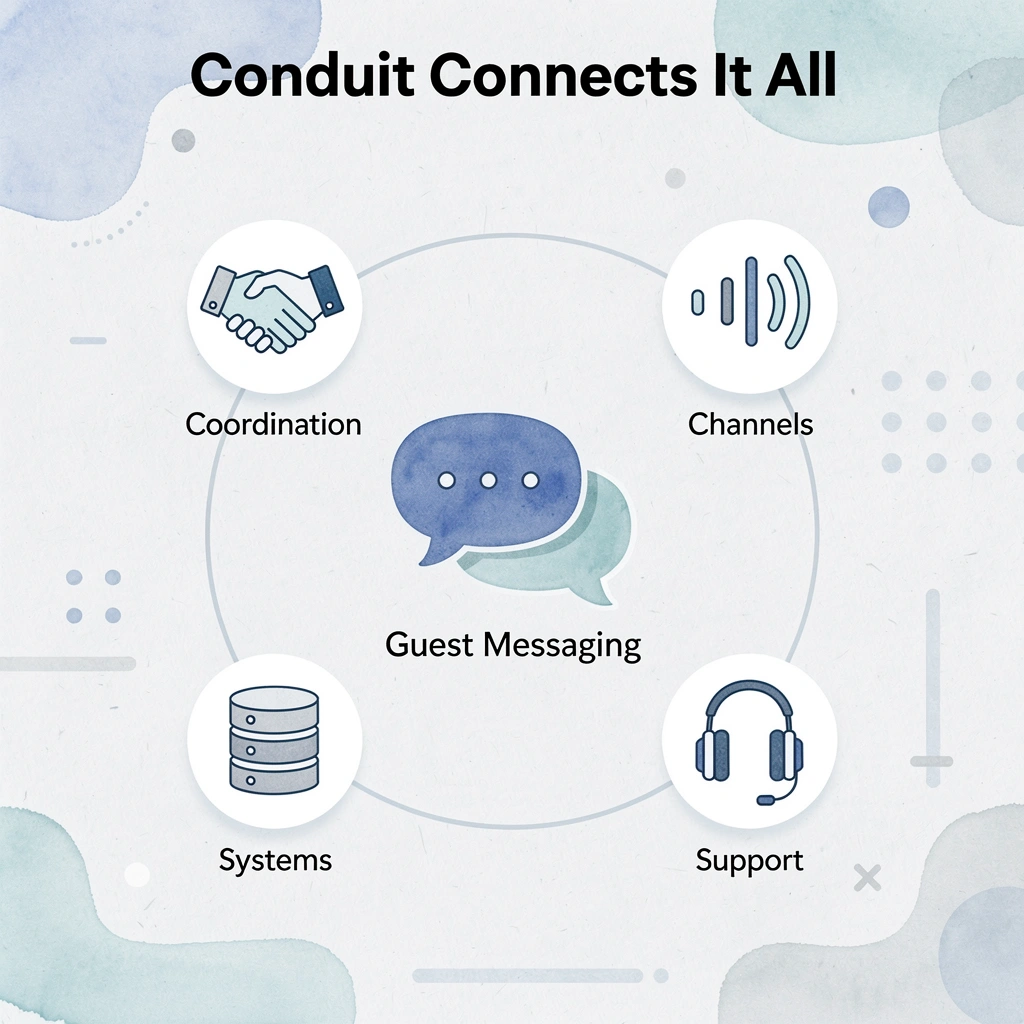
How does Conduit automate guest communication across channels?
Conduit streamlines operations through AI-powered automation across guest communication channels. Rather than requiring staff to manually manage every inquiry, the platform handles routine guest requests and responds quickly across channels, reducing response times and freeing employees to focus on higher-value interactions.
Conduit connects directly to a property's hospitality technology stack, including reservation and property data. By pulling real guest, booking, and property context into conversations, our platform provides accurate, relevant responses tailored to specific reservations or stays, reducing time spent searching across systems.
How does Conduit route requests to the right teams?
When requests require assistance from people, Conduit sends guest requests, operational issues, and service exceptions to the appropriate teams with all necessary information. Whether requests require attention from housekeeping, maintenance, guest services, or management, teams receive the information needed to act quickly.
Conduit improves internal coordination by helping operational teams stay aligned around guest needs and service requests. Escalations include full context, reducing unnecessary back-and-forth communication between departments while keeping hospitality teams in control of critical decisions.
How does Conduit create proactive revenue opportunities throughout the guest lifecycle?
Conduit helps properties create proactive revenue opportunities throughout the guest lifecycle. Automated workflows trigger personalized outreach based on booking activity, check-ins, purchases, and other guest events, promoting room upgrades, stay extensions, and add-ons at the right time without manual intervention.
For hospitality leaders, the goal is to reduce operational friction while maintaining exceptional guest experiences. Conduit achieves this by combining AI-powered guest service automation, connected operational workflows, and proactive engagement tools within a hospitality-focused platform.
Book a Demo to See Conduit's AI for Hospitality Customer Service in Action
Systems that work well under pressure are built to be watched, adjusted, and improved over time. If your team is still assembling guest request workflows by hand, the gap between where you are and where your operation could be is measurable, not theoretical.
"The difference between a hospitality operation that scales and one that struggles isn't headcount --- it's whether your systems are built to be optimized."
🎯 Key Point: Manual workflows create measurable gaps in guest experience quality that directly impact revenue, retention, and reviews.
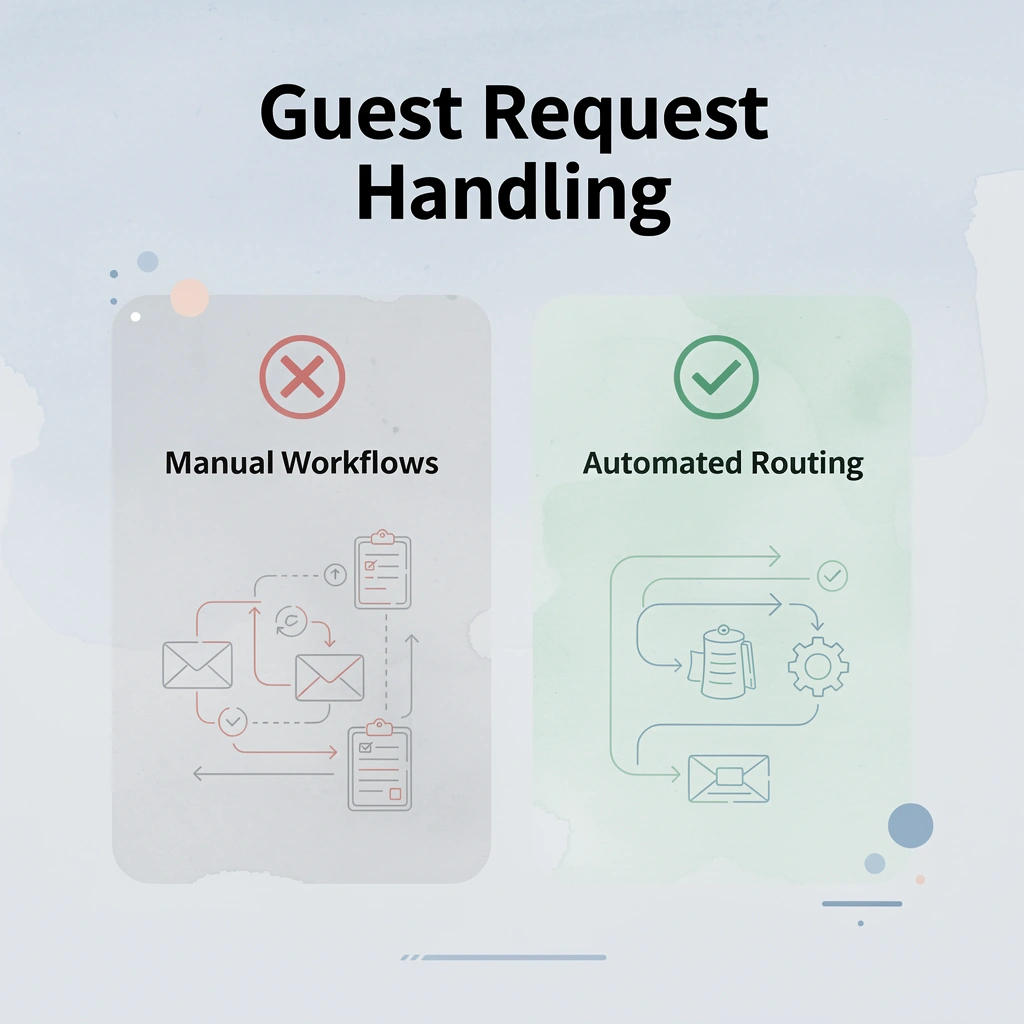
Book a demo with AI for hospitality to see how Conduit maps your current guest request journey, identifies bottlenecks, and shows how our automated routing and contextual responses help your team resolve more without adding headcount.
💡 Tip: When you book your demo, come prepared with your top 3 guest request pain points. Conduit's team will show you how the platform addresses each one in real time.
✅ Best Practice: The most successful hospitality teams don't wait until peak season to fix broken workflows; they audit and automate before demand spikes.
Related Reading
-
Siteminder Competitors
-
Hospitality Conferences
-
Best Hotel Channel Manager Software
-
Hotel Distribution Management
-
Best Revenue Management Software For Hotels
-
Canary Technologies Competitors
-
Cloudbeds Alternatives
-
Hospitality Chatbot
-
Digital Concierge Software

Stay in the loop
Get the latest on AI automation, product updates, and customer stories.

