The Gap Night Strategy — How AI Turns Empty Calendar Days Into Revenue


The Gap Night Play
Turn empty nights into $126K a year
Every STR operator knows the feeling. You look at a listing's calendar and see a single night sitting empty between two confirmed reservations. You think: "I should reach out to one of those guests." Then you move on to the next fire, and that night goes unbooked.
Multiply that by 200 listings. Multiply it by every week of the year.
That's the gap night problem. According to AirDNA, gap nights account for 15-25% of all unbooked nights across the platform. At scale, those orphan nights aren't a nuisance. They're a structural revenue problem — and one of the highest-ROI workflows you can hand to AI.
TL;DR
- Gap nights (1-2 night openings between reservations) represent 15-25% of all unbooked nights in a typical STR portfolio
- Manually tracking and filling them across 200+ listings is operationally impossible
- AI can detect gaps in real time, reach out to incoming or outgoing guests with a discounted extension offer, and notify your team when a booking is confirmed
- Filling just 10% of gap nights across 200 listings at a $175 ADR adds roughly $10,500 in monthly revenue
- Conduit automates this entire workflow end-to-end
Why Gap Nights Are a Scale Problem, Not a Pricing Problem
Most operators try to solve gap nights with pricing tools. Drop the minimum stay requirement. Apply an orphan night discount. That helps at the margin, but it's passive. You're waiting for a new guest to find the listing and book it.
The better play is proactive outreach to guests who are already confirmed. An incoming guest flying in Friday might happily arrive Thursday for a discounted night. An outgoing guest checking out Sunday might extend to Monday if the price is right.
The problem: doing this at scale requires real-time calendar awareness across every listing, simultaneously. At 200 properties, that's not a workflow. That's a full-time job that doesn't exist.
Here's what manual gap night management actually requires:
- Monitoring every calendar, every day, for new 1-2 night openings
- Cross-referencing which reservations are adjacent to each gap
- Drafting personalized outreach to the right guest (incoming vs. outgoing)
- Sending the message before the window closes (often within hours)
- Tracking responses and updating the calendar if accepted
- Notifying the operations team to adjust cleaning schedules
No ops team does all of this consistently. It gets done when someone remembers, which means most gap nights go unfilled.

The AI Workflow: How It Actually Works
Here's the exact workflow Conduit runs for large portfolios.
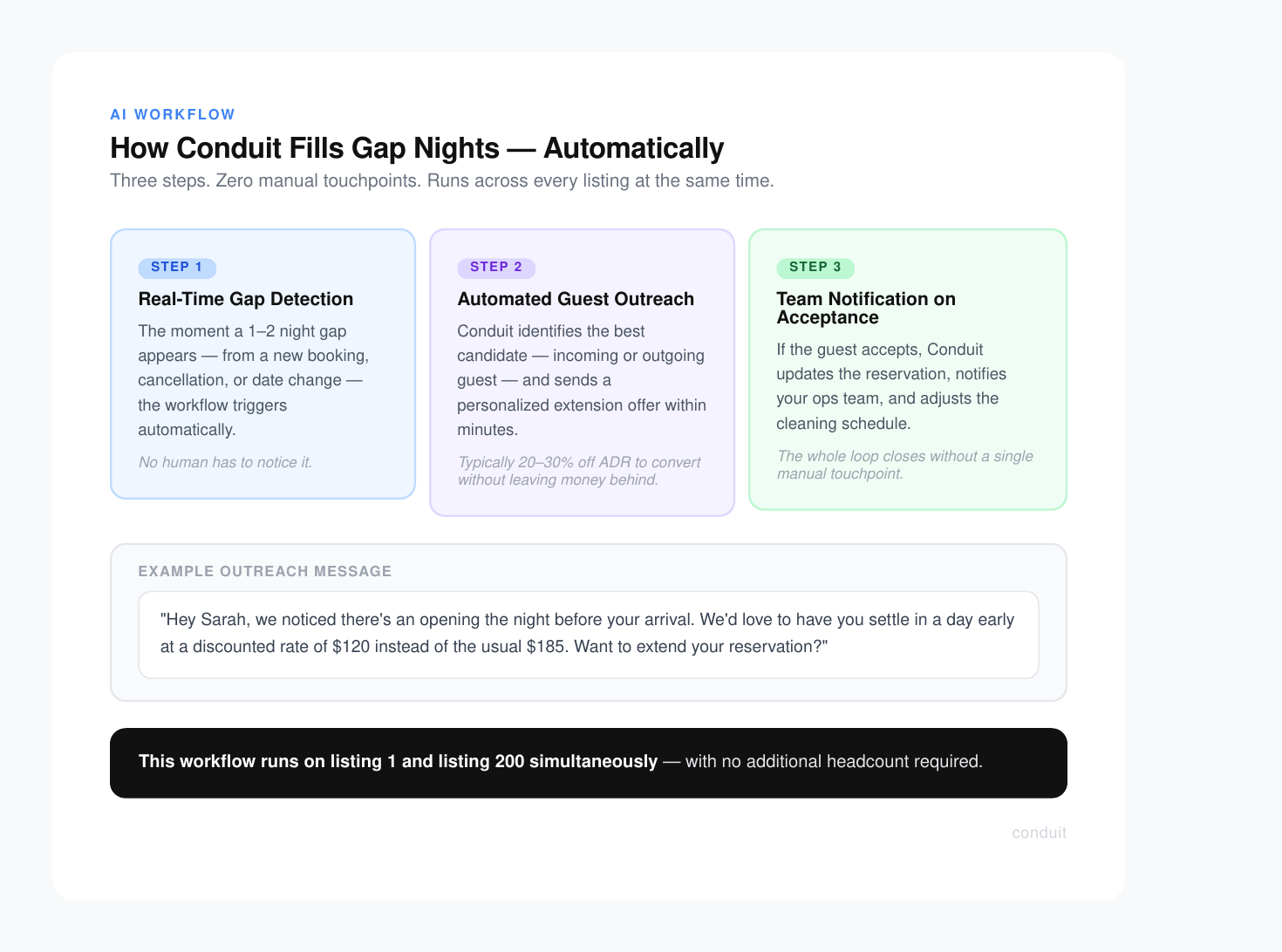
Step 1: Real-Time Gap Detection
Conduit monitors every connected listing. The moment a 1-2 night gap appears between two confirmed reservations — from a new booking, a cancellation, or a date change — the workflow triggers automatically. No human has to notice it.
Step 2: Automated Guest Outreach
Within minutes, Conduit identifies whether the outgoing or incoming guest is the better candidate and sends a personalized message offering a discounted extension.
The message doesn't read like a form letter. A well-configured conversation engineer builds the outreach to feel like it's coming from the property team directly: warm, specific to their stay, and clear about the offer. Something like:
"Hey Sarah, we noticed there's an opening the night before your arrival. We'd love to have you settle in a day early at a discounted rate of $120 instead of the usual $185. Want to extend your reservation?"
The discount is set by you. Typically 20-30% off ADR is enough to convert without leaving money on the table.
Step 3: Team Notification on Acceptance
If the guest accepts, Conduit automatically updates the reservation, triggers a notification to your operations team, and adjusts the cleaning schedule. The whole loop closes without a single manual touchpoint.
This is what makes it genuinely scalable. The workflow runs on listing 1 and listing 200 at the same time, with no additional headcount.
The Revenue Math (Run It for Your Portfolio)
Let's put real numbers to this. Here's a conservative model for a 200-listing portfolio.
- Variable: Portfolio size — Assumption: 200 listings
- Variable: Gap nights per listing per month — Assumption: 3 nights (conservative)
- Variable: Total gap nights per month — Assumption: 600 nights
- Variable: AI fill rate — Assumption: 10%
- Variable: Nights filled per month — Assumption: 60 nights
- Variable: Discounted ADR — Assumption: $175 (30% off $250 ADR)
- Variable:Monthly revenue recovered — Assumption:$10,500
- Variable:Annual revenue recovered — Assumption:$126,000
That's $126,000 a year from a workflow running entirely in the background.
And 10% is the floor, not the ceiling. Operators with warm guest relationships and well-timed outreach see conversion rates of 15-20%. At 15%, that same portfolio recovers $189,000 annually.
The ADR math also works in your favor. The guest is already committed to the property. The offer is framed as an add-on, not a new booking. Conversion friction is lower than a cold listing view. You're selling one more night to someone who already said yes.

Why Timing Is Everything (and Why Humans Can't Win This Race)
Gap night outreach has a short window. A guest who books a Thursday arrival is making travel plans right now. If you reach out Wednesday night to offer a Wednesday add-on, you've already lost. The window to convert a gap night is typically 48-72 hours after it opens, often less.
At 200 listings, gaps open and close constantly. A cancellation creates a gap at 9 AM. A new booking fills half of it by noon. Another guest extends and the gap disappears. Gap night opportunities are perishable.
This is the core reason manual management fails at scale. The workflow demands real-time, portfolio-wide awareness that no human can maintain across hundreds of listings.
AI doesn't sleep. It monitors every calendar simultaneously and fires the outreach the moment a gap becomes actionable. That speed is the difference between a filled night and an empty one.

What Conduit Does for STR Operators
Conduit connects directly to your PMS and booking channels, monitors calendars in real time, and runs automated guest messaging across text and voice — all from a single unified inbox your team can see and override at any time.
Gap night automation is one workflow. Conduit also handles:
- Pre-arrival and post-checkout messaging to drive reviews and repeat bookings
- Maintenance and issue escalation so the right team member gets notified instantly
- Upsell workflows for early check-in, late checkout, and add-on services
- AI voice calls for guests who prefer to talk rather than text
Operators managing 50 to 500+ listings use Conduit to run leaner teams without sacrificing guest experience. The platform integrates with Guesty, Hostaway, Lodgify, Streamline, and 15+ other PMS tools, so there's no rip-and-replace required.
"Before Conduit, we had thousands of unanswered messages and no way to prioritize. Now we've reached 60% automation, sending 15,000 guest messages fully autonomously, and we know we can scale without constantly hiring." Iuliia Rymar, Operations Manager at Arbio
If gap nights are leaving money on the table in your portfolio, the fix isn't more headcount. It's a smarter workflow.
Book a demo with Conduit and we'll show you exactly how the gap night automation runs, and what it would recover for your specific portfolio size and ADR.
Stay in the loop
Get the latest on AI automation, product updates, and customer stories.

