Self-Service Hotel: Benefits, Challenges, and How to Get It Right


Self-Service Hotel
Self-service hotel satisfaction.
Self-Service Hotel: Benefits, Challenges, and How to Get It Right
Travelers increasingly expect control over their stay, from checking in on their own schedule to skipping the front desk altogether. Hotels that embrace a self-service model are seeing measurable gains in guest satisfaction and operational efficiency. The right hospitality management software makes this transition practical, supporting self-check-in kiosks, automated room assignments, and contactless payments without adding pressure on staff.
Shifting to a self-service hotel model comes with real challenges worth planning for, including technology integration, staff retraining, and maintaining a personal guest experience. When done well, it positions a property to meet modern travelers' expectations while reducing friction at every touchpoint. Teams looking to move faster and smarter can explore what Conduit offers through its AI for hospitality platform.
Table of Contents
- Why More Hotels Are Moving Toward Self-Service Operations
- What Is a Self-Service Hotel?
- Benefits of a Self-Service Hotel for Guests and Operators
- Common Challenges Hotels Face When Implementing Self-Service
- How to Build a Successful Self-Service Hotel Experience
- How Conduit Helps Hotels Deliver a Better Self-Service Experience
- Book a Demo to See Conduit's AI for Hospitality Customer Service in Action
Summary
-
Travelers increasingly expect to manage their hotel stay on their own terms, and properties that accommodate this preference are gaining a measurable competitive edge. According to Oracle and Skift Research, 73% of travelers are more likely to choose hotels offering self-service technology, which means mobile check-in, contactless payments, and digital room keys have moved from differentiators to baseline expectations.
-
Staffing shortages are accelerating the shift toward self-service operations, not just guest preference. The American Hotel and Lodging Association confirmed in 2025 that 65% of hotels report active staffing shortages, making it operationally difficult to sustain traditional front-desk models that rely on staff handling every routine guest request manually.
-
Self-service technology produces meaningful financial returns for hotel operators, particularly in labor allocation. Research from Akia shows that hotels using self-check-in report up to a 30% reduction in labor costs, and hotels using self-service kiosks see up to a 30% reduction in front desk wait times, according to Escoffier's hospitality industry research. The more significant outcome is often where those recovered staff hours go, toward higher-value guest interactions rather than processing routine arrivals.
-
Digital guest journeys create natural, well-timed opportunities to generate incremental revenue without pressure or friction. Automated upsell prompts tied to reservation data and guest behavior, such as late check-out offers on the morning of departure or spa suggestions the evening before, perform better than generic pitches at check-in because the timing is relevant rather than transactional.
-
System integration remains the most common point of failure in self-service rollouts, not the technology itself. A 2023 Hospitality Technology report found that 58% of hoteliers identified system integration as their top operational challenge. When guest preferences, housekeeping schedules, and service requests live in disconnected platforms, staff end up manually bridging gaps, which erodes the efficiency gains self-service is supposed to deliver.
-
Guests abandon self-service tools when the experience is slower or more complicated than simply walking to the front desk. Research from Salesforce found that 68% of customers expect companies to anticipate their needs before they ask, and in hospitality, that expectation is especially high. Properties that send proactive information about parking, Wi-Fi, and check-in details before guests need to ask remove friction that most operators do not realize they are creating.
-
AI for hospitality helps hotel teams handle routine guest communication across every channel around the clock, so staff can focus on the interactions that genuinely require human presence and judgment.
Why More Hotels Are Moving Toward Self-Service Operations
Hotels are moving toward self-service operations because guests expect it and staffing economics require it. These two forces are occurring simultaneously, pushing the industry toward a completely different way of operating.
"Guest expectations and staffing economics are converging simultaneously — forcing hotels into a fundamentally new operational model."
— Hospitality Industry Insight
🎯 Key Point: This isn't a trend hotels can opt into — it's a dual pressure from both the demand side (guests) and the supply side (labor costs) hitting at once.
💡 Tip: Hotels that proactively adopt self-service models now will be far better positioned than those waiting for the pressure to become unavoidable.
| Driving Force | What It Means for Hotels |
|---|---|
| Guest Expectations | Travelers demand faster, frictionless experiences |
| Staffing Economics | Rising labor costs make full-service models harder to sustain |
| Simultaneous Pressure | Both forces compound, making self-service a necessity, not a luxury |
What is driving guest demand for self-service hotel experiences?
Guest demand is clear. According to Oracle & Skift Research's Hospitality in 2025 study, 73% of travelers are more likely to choose hotels offering self-service technology. Guests who check in via mobile app, request late checkout through chat, or receive dining recommendations without calling the front desk are getting exactly what they want, on their own schedule.
Staffing shortages make this shift essential. When 65% of hotels report active shortages, as the American Hotel and Lodging Association confirmed in 2025, every routine request handled manually pulls a team member away from interactions requiring human attention. Most hotels manage this load, but the approach erodes both employee experience and guest satisfaction.
How does self-service redirect human energy rather than replace it?
The shift to self-service is not about replacing hospitality with automation, but directing human energy toward moments that genuinely benefit from it. AI for hospitality platforms like Conduit handle guest communication across every channel around the clock, learning how a property operates and responding in the guest's language. The result is a more consistent experience, with staff freed to focus on guests who need their rooms moved due to noise or on families celebrating an anniversary.
The self-service kiosk market is projected to grow significantly, with hospitality being a key adopter as properties balance labor costs against rising guest expectations. Hotels investing in self-service infrastructure make deliberate choices about where staff time delivers the most value. Automated check-in, digital room keys, contactless payment, and AI-powered messaging form the foundation of a responsive guest experience.
What separates hotels that succeed with self-service from those that fail?
The critical difference between hotels that succeed and those that fail comes down to intent. Self-service deployed purely to reduce staff feels exactly like that. Self-service designed around the guest's journey, with smart automation handling routine tasks and human staff handling meaningful interactions, produces something that feels more personal, not less.
Understanding why hotels are moving in this direction is only half the picture. What it means to operate as a self-service hotel is more specific and surprising than most people assume.
What Is a Self-Service Hotel?
A self-service hotel is a property where guests complete common tasks — check-in, room access, service requests, and dining reservations — through digital tools instead of waiting for staff assistance. Staff focus their attention on moments that truly benefit from human presence.
"A self-service hotel empowers guests to complete check-in, room access, and service requests through digital tools — shifting staff focus to moments that genuinely require a human touch."
💡 Example: Instead of queuing at a front desk, a guest uses a mobile app or kiosk to check in, unlock their room, and request extra towels — all without speaking to a single staff member.
🔑 Takeaway: The self-service model isn't about removing the human element — it's about redirecting it to where it matters most.
| Task | Traditional Hotel | Self-Service Hotel |
|---|---|---|
| Check-in | Front desk staff | Mobile app or kiosk |
| Room access | Physical key from staff | Digital key or keypad |
| Service requests | Phone call to reception | In-app or chatbot request |
| Dining reservations | Concierge assistance | Self-service booking portal |
How the guest journey changes
A traveler books a room, receives a mobile check-in link before arrival, unlocks their door with a smartphone, messages the property for extra towels, and checks out without visiting the front desk. Every touchpoint that once required standing in line or calling now happens on the guest's terms and timeline. According to Oracle and Skift Research, 73% of travelers are more likely to choose hotels offering self-service technology.
How does self-service technology generate revenue in the background?
Self-service environments also generate revenue quietly in the background. Automated upsell prompts timed to appear when guests are most receptive — the night before arrival or right after check-in — offer room upgrades, late check-out, or spa bookings without requiring sales conversations.
How does AI handle the strain when a full property hits peak demand?
Most hotels today have front desk agents who answer phone calls, handle repetitive questions, and manually relay requests to housekeeping or maintenance. When a 200-room property is completely full on a Friday night, the system becomes overwhelmed, and guests wait. AI for hospitality platforms like Conduit solves this directly: our AI agents learn how a specific property works, respond in the guest's preferred language, and take real action inside existing systems, handling routine requests so staff can focus on guests who need their help.
What self-service doesn't mean
The critical difference between a self-service hotel and a cold, transactional one is intent. Self-service done well removes friction without removing warmth. A guest who never waited in line is not a guest who felt ignored; they're a guest who felt respected. Escoffier's hospitality industry research reports that hotels using self-service kiosks see up to a 30% reduction in front-desk wait times, transforming the lobby from a bottleneck to a welcome.
Digital concierge tools, automated guest messaging, and contactless check-in are not replacements for hospitality. They're the infrastructure that enables genuine hospitality at scale, freeing staff to notice the guest who looks lost, remember the one celebrating an anniversary, or have a real conversation without a queue forming behind them.
Related Reading
- How To Maximize Your Hotel Revenue
- Hotel Revenue Generating Ideas
- How To Improve Guest Experience in a Hotel
- Hotel Operating Costs Breakdown
- Best Hospitality Management Software
- How To Increase Hotel Occupancy Rate
- What Is Revpar
Benefits of a Self-Service Hotel for Guests and Operators
Guests and hotel operators both benefit from self-service, even though the benefits they receive are distinctly different — and equally compelling.
"Self-service technology is reshaping hospitality from both sides of the front desk, delivering faster experiences for guests and leaner operations for hoteliers."
🎯 Key Point: Self-service isn't a one-sided advantage — it creates a win-win dynamic where both guests and operators gain measurable value from the same technology.
💡 Tip: When evaluating self-service solutions, consider the dual impact — map out benefits for each stakeholder group separately to build a stronger business case.
| Stakeholder | Core Benefit |
|---|---|
| Guests | Faster, frictionless experiences with greater control |
| Hotel Operators | Reduced labor costs and improved operational efficiency |
What guests actually get
Guests get control, and control is what modern travelers want. According to Mews, 73% of travelers want to use their mobile device to manage their hotel experience. The preference for self-service is about avoiding problems, not avoiding people. A guest who can check in through an app at 11 pm, request towels without calling the front desk, and check out without waiting in line experiences a markedly different stay — one that compounds across three nights.
What do operators actually get from self-service hotel technology?
The operator side shows measurable returns. Akia's research on self-check-in profitability demonstrates that hotels using self-check-in technology report up to a 30% reduction in labor costs. More importantly, staff freed from processing routine arrivals can help guests with restaurant recommendations, solve room problems, or provide genuine attention. That is the real return.
How do AI platforms close the communication gaps operators face?
AI for hospitality platforms like Conduit solves communication problems by managing guest interactions across every channel, learning how a specific property operates, and responding in the guest's language. Our platform addresses hidden costs that occur at 2 am when guests have unanswered questions, or during busy Saturdays when staff handle check-ins while other guests wait.
Where revenue enters the picture
Self-service changes the revenue model by creating natural moments to show relevant offers. Because offers can be timed to reservation data and guest behavior, they feel like helpful suggestions rather than sales pitches. A guest who receives a late check-out option the morning of departure or a spa offer the evening before is more likely to act on it than one who receives a generic pitch at check-in. The timing is the product.
What does a friction-free guest experience actually look like?
The result is a guest experience that feels more responsive and a hotel operation that feels less reactive. Fewer dropped requests, fewer missed communications, fewer moments where guests chase down information they should have already received. In hospitality, the absence of friction is itself a form of service.
But knowing the benefits is only half the picture. The half that catches most properties off guard comes next.
Related Reading
- Hotel Revenue Management Strategies
- Hotel Demand Forecasting
- How To Improve Hotel Operations
- Hospitality Operations Management
- Hotel Upselling
- Adr Vs Revpar
- Hotel Budgeting And Forecasting
- Hotel Guest Messaging
- Automated Hotel Reservation System
- How To Increase Revpar
- Hospitality Automation
Common Challenges Hotels Face When Implementing Self-Service
Self-service implementation fails more often at the strategy level than the technology level. The breakdown occurs in how tools connect to each other, to guests, and to daily hotel operations — not in the tools themselves. Our platform helps bridge these gaps by ensuring seamless integration across your entire hospitality tech stack.
"Self-service implementation fails more often at the strategy level than the technology level — the real problem is disconnected tools, not the tools themselves."
⚠️ Warning: Don't assume a failed self-service rollout is a technology problem. Most breakdowns trace back to poor integration strategy and misaligned workflows — not the software itself.
💡 Tip: Before deploying any self-service solution, audit how it will connect to your existing hospitality tech stack — from PMS to guest communication tools — to avoid costly silos.
| Challenge Area | Root Cause | Impact |
|---|---|---|
| Tool connectivity | Siloed systems are not integrated | Fragmented guest experience |
| Guest-facing workflows | Poor UX or unclear touchpoints | Low adoption rates |
| Daily hotel operations | Misaligned processes | Staff inefficiency |
🔑 Takeaway: Seamless integration across your full hospitality tech stack is the critical foundation for any self-service strategy that actually works.
Why do disconnected systems undermine the guest experience?
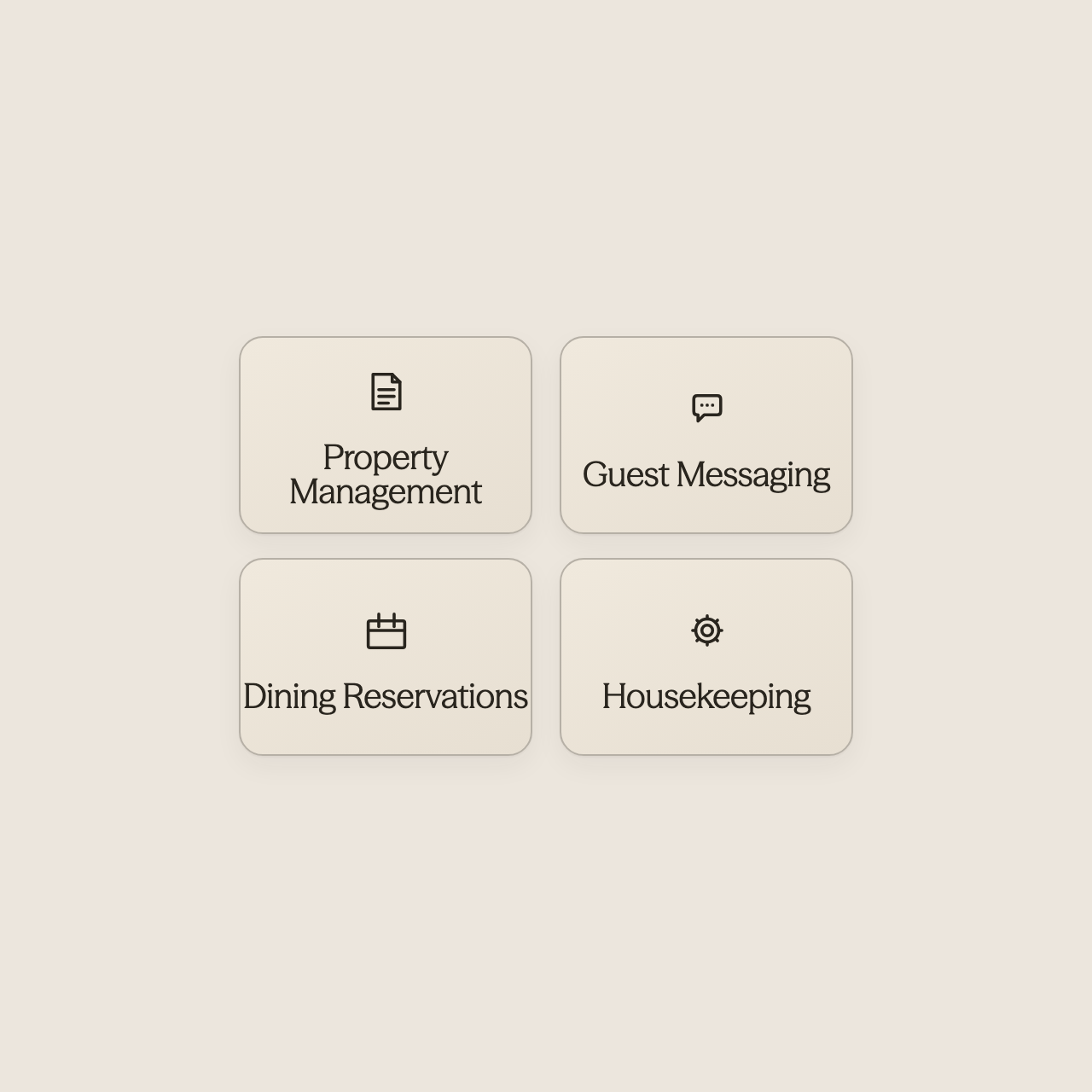
The failure point is usually integration. A guest completes mobile check-in on one platform, but their room preferences are in a separate property management system, their dining reservation is in a third tool, and the housekeeping team works off a fourth. Nobody has the full picture. The guest arrives expecting a seamless experience and instead encounters staff catching up in real time. According to a 2023 Hospitality Technology report, 58% of hoteliers cited system integration as their top operational challenge. Disconnected systems undermine the personalization that makes self-service feel like an upgrade to the guest experience rather than a cost-cutting workaround.
How does bridging system gaps reduce operational strain?
Most teams handle this by manually bridging gaps: copying information between platforms, checking multiple dashboards, and relaying requests through group chats or printed handoff sheets. This approach breaks down due to volume or staff absence. Platforms like AI for hospitality address this differently by acting across internal systems rather than sitting on top of them. A guest request handled through automated messaging triggers the right operational response without human relay. The guest gets a faster answer; the team gets fewer interruptions.
Why does self-service adoption collapse before it starts?
When a self-service check-in process takes longer than walking to the front desk, guests will walk to the front desk. Speed and clarity are the entire value proposition. If a mobile interface requires account creation, three-step identity verification, and navigating a confusing menu before confirming their room, adoption collapses. The technology gets blamed, but the real issue is that nobody mapped the guest's actual experience before launch.
How does proactive communication remove friction that guests never mention?
Proactive communication is where most properties leave real efficiency gains on the table. Guests ask about parking, Wi-Fi passwords, pool hours, and early check-in availability because nobody told them. A 2022 study by Salesforce found that 68% of customers expect companies to anticipate their needs before they ask. In hospitality, that expectation is sharper because the stakes feel personal. Sending the right information at the right moment removes friction that most hotels don't recognise they're creating.
Automation Without Losing the Human Feel
The worry that self-service makes hospitality feel cold can be addressed. Properties that succeed use automation to handle predictable tasks, freeing staff to focus on unpredictable ones. A guest requesting extra towels at 11 pm needs a fast response, not conversation. A guest dealing with difficulty after a long travel delay needs the opposite. The best setups distinguish between these situations from the start.
Seeing where this leads in practice changes what's possible.
How to Build a Successful Self-Service Hotel Experience
Good self-service hotels create experiences that focus on what guests truly need while keeping operations running smoothly. A thoughtful approach makes guests happier, reduces the work staff has to do, and creates new ways to make money without losing the personal touch of hospitality.
"A thoughtful self-service approach makes guests happier, reduces staff workload, and creates new revenue opportunities — all without sacrificing the personal touch of hospitality."
💡 Tip: The most successful self-service hotels balance automation and human connection — use technology to handle routine tasks so your staff can focus on high-value guest interactions.
⚠️ Warning: Avoid the common mistake of going fully automated without a fallback human touchpoint — guests who encounter problems need immediate, personal support to prevent negative reviews.
| Self-Service Element | Guest Benefit | Operational Benefit |
|---|---|---|
| Digital check-in/check-out | Faster, friction-free arrival | Reduced front desk congestion |
| In-app room controls | Personalized comfort on demand | Lower energy waste |
| Automated upsells | Convenient access to upgrades | New revenue streams |
| 24/7 chatbot support | Instant answers anytime | Reduced staff workload |
🎯 Key Point: Self-service hospitality is not about replacing people — it's about empowering guests with control while freeing your team to deliver meaningful, memorable moments that no app can replicate.
✅ Best Practice: Start by mapping your guest journey end-to-end, identifying every friction point where smart self-service tools can save time, reduce frustration, and unlock incremental revenue.
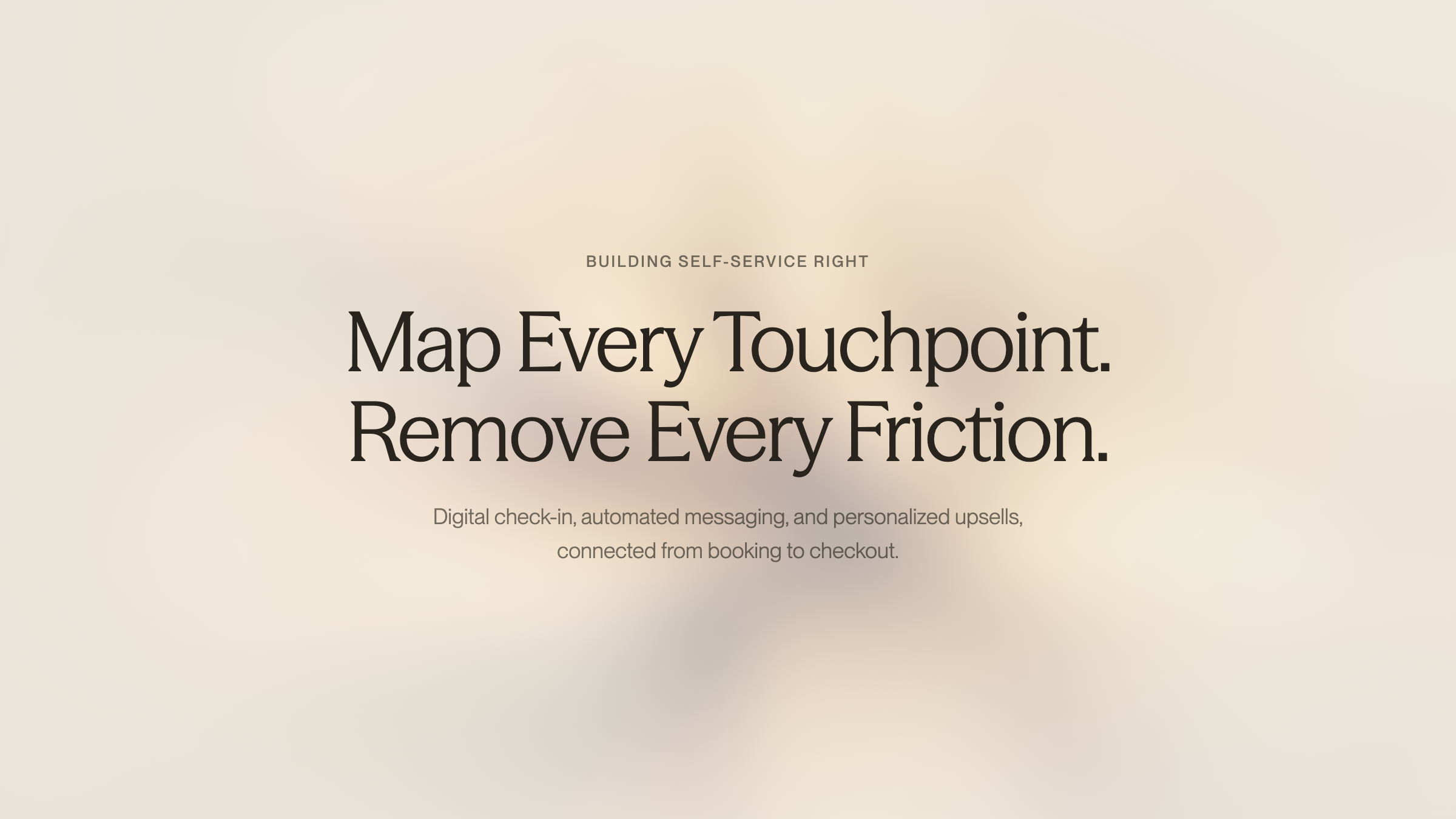
Where should you start when mapping the guest journey?
Map every major touchpoint from booking and pre-arrival communications through check-in, in-stay experience, and post-stay follow-up. Identify moments when guests experience delays, confusion, or friction — such as parking questions before arrival, Wi-Fi information gaps after check-in, or peak-departure wait times. These pain points represent the greatest opportunities for self-service improvements.
Which high-frequency requests should you automate first?
Focus on high-volume tasks that guests often need help with:
- Check-in and check-out
- Wi-Fi instructions
- Property information
- Amenity requests
- Parking details
- Directions and local recommendations
- Frequently asked questions
Automating these interactions reduces staff pressure, gives guests faster access to information, and eliminates unnecessary friction in routine processes.
Why should human support remain available alongside self-service?
Self-service should enhance hospitality, not replace it. Advanced technology cannot handle every situation. Guests may have unique requests, unexpected issues, or concerns requiring empathy and human judgment. Every self-service experience should include clear escalation paths to live chat, messaging, phone support, or on-property staff.
Hotels that balance automation and human support achieve the highest guest satisfaction by offering convenience without abandoning guests.
How does personalizing guest interactions improve the self-service experience?
Modern guests expect relevant experiences. A business traveler staying one night has different needs than a family visiting for a week. Personalized recommendations, targeted offers, and contextual communication make self-service more helpful. A hotel might automatically offer late check-out to guests with evening flights or recommend attractions based on travel preferences. Personalized systems deliver more meaningful experiences while increasing engagement and revenue.
What metrics should you track to measure self-service success?
Keep checking how well things are working by monitoring key metrics:
- Mobile check-in adoption rates
- Self-service option usage frequency
- Guest satisfaction scores
- System response time
- Upsell conversion rates
- Revenue from automated offers
- Staff productivity gains
Think of this as ongoing work, not a one-time task. Continuously improve your workflows, refine guest communication, and update automation strategies. This approach delivers convenience to guests, boosts staff efficiency, and increases property revenue.
How Conduit Helps Hotels Deliver a Better Self-Service Experience
Creating a successful self-service hotel experience means connecting guest information, communication channels, and operational workflows across multiple systems. Guests expect every interaction to feel connected, relevant, and easy — from booking through checkout.
"Guests expect every interaction to feel connected, relevant, and easy — from the moment of booking all the way through checkout."
— Conduit
💡 Tip: The real key to seamless self-service isn't just adding technology — it's ensuring your guest data, messaging platforms, and operational systems all speak the same language.
🎯 Key Point: Hotels that unify communication channels and operational workflows into a single connected experience are best positioned to meet rising guest expectations at every touchpoint.
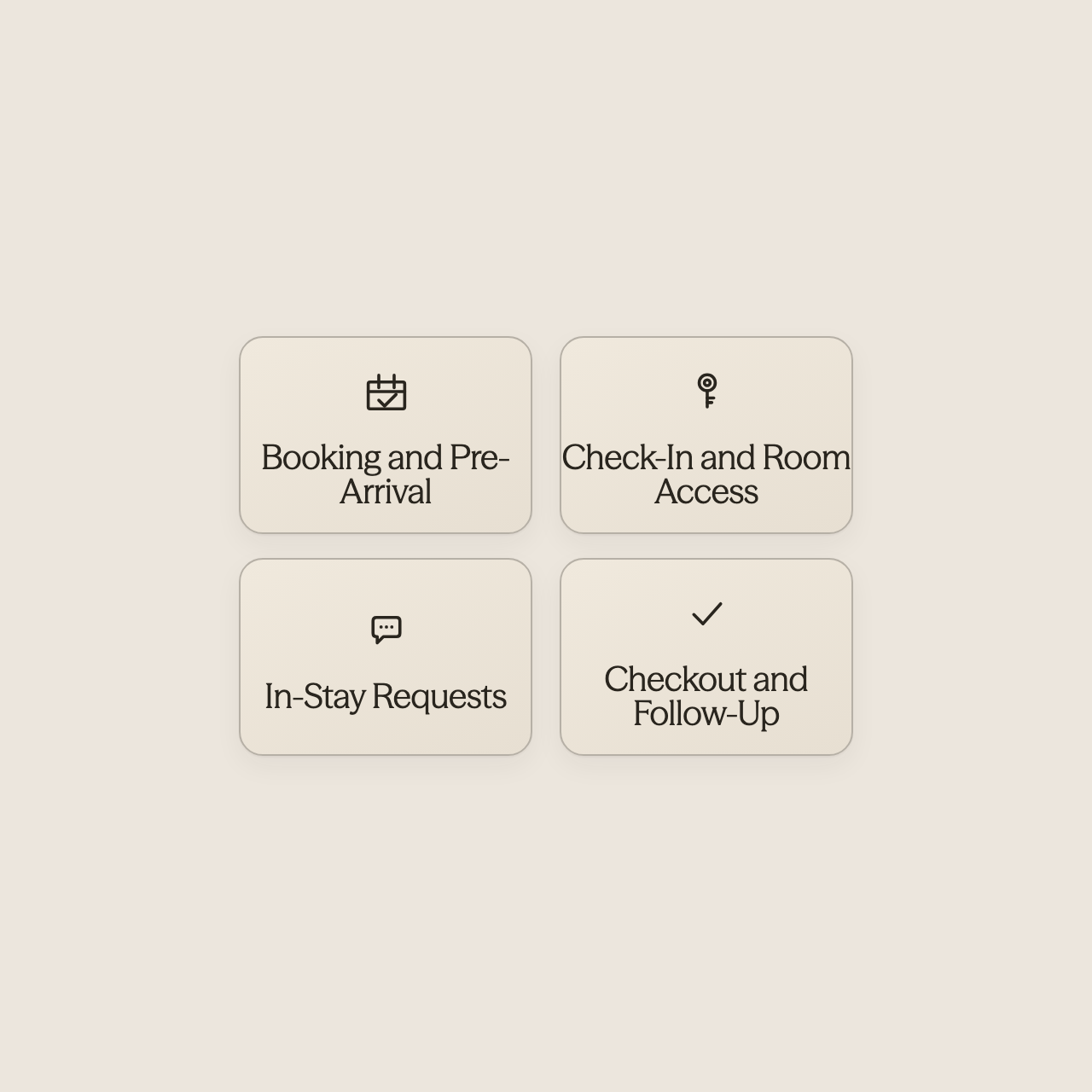
| Self-Service Element | Guest Expectation |
|---|---|
| Booking & Pre-Arrival | Relevant, personalized communication |
| Check-In & Room Access | Fast, frictionless, no waiting |
| In-Stay Requests | Instant responses across any channel |
| Checkout & Follow-Up | Smooth, connected, and effortless |
How does Conduit personalize the guest journey without manual intervention?
Conduit connects self-service capabilities to the entire guest journey. Our reservation-aware AI understands the context of each conversation: reservation details, stay dates, room information, and guest preferences. This enables personalized experiences without manual staff intervention.
The platform automates guest communication before, during, and after a stay, delivering timely check-in instructions, property details, service updates, recommendations, and post-stay follow-ups. This reduces confusion and repetitive inquiries.
How does Conduit give guests instant access to information and services?
Conduit answers common guest questions through automated messaging and digital concierge experiences. Guests can obtain directions, amenity information, dining recommendations, and FAQs without waiting for front-desk assistance.
The platform creates revenue opportunities through personalized upsells. Understanding guest context allows hotels to present relevant offers — room upgrades, late check-out, dining experiences, spa services — at moments when guests are most likely to engage.
How does Conduit streamline hotel operations and staff workflows?
Conduit works with hospitality systems to ensure information flows smoothly across the guest journey, breaking down operational silos and improving communication and service delivery management.
Automated workflows send timely guest communications while keeping staff informed about operational tasks, simplifying the self-service experience.
Conduit helps hotels deliver the convenience guests expect without losing the personal touch of hospitality. By automating routine interactions and providing instant access to information, teams spend less time on repetitive requests and more time creating meaningful experiences.
Conduit automates guest communication, streamlines operations, and creates personalized interactions at scale, helping properties deliver convenience while increasing efficiency and revenue.
Book a Demo to See Conduit's AI for Hospitality Customer Service in Action
AI for hospitality, like Conduit, handles routine guest requests across every channel, around the clock, while learning how your specific property operates so responses feel personal rather than templated. From automated digital concierge capabilities to reservation-aware upsells and seamless guest communication, our platform connects to the full guest journey rather than sitting alongside it.
"From automated digital concierge capabilities to reservation-aware upsells and seamless guest communication — Conduit connects to the full guest journey rather than sitting alongside it."
— Conduit
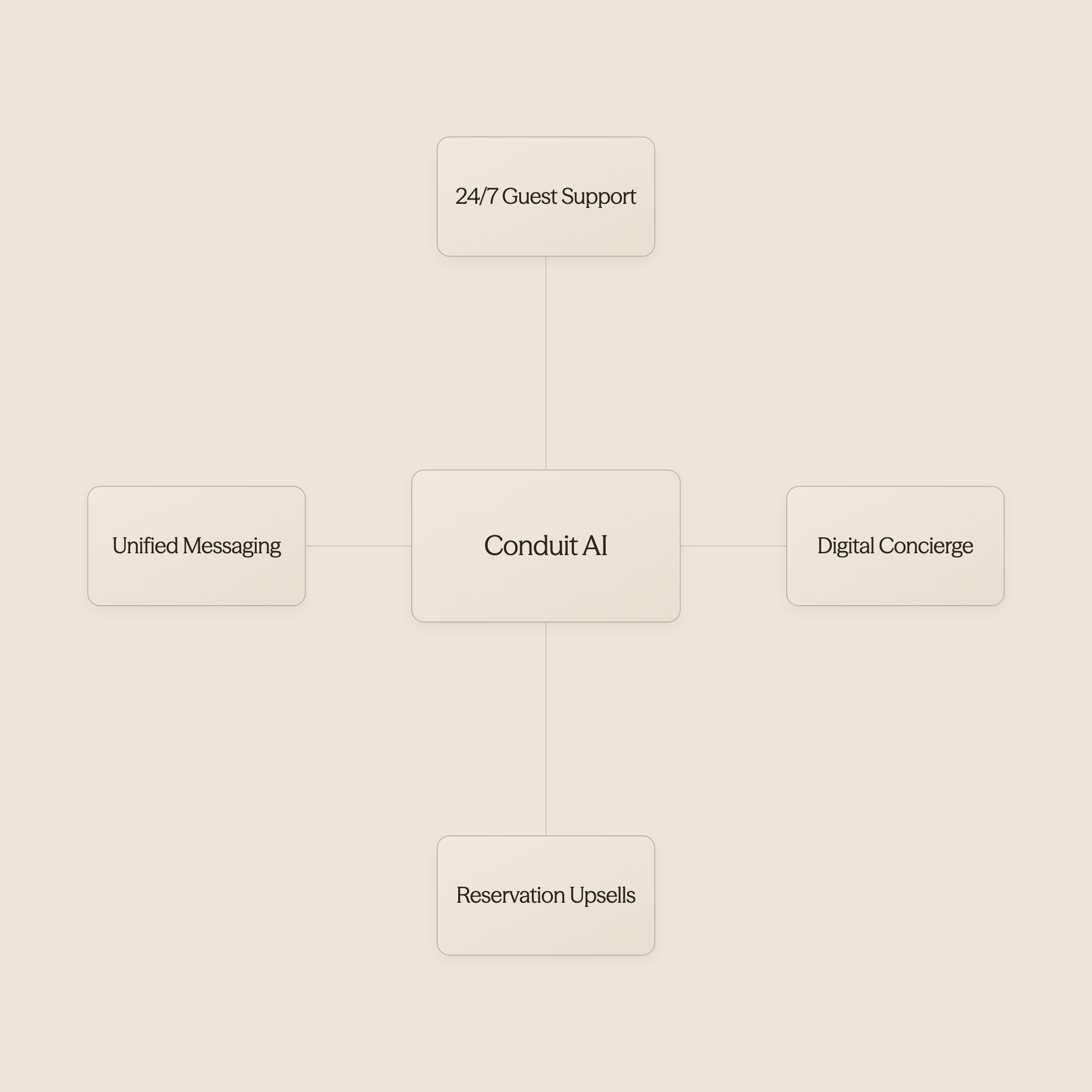
| Conduit Capability | What It Delivers |
|---|---|
| 24/7 Automated Guest Requests | Handles routine inquiries across every channel, around the clock |
| Digital Concierge | Personalized responses that feel property-specific, not templated |
| Reservation-Aware Upsells | Timely, context-driven offers tied to the full guest journey |
| Seamless Guest Communication | Unified messaging that connects rather than interrupts the experience |
🎯 Key Point: Conduit doesn't just sit alongside your guest journey — it integrates directly into it, from first inquiry to post-stay follow-up.
💡 Tip: Properties using AI-powered hospitality platforms like Conduit can redirect staff energy toward high-value human moments — the interactions that genuinely require a person in the room.
Book a demo to see how Conduit works in practice and how your team could redirect its energy toward the guest moments that require a human in the room.
✅ Best Practice: Use a live demo to evaluate exactly how Conduit maps to your property's workflows, not just its features in the abstract.
Related Reading
- Digital Concierge Software
- Best Hotel Channel Manager Software
- Hotel Distribution Management
- Best Revenue Management Software For Hotels
- Siteminder Competitors
- Hospitality Chatbot
- Hospitality Conferences
- Canary Technologies Competitors
- Cloudbeds Alternatives

Stay in the loop
Get the latest on AI automation, product updates, and customer stories.


