13 Best Short Term Rental Automation Tools for 2026


Short Term Rental Automation
13 Best Short Term Rental Automation Tools
Automating messaging alone leaves 75% of your time-drain untouched. Here is what the other four jobs are, and why connecting them matters more than adding another tool.
Short-term rental automation is one of the most misunderstood categories in property management. Most vacation rental property managers and operations leads think that short-term rental automation means adding purpose-specific tools for each job, one for messaging, one for pricing, one for cleaning, and that the only way to actually scale is to keep stacking software or hiring people to manage the gaps between tools. The real scope is far wider, and understanding it separates operators who feel perpetually buried from those who run lean portfolios without adding headcount. See our AI for hospitality for how this works in practice.
Operators spend roughly 12.5 hours per week per listing on manual management tasks. That number surprises most operators, because they assume messaging is the main culprit. It isn't.
Guest communication is only one slice of a much larger coordination load. Short-term rental automation means removing the human who routes work between systems, not just the human who types replies. The real cost isn't unanswered messages; it's the invisible coordination tax paid every time someone manually forwards a cleaning request, updates a lock code, checks a pricing dashboard, and circles back to confirm it all happened.
Automation that only handles messaging leaves most of that time intact. STR workflow automation spans five distinct jobs: the guest journey (pre-arrival through post-stay), housekeeping and turnover coordination, access and device management, verification and risk screening, and revenue capture. Messaging is the most visible task, so it gets automated first.
But cleaning coordination, turnover confirmations, lock code rotation, and pricing reviews collectively consume far more time. Guest communication accounts for roughly a quarter of the weekly load; the rest splits across scheduling, access management, and follow-up work that falls between tools. The failure point is almost never a missing tool; it's the absence of a shared source of truth connecting all five jobs.
Platforms built as a hospitality AI coordination layer are most effective when a business already has SOPs and FAQs documented, because AI agents can internalize those policies and apply them consistently across every guest interaction, without requiring a human to re-communicate the rules each time a new message arrives.
12.5 hours Lost per listing weekly on manual tasks
Key takeaways
- Short-term rental automation is not a toolbelt, it's a coordination layer, and operators who treat it like one stop hiring to keep up with growth.
- 80–90% of guest inquiries are predictable and repeat the same patterns, which makes guest communication the highest-ROI place to start automating, not pricing, not cleaning, not reporting.
- Stacking purpose-specific tools for each job creates a new bottleneck: a human in the middle routing information between systems that don't talk to each other.
- The operators hitting 96% automation didn't add more software, they replaced the routing layer with a single AI system that already understands how their business runs.
- 35 properties, zero new hires, 96% of guest interactions handled without a human touching the inbox, that's a published Conduit case study, not a projection.
- Conduit closes the coordination gap directly: its AI layer handles guest communication end-to-end, learns your property operations, and removes the human-in-the-middle without requiring you to rebuild your existing stack.
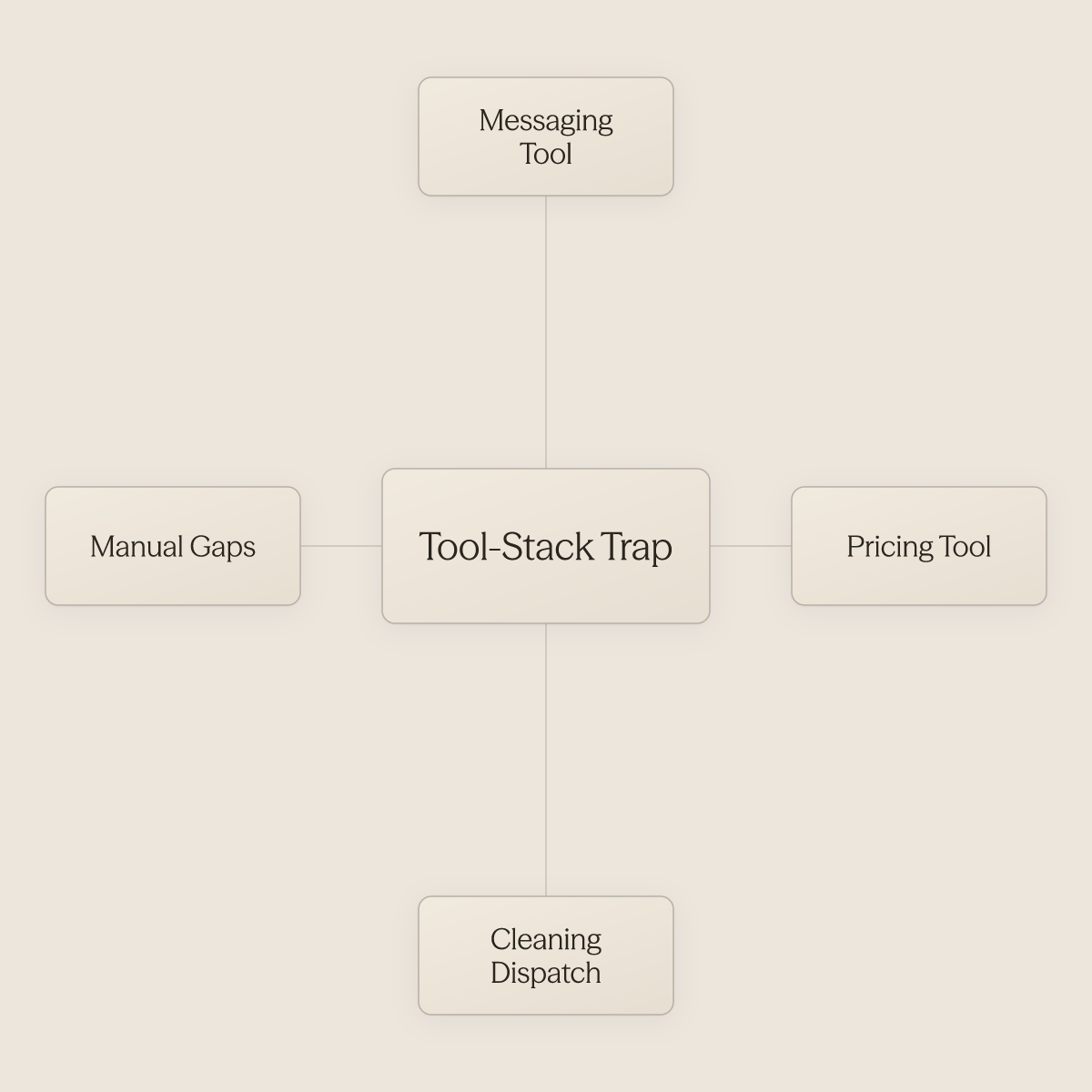
Why Most STR Operators Are Stuck in the Tool-Stack Trap
Stacking another subscription feels like progress. Each new tool promises to eliminate a specific bottleneck, and for a while, it does. But most vacation rental property managers and operations leads believe that short-term rental automation means adding purpose-specific tools for each job, one for messaging, one for pricing, one for cleaning, and that the only way to actually scale is to keep stacking software or hiring people to manage the gaps between tools. Operators managing 20, 30, or 50 properties eventually hit the same wall: the tools don't talk to each other, and a human ends up doing the talking for them.
The $80-$120-per-Tool Subscription Math Only Shows Half the True Cost
Assembling a fragmented stack of purpose-specific tools (channel manager, dynamic pricing, messaging, cleaning dispatch) typically costs $80-$120 per unit per month. For a 30-unit portfolio running four tools, that's $9,600 to $14,400 monthly in visible subscription fees. The invisible line item is staff hours spent copying reservation details from the PMS into the pricing tool, then into the cleaning scheduler, then back into the inbox.
That routing work doesn't appear on any invoice, but it consumes real hours every day. What makes the math worse is that the tools most operators already rely on, Notion SOPs, Google Drive manuals, Airbnb listings, contain the answers guests need, but no single layer reads them and acts on them automatically. Conduit's Integrations feature is most beneficial precisely when a business already uses tools like Notion, Google Drive, or Airbnb and wants an AI agent to leverage that existing content without manual re-entry.
The operator links the accounts; no IT or developer is needed. The cost of re-keying information from one system into another, a cost that never shows up on any software invoice, disappears.
Most Operators Are Still Stuck in the Partially-Manual Middle Ground
The majority of operators are running a hybrid model: some tasks automated, others still routed manually through a person. This middle ground is the most expensive place to operate.
Automation investments are already being paid for, but the human-routing tax persists because no single tool connects the outputs of every other tool in the stack. The operators we work with who are stuck in this middle ground share a specific pattern: they have documentation, SOPs, FAQs, house manuals, but it lives in Google Drive or Notion, disconnected from the guest inbox. Conduit's AI Agents feature is most beneficial when a business receives a high volume of repetitive guest messages and already has that documentation available to train the agent on.
Once an ops lead connects the docs, no IT needed, the agent begins handling guest replies automatically. The Inbox then gives the operations or support team a single place to monitor, review, and manage every conversation the AI agent is handling across multiple platforms and properties simultaneously, so the human-routing tax shrinks without requiring a new hire.
Why Adding Headcount Doesn't Fix a Fragmented STR Automation Stack
The instinct to hire a better coordinator treats a structural problem as a personnel problem. Every tool added to a fragmented automated property management stack creates a new handoff point. Someone still needs to know that the guest in unit 4 extended their stay, that the cleaner needs rescheduling, and that the dynamic pricing tool should hold the next night's rate open.
Adding a coordinator treats the symptom; a connected coordination layer treats the structure. Conduit's Workflows feature addresses this at the structural level. It is most beneficial when a business has recurring, predictable guest touchpoints that currently require manual staff action:
- Booking confirmations
- Check-in instructions
- Post-stay follow-ups
Workflows fire automatically after a trigger event occurs in the conversation or guest lifecycle: after a booking is confirmed, after check-in, or when a specific keyword is detected. The ops or brand lead sets the rules; no IT is needed. The result is that the guest in unit 4 who extended their stay triggers the right downstream actions automatically, not because a coordinator caught it, but because the structure caught it.
That is the difference between treating the symptom and treating the stack.
Adding a coordinator treats the symptom; a connected coordination layer treats the structure.
Related Reading
- Airbnb Guest Screening
- Vacation Rental Operations
- Vacation Rental Guest Screening
- Airbnb Revenue Management
- Airbnb Inventory Management
- Managing Short Term Rentals
- How To Automate Property Management
- How To Manage Airbnb Remotely
- Best Short Term Rental Channel Manager
What to Automate First - A Prioritized Roadmap for STR Operators
The operators who build the most efficient short-term rental portfolios rarely automate the most sophisticated thing first. They automate the most frequent thing first. That distinction is the difference between a stack that compounds and one that just gets more expensive.
Guest communication is the right starting point because 80-90% of guest inquiries are predictable and repeat the same patterns daily, according to industry research. Check-in instructions, parking details, Wi-Fi passwords, early check-out requests: the same handful of questions, every property, every week. Automating this layer first does not just save time; it captures revenue.
Fast response times are consistently linked to meaningfully higher booking conversion rates, including a documented 116% boost in bookings, meaning every hour a human-in-the-middle is unavailable is a measurable loss that never shows up as a line item. Cleaning coordination comes second because turnovers are where communication failures become physical failures. A missed handoff between a late checkout and a same-day arrival generates a bad review that suppresses future bookings for weeks.
Automating the scheduling trigger, cleaner notification, and completion confirmation closes that gap structurally. Access automation follows. Keyless entry removes the physical dependency on a human being present at check-in, and it works best when guest messaging is already stable enough to handle pre-arrival instructions reliably.
Skipping to smart locks before communication is stable means guests arrive with questions your lock cannot answer. Maintenance workflows and dynamic pricing come last, in that order. Pricing algorithms perform best on a stable operational foundation.
Operators who shortcut this sequence by starting with pricing end up with sophisticated revenue tools sitting on top of a guest experience that still requires a human to triage every edge case. That is not automation. That is over-engineering one layer while the others stay manual.
The structural fix is to treat guest communication as the load-bearing layer of the entire stack. Platforms like Conduit's hospitality AI deploy an AI layer that understands each reservation's context and handles the full predictable majority of inquiries autonomously, pulling the team in only for disputes and edge cases that genuinely require judgment.
"STR operators tend to over-stack tools and workflows, creating systems that are harder to manage than the underlying business itself, suggesting a need for a prioritized, not exhaustive, automation roadmap."
116% Booking boost from fast response times
Pros and cons at a glance
| ✓ Pros | ✗ Cons |
|---|---|
| Hyper-local demand data for granular revenue strategy | Rewards correct upfront configuration, setup time is significant |
| Customizable base price rules and portfolio-level controls | Early results underperform manual rates before algorithm stabilizes |
| No revenue manager on staff required | Requires stable occupancy history and calibrated base price |
1. Guest Messaging Sequences - The Highest-ROI First Step in Short Term Rental Automation
Automated guest messaging delivers the fastest return because it eliminates the single most time-consuming daily task for STR operators: answering repetitive questions about check-in, house rules, and checkout. Set up booking confirmation, pre-arrival, mid-stay, and checkout message sequences once and they run indefinitely across Airbnb, Vrbo, and direct bookings. The tradeoff is that generic templates can feel impersonal, so operators must invest upfront time crafting messages that sound human.
2. Keyless Entry and Self Check-In - Eliminate the Physical Handoff Bottleneck

Smart locks with automated access code generation remove the need for any human presence at check-in, which is the single biggest operational constraint for operators managing multiple properties or remote portfolios. Unique codes generated per reservation and auto-expired at checkout also reduce security risk compared to rekeying. The real limitation is upfront hardware cost and the occasional guest who struggles with technology, requiring a backup support protocol.
3. Turnover and Cleaning Scheduler - Automate the Coordination Layer Between Bookings
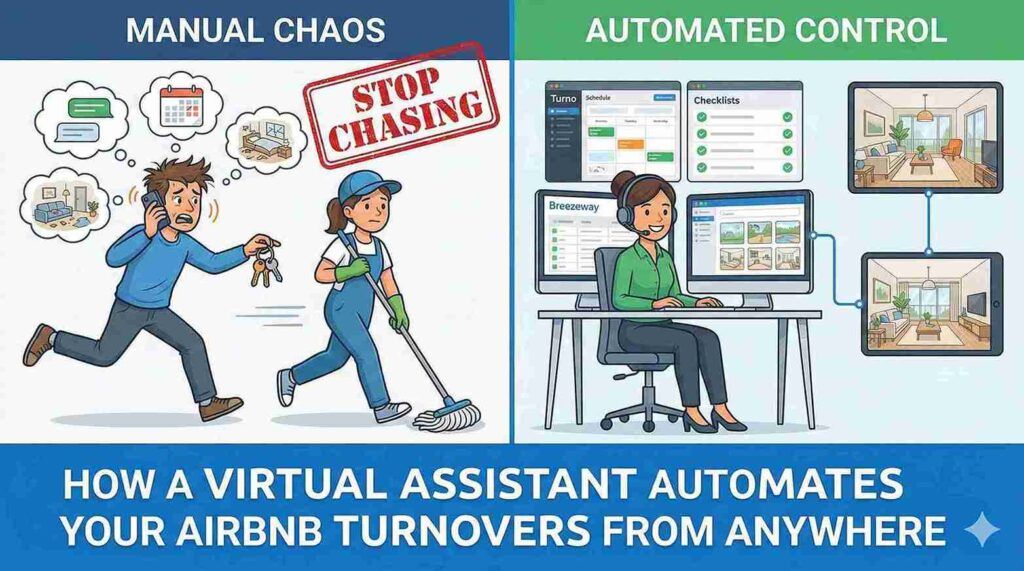
Automating turnover scheduling by syncing iCal feeds from Airbnb and Vrbo directly into cleaning job assignments eliminates the manual screenshot-and-text workflow that breaks down at scale. The system spots same-day tight gaps automatically and dispatches cleaners without operator intervention. This is the right automation priority for operators with three or more properties. The tradeoff is dependency on cleaner adoption of the scheduling software, which requires onboarding time.
4. Dynamic Pricing Automation - Let Algorithms Capture Revenue You'd Otherwise Leave Behind
Dynamic pricing tools continuously adjust nightly rates based on local demand signals, competitor rates, seasonality, and lead time, capturing revenue that flat-rate or manually adjusted pricing consistently misses. For STR operators with even one property, this automation pays for itself quickly during peak periods. The critical tradeoff is that fully automated pricing requires periodic human review, algorithms can misprice during local events or anomalous demand spikes if left completely unchecked.
5. Automated Review Requests - Systematize the Social Proof Engine That Drives Future Bookings
Review velocity directly impacts search ranking on Airbnb and Vrbo, yet most operators leave reviews to chance because manually requesting them after every checkout is easy to forget. Automating post-checkout review request messages sent within the platform's review window ensures consistent solicitation without operator effort. This is a low-complexity, high-leverage automation that compounds over time. The one limitation is that automated messages must still comply with platform policies prohibiting incentivized or conditional review requests.
The 13 Best Short-Term Rental Automation Tools for 2026
That review conversion advantage does not exist in isolation; it reflects a broader infrastructure shift already well underway across the industry. The vacation rental management software market has grown into a multi-hundred-million-dollar segment with projections pointing to continued expansion through the early 2030s, according to market sizing research across the category. It is a mature, competitive market where a growing share of property management professionals already report using AI tools in their daily workflows, per industry surveys.
Operators still asking "should we automate?" are no longer early adopters weighing risk. They are late movers absorbing the cost of delay.
The real question has shifted: not whether to automate, but which tool should own which layer of your operation, and what sits in the middle connecting them.
How to Structure Your Short-Term Rental Automation Stack by Layer
Most operators building their first automation stack find one platform for messaging, one for pricing, one for cleaning, one for access. The logic is sound. The execution is where it breaks.
The fragmentation tax is not the $80 to $120 per-unit monthly software cost. The real cost is the human coordinator salary required to bridge the gaps between tools. Because 47.8% of operators are fielding guest conversations across Airbnb, WhatsApp, SMS, and email, per-unit overhead from a fragmented stack routinely exceeds the software line item by a margin operators rarely attribute to their tool choices.
The software is visible. The human routing work is not. The operators hitting 80% or higher automation rates are not running fewer tools.
They are running the right tools at the right layers, connected through a coordination layer that removes the human router between every system. The 13 tools below are mapped to that model, not listed as a flat vendor roundup.
1. Conduit.ai - Best AI Guest Communication for Short-Term Rental Automation
Most operators assume any messaging platform with templates and auto-triggers will handle guest communication. The gap surfaces fast: templated autoresponders reliably cover routine, keyword-triggered inquiries, but a significant share of conversations, upsell requests, pre-booking conversion questions, complaint de-escalation, require contextual reasoning that rigid templates cannot provide, and those messages route straight back to a human inbox, recreating the bottleneck automation was supposed to eliminate. Conduit's hospitality AI platform closes that gap by handling the nuanced, revenue-bearing conversations generic autoresponders drop.
Published case study data: Cascadia Getaways maintains a top-rated communication score with a high degree of automation; Easy BnB recovered approximately $22,000 per month in staff costs across 75 units without adding a single hire; Cash Flow Street reached 96% automation across 35 properties; and Blue Gems operates at a high level of automation. Most beneficial when managing guest communications across multiple platforms or properties simultaneously, where scattered inboxes and delayed responses directly erode review scores.
2. PriceLabs - Best Dynamic Pricing Engine for Revenue Maximization
PriceLabs is the most widely adopted dynamic pricing engine in short-term rentals: its hyper-local demand data, customizable base price rules, and portfolio-level controls give operators granular command over revenue strategy without requiring a revenue manager on staff. The real tradeoff is setup time. The tool rewards operators who configure rules correctly upfront; hosts who deploy it without stable occupancy history or a calibrated base price often see early results that underperform their manual rates before the algorithm stabilizes.
3. Hospitable - Best All-in-One Messaging and Automation Platform
Hospitable earns its place for independent hosts and small portfolio operators who want messaging automation, review management, and basic channel sync inside a single interface without paying enterprise PMS pricing, a positioning consistent with its reputation as one of the more affordable messaging automation platforms on the market, commonly used by operators running portfolios under 20 units. Its rule-based message sequences handle pre-arrival, check-in, and post-stay communications reliably, and the review automation alone saves several hours per week at scale. The ceiling shows up around 15 to 20 properties, where operators typically outgrow Hospitable's reporting depth and need a more structured operations layer. It is the right starting point, not the permanent foundation for a scaling portfolio.
4. Turno - Best Automated Cleaning Scheduling for Vacation Rentals
Turno (formerly TurnoverBnB) solves one of the most operationally painful failure points in multi-property management: the gap between a checkout and a confirmed, briefed cleaning team. Its calendar-triggered turnover scheduling connects directly to most major PMS platforms, auto-assigns cleans based on availability and location, and gives cleaners a mobile checklist with photo documentation. The limitation worth knowing: Turno handles scheduling and coordination well, but it is not a full property operations platform. Deeper inspection workflows and maintenance dispatch require a dedicated operations tool alongside it.
5. Hostaway - Best Channel Manager for Multi-Platform STR Operators
Hostaway is the channel manager most commonly cited by operators managing 10 to 100 properties across Airbnb, Vrbo, Booking.com, and direct booking simultaneously. Its unified calendar and real-time sync architecture is built specifically to prevent double bookings, which remains the single most damaging operational failure in multi-channel STR management. Operators in short-term rental communities who have migrated from lighter channel managers consistently point to Hostaway's automation rules engine as the feature that made the switch worthwhile, not just the channel sync. The tradeoff is pricing: smaller operators with fewer than five units will likely find the cost-to-benefit ratio harder to justify.
6. Lodgify - Best Direct Booking Website Builder with Automation Built In
Lodgify occupies a specific and underserved niche: operators who want to reduce OTA commission dependency by building a direct booking channel without managing a separate website platform alongside their PMS. Its website builder is usable without a developer, a point consistently cited by customers in G2 and Capterra reviews, and the built-in booking engine handles payments, availability sync, and basic guest communication automation in one package. Direct booking infrastructure delivers clear value for operators at this stage of growth. Operators running 20 or more units will find they need to layer a more robust PMS on top of it, at which point Lodgify functions as the direct booking front-end rather than the operational backbone.
7. Beyond Pricing - Best Set-and-Forget Revenue Automation for Busy Hosts
Beyond Pricing is designed for operators who want dynamic pricing without the configuration overhead that tools like PriceLabs require. Its market-based algorithm adjusts rates automatically using local demand signals, and the interface is intentionally simpler than competing tools, a design philosophy the company documents explicitly in its product positioning, and one echoed in operator reviews on Capterra that contrast it favorably with PriceLabs' rule-configuration depth. For hosts managing fewer than 15 units who want pricing automation running in the background without weekly calibration, Beyond Pricing delivers. Operators who want granular rule-setting, custom minimum stay logic, or deep portfolio-level reporting will hit its ceiling quickly.
8. Escapia - Best Smart Home and Access Automation for Vacation Rental Managers
Escapia serves property managers with larger, professionally managed vacation rental portfolios who need a PMS with deep owner accounting, trust accounting compliance, and integrated reservation management. Its access automation capabilities connect with major smart lock providers to generate check-in codes tied directly to reservation windows, reducing manual key handoffs. The platform's depth in owner reporting and financial reconciliation makes it particularly strong for operators managing properties on behalf of homeowners who require detailed statements. Smaller independent operators often find Escapia's feature set more than they need.
9. Wheelhouse - Best Pricing Automation for Hosts Focused on Competitive Market Intelligence
Wheelhouse differentiates itself through its competitive intelligence layer: operators can see how their rates compare to nearby listings in real time, which is particularly useful in markets with dense competition where relative positioning matters as much as absolute demand signals. Wheelhouse's onboarding is designed to get pricing live quickly, and operators who have used both tools commonly note that Wheelhouse requires less initial configuration time than more rule-intensive platforms, a trade-off that works in Wheelhouse's favor for operators who want pricing running fast, and in PriceLabs' favor for operators who want granular control. The tradeoff is that Wheelhouse's algorithm is less customizable at the rule level, so operators with complex minimum stay logic or multi-market portfolios may find PriceLabs a better long-term fit once their revenue strategy matures.
10. Breezeway - Best Operations and Property Care Automation Platform
Breezeway is the operations layer most PMS platforms do not fully cover: structured property care workflows, inspection checklists, maintenance scheduling, and task dispatch built specifically for the STR context. For operators managing quality across multiple properties with rotating cleaning and maintenance staff, Breezeway's visual task management and photo-verified completion tracking directly reduces the supervisory overhead that otherwise lands on the operations lead. Operators using Breezeway consistently report meaningful reductions in the time spent on scheduling and follow-up tasks across their properties. Breezeway is an operations tool, not a communication tool; it needs a guest-facing communication layer alongside it to cover the full operational stack.
11. AirDNA - Best Market Intelligence Automation for Data-Driven STR Investors
AirDNA is the market intelligence layer operators and investors use to make data-backed decisions on new market entry, pricing benchmarks, and portfolio performance relative to local competition. Its automated reporting surfaces occupancy trends, average daily rates, and revenue per available night across most major STR markets. It is research and benchmarking infrastructure, not an operational tool, and operators who expect it to replace dynamic pricing or channel management will be disappointed by the scope mismatch.
12. Guesty - Best Enterprise Property Management Automation for Large Portfolios
Guesty is the PMS most frequently chosen by operators managing 50 or more properties who need enterprise-grade channel management, owner portals, trust accounting, and multi-user team permissions inside a single platform. Its channel sync architecture delivers real-time calendar updates across Airbnb, Vrbo, Booking.com, and direct booking channels, preventing the double bookings that become increasingly costly as portfolio size grows. Operators in the 50 to 500 unit range cite Guesty's automation rules engine and open API as the features that justify the premium pricing. For operators under 20 units, the cost structure is harder to justify against lighter alternatives.
Related Reading
- How To Automate Airbnb Business
- Vrbo Management
- Airbnb Self Check In
- How To Manage A Vacation Rental Property
- Vrbo Smart Pricing
- Vacation Rental Automation
- Best Apps For Short Term Rentals
- Best Pms For Airbnb
- Best Pms For Short Term Rentals
- Best Accounting Software For Short Term Rentals
What 96% Automation Actually Looks Like Across a Real Portfolio
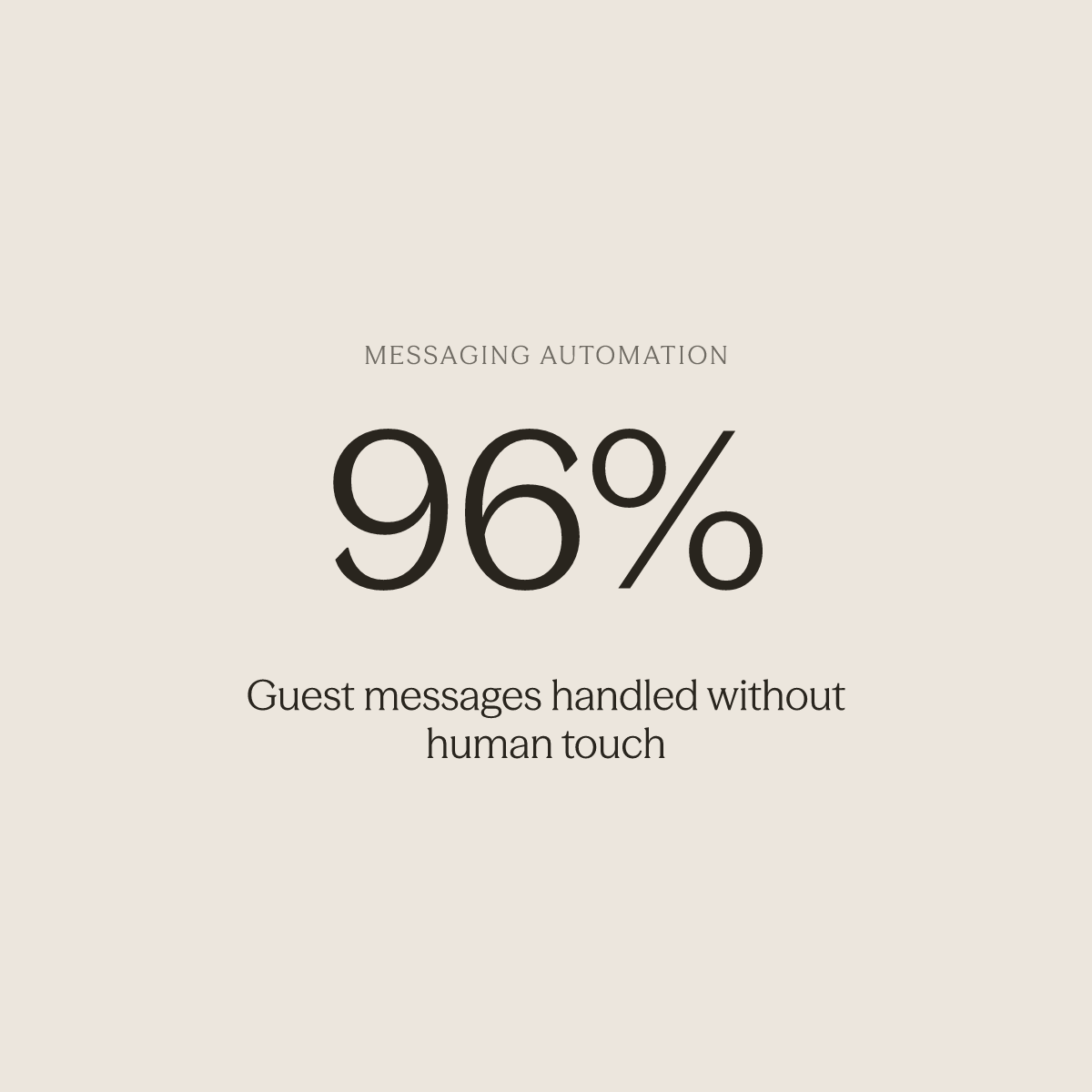
Thirty-five properties. Zero new hires. Ninety-six percent of guest messages handled without a human touching the inbox. The instinct is to look for the asterisk. There is no asterisk, only a different architectural decision about where human attention belongs.
Image: Bold stat showing 96% automation rate across a 35-property portfolio with zero new hires
Cash Flow Street: 35 Properties, Zero New Hires, 96% Automation
According to Conduit's published case study data, Cash Flow Street reached 96% messaging automation across a 35-property portfolio without adding a single guest-communications hire. The result reframes the standard hiring question. Most operators ask when they need to add a communications manager as the portfolio grows.
The Cash Flow Street outcome suggests a better question: at what point does an AI coordination layer outperform a human hire on both response speed and margin? The coordinator role did not scale here; it was structurally replaced by a system that reasons across property-specific rules, guest history, vendor contacts, and brand voice simultaneously. This is the tension most multi-property operators feel acutely: every new property added to the portfolio means more message volume, more platform-switching, more shift handoffs, and the assumption that headcount must grow to match.
Conduit's AI Agents work differently. Once trained on existing documentation, SOPs, FAQs, and property manuals, they begin handling the first automated guest reply within days of connecting those materials, and continue responding continuously, before, during, and after every stay, without adding coordination headcount. The Cash Flow Street outcome is what standardizing guest communication quality and brand voice across a large, distributed portfolio actually looks like in practice.
Easy BnB - Recovering Approximately $22K by Removing the Messaging Bottleneck
Darren, founder of Easy BnB, was running a large team of virtual assistants to cover 24/7 guest messaging until he examined what those VAs were actually doing: the overwhelming majority of message volume was low-stakes, predictable communication requiring no real judgment. The labor cost was real; the value delivered was not proportional. After a staffing crisis forced an immediate shift, Darren moved overnight messaging and the majority of daytime volume to Conduit's AI Agents, recovering approximately $22,000 per month across 75 units with no new headcount added.
The Easy BnB situation reflects a pattern that catches operators off guard: staff time that looks like guest service often turns out to be message-routing overhead dressed up as skilled labor. Conduit's AI Agents are most beneficial precisely when a business receives high volumes of repetitive guest messages and already has existing documentation to train the agent on, the infrastructure most established short-term rental operations already possess. Connecting that documentation through Conduit's Integrations, which pull from tools like Notion, Google Drive, or Airbnb without requiring manual re-entry, means the AI inherits institutional knowledge immediately rather than being built from scratch.
Wynwood House - Cutting Guest Resolution Time Across 7 Countries
The complexity at Wynwood House was coordination across seven countries in Latin America and Europe, with multilingual guests, inconsistent shift handoffs, and manual sentiment tracking in spreadsheets. Guest resolution times averaged many minutes per interaction. After consolidating all guest communication into a single AI-powered Inbox, an ongoing operational layer the team uses to monitor, review, and manage every conversation the AI Agent handles, resolution times dropped dramatically.
What Mayra, Wynwood House's Global Head of Customer Experience, observed went beyond speed: "The first thing we noticed was the quality of the AI replies. You cannot tell the difference between an AI agent and a human agent. I work with ChatGPT and other AI tools every day, and sometimes you can immediately tell it's AI. With Conduit, we're not seeing that."
That distinction matters operationally. The failure mode operators fear most, an AI that sounds like an AI, erodes guest trust, and creates a new class of escalations to manage, is the reason teams hesitate. The Wynwood House result, across seven countries and multiple languages, addresses that hesitation directly with a documented outcome, not a feature claim.
The Coordination Layer vs. the Chatbot
Teams that have tried generic AI messaging tools hit the same wall: the AI embarrasses them in front of guests because it has no context about the specific property, its policies, or the reservation in question, so it either gives wrong answers confidently or deflects to a human, recreating the exact bottleneck it was supposed to replace. This is the most common disillusionment point for operators who adopted early-generation chatbot tools and concluded that AI guest messaging simply doesn't work at a professional standard. A coordination layer trained on property-specific SOPs, guest history, and vendor contacts handles those conversations differently, because it already knows how the business runs before the first guest messages.
Conduit's Workflows extend this further: when a booking is confirmed, when check-in occurs, or when a specific keyword appears in a conversation, automated touchpoints fire without anyone on the operations team initiating them. The Inbox gives that team continuous visibility, not to approve every reply, but to monitor the system that is handling volume they would otherwise be absorbing manually. AI for hospitality reflects the same underlying principle: scale the portfolio without scaling the coordination headcount required to run it.
Related Reading
- Vrbo Automated Messages
- Lodgify Competitors
- Guesty Alternatives
- Hospitable Vs Hostaway
- Guesty Vs Hostaway
- Lodgify Vs Smoobu
- Guesty Vs Hostfully
- Guesty Vs Hospitable
- Ownerrez Vs Guesty
Next steps
If your portfolio keeps growing while your inbox, cleaning schedule, and access coordination still flow through a human in the middle, the path forward starts with replacing that routing dependency structurally, not patching it with another point solution. The operators who reached 96% automation across 35 properties without adding headcount did not find a better tool for each job. They removed the person bridging the gaps between tools.
The documented 116% booking uplift tied to fast response times means every hour your team manually triages guest messages is a compounding revenue loss that never appears on any invoice. The fragmentation tax, where 47.8% of operators remain partially manual while fielding conversations across Airbnb, WhatsApp, SMS, and email, means the real cost of a siloed stack is the human coordinator salary required to hold it together, not the software line items. Together, they point to one action: install a coordination layer that already knows your properties, your SOPs, and your guest history before the first message arrives.
Start with AI for hospitality from Conduit to see how the coordination layer handles guest communication, automates recurring touchpoints through Workflows, and consolidates every conversation into a single Inbox your team monitors without manually routing. What happens after is the message queue shrinks, the coordinator bottleneck dissolves, and portfolio growth stops generating a proportional staffing bill.
Frequently Asked Questions
I already have tools for messaging, pricing, and cleaning, why am I still spending so much time on manual work?
The problem isn't the individual tools; it's the gaps between them. When tools don't share a common source of truth, a human ends up routing work between them, forwarding cleaning requests, updating lock codes, checking pricing dashboards, and that coordination tax is where the bulk of the 12.5 hours per week per listing actually goes, not in the tasks each tool handles on its own.
What should I automate first if I'm just getting started?
Start with guest communication, because 80–90% of guest inquiries are predictable and repeat the same patterns daily. Automating this layer first also captures revenue directly, fast response times are linked to meaningfully higher booking conversion rates, including a documented 116% boost in bookings, so every hour a human is unavailable is a measurable loss.
How do smart locks and access automation fit into the overall stack?
Access automation is the third priority, after guest communication and cleaning coordination are already stable. Keyless entry removes the physical dependency on a human being present at check-in, but it works best when pre-arrival messaging is reliable enough to handle guest questions before they arrive at the door, skipping ahead to smart locks before communication is stable means guests arrive with questions your lock can't answer.
Can an AI agent actually handle the nuanced guest messages, or just the simple template-style replies?
A purpose-built hospitality AI can handle nuanced, revenue-bearing conversations, including upsell requests, pre-booking conversion questions, and complaint de-escalation, that rigid templates drop back into a human inbox. Conduit's AI agents do this by internalizing a business's existing SOPs and FAQs and applying them consistently across every guest interaction, pulling the team in only for disputes and edge cases that genuinely require judgment.
Does running automation across multiple properties mean I need a developer or IT person to set it up?
No. Connecting existing tools like Notion, Google Drive, or Airbnb to an AI coordination layer requires no IT or developer involvement, the operator links the accounts directly. Once connected, the AI agent can leverage that existing documentation to handle guest replies automatically across multiple platforms and properties simultaneously.
Stay in the loop
Get the latest on AI automation, product updates, and customer stories.