How to Do Airbnb Guest Screening and Avoid Bad Stays


Airbnb Guest Screening
Learn how rental managers avoid bad stays
Airbnb hides guest identity until after you accept. Here is why the screening gap is structural, not a skill problem, and where host-level filtering has to take over.
Most experienced Airbnb hosts and vacation rental operations leads believe that screening is a host skill, that experienced operators develop an eye for red flags over time, and that the answer to getting better at it is more experience, not a different process. They read the profile, check the reviews, look for the verification badge, and trust their gut. The problem is that this sequence happens almost entirely on incomplete information, and the platform is designed that way by default. See our AI for hospitality for how this works in practice.
Airbnb's own help documentation confirms that guest identity details are withheld from hosts until after a booking is confirmed. That single architectural fact means every accept or decline decision is based on curated platform signals, not actual guest data. The screening happens blind, and most hosts never realize it.
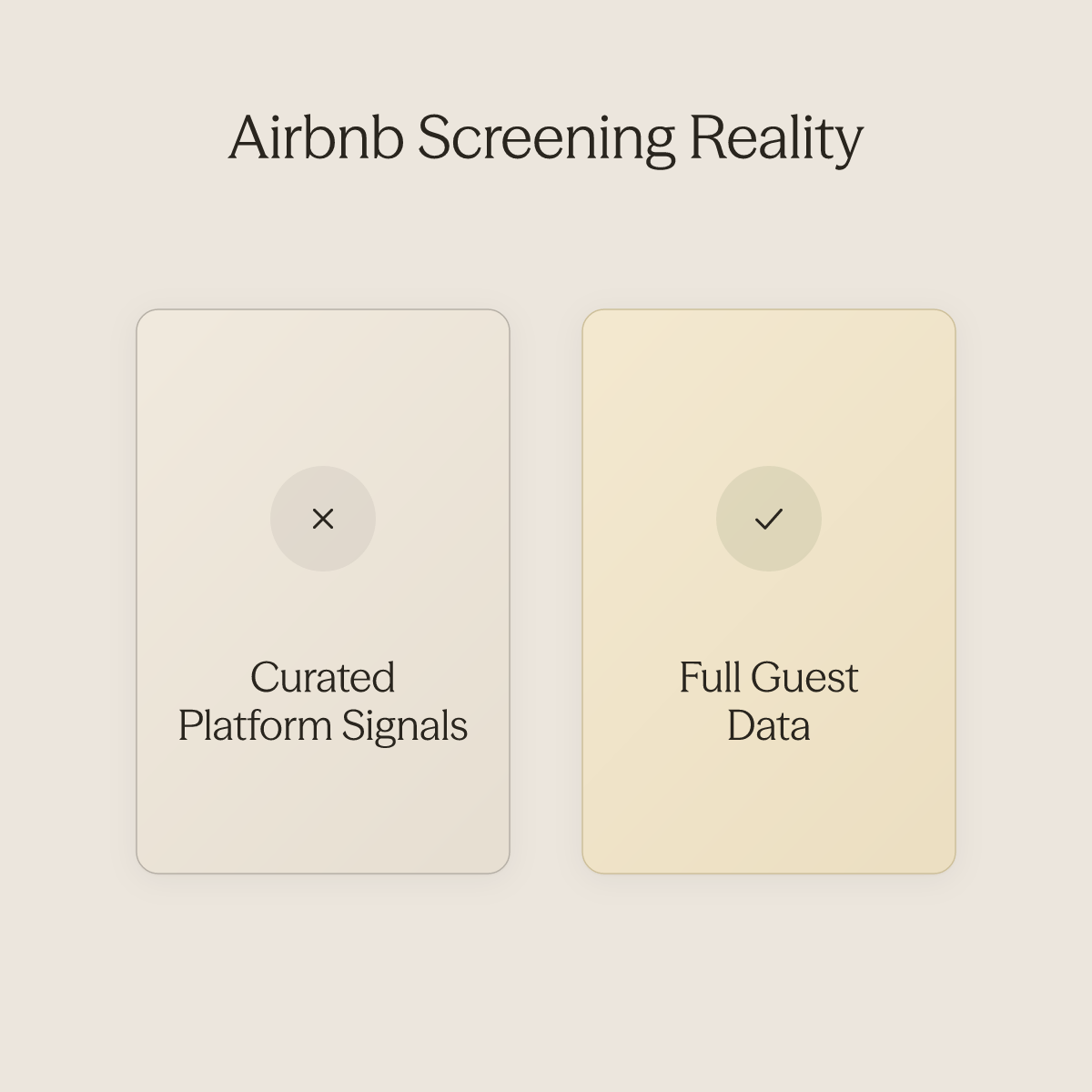
Airbnb does not share a guest's real contact information or verified identity with the host before the booking is locked in. Hosts are left reading message tone, profile completeness, and response speed as proxies for trustworthiness. Those signals carry real information, but they are indirect, and reading them consistently requires a framework most operators have never been given.
A host who reads every inquiry carefully is still working with a curated preview, not a full picture, and that distinction determines where the solution needs to live. Airbnb's verification badge tells you a guest cleared the platform's minimum threshold. It does not tell you whether this guest is right for your specific property, your house rules, or your risk tolerance.
The badge signals compliance with a floor, not a genuine filter. A sharp operator managing five listings can read every inquiry slowly and flag the booking that feels slightly off. That same operator managing 30 properties faces a queue that never empties. Bookings that arrive on a Friday get a fraction of the scrutiny Monday morning bookings do. Operations like Erwan Le Roy's 35-property portfolio use AI for hospitality to route the vast majority of routine guest interactions automatically, so human judgment is applied where it actually changes the outcome, on the ambiguous, high-stakes bookings that warrant a real decision, not on the routine inquiries that consume time without adding signal.
"Guest screening fails before the first message because problematic behavior patterns, such as excessive pre-stay messaging about already-documented listing details, are not flagged or visible to me until after booking is confirmed."
Key takeaways
- Airbnb's built-in screening sets a floor, verified identity and a basic background check for US guests only, not a filter you can rely on to protect a specific property from a specific guest.
- A guest who cleared Airbnb's background check and one who was never checked look identical in your inbox, because the platform doesn't surface that distinction to hosts.
- Gut-feel screening doesn't degrade because hosts get lazy, it degrades because judgment that lives in one person's head can't be distributed across a team without collapsing into inconsistency.
- The friction-to-safety tradeoff only feels unavoidable when every inquiry hits the same human inbox with the same scrutiny and the same wait time, that's a workflow problem, not a screening problem.
- Manual screening breaks structurally around 10 to 15 properties; past that point, variance in who handles the inbox becomes indistinguishable from having no screening standard at all.
- The operators catching bad guests before check-in aren't more experienced, they've built a structured, repeatable review layer into their communication workflow so screening signals reach a human only when they actually matter.
- Conduit closes that gap by automating up to 96% of guest interactions within one minute, the way Erwan Le Roy's 35-property operation runs, so every flag that needs a human decision actually gets one, without the inbox bottleneck that makes consistent screening impossible at scale.
How Airbnb's Built-In Guest Screening Works: and Where Its Floor Actually Sits
Screening is a host skill, experienced operators develop an eye for red flags over time, and the answer to getting better at it is more experience, not a different process. Most vacation rental property managers and operations leads hold this belief so firmly that they treat Airbnb's built-in tools as a reasonable starting point and personal judgment as the real differentiator. But Airbnb's screening system processes hundreds of millions of bookings, and that scale is precisely why it cannot do what individual hosts need it to do. The platform is built to protect Airbnb at the brand level, not to protect your specific property from the specific guest about to walk through your front door.
What Airbnb's ID Verification Actually Confirms and What It Deliberately Withholds From You
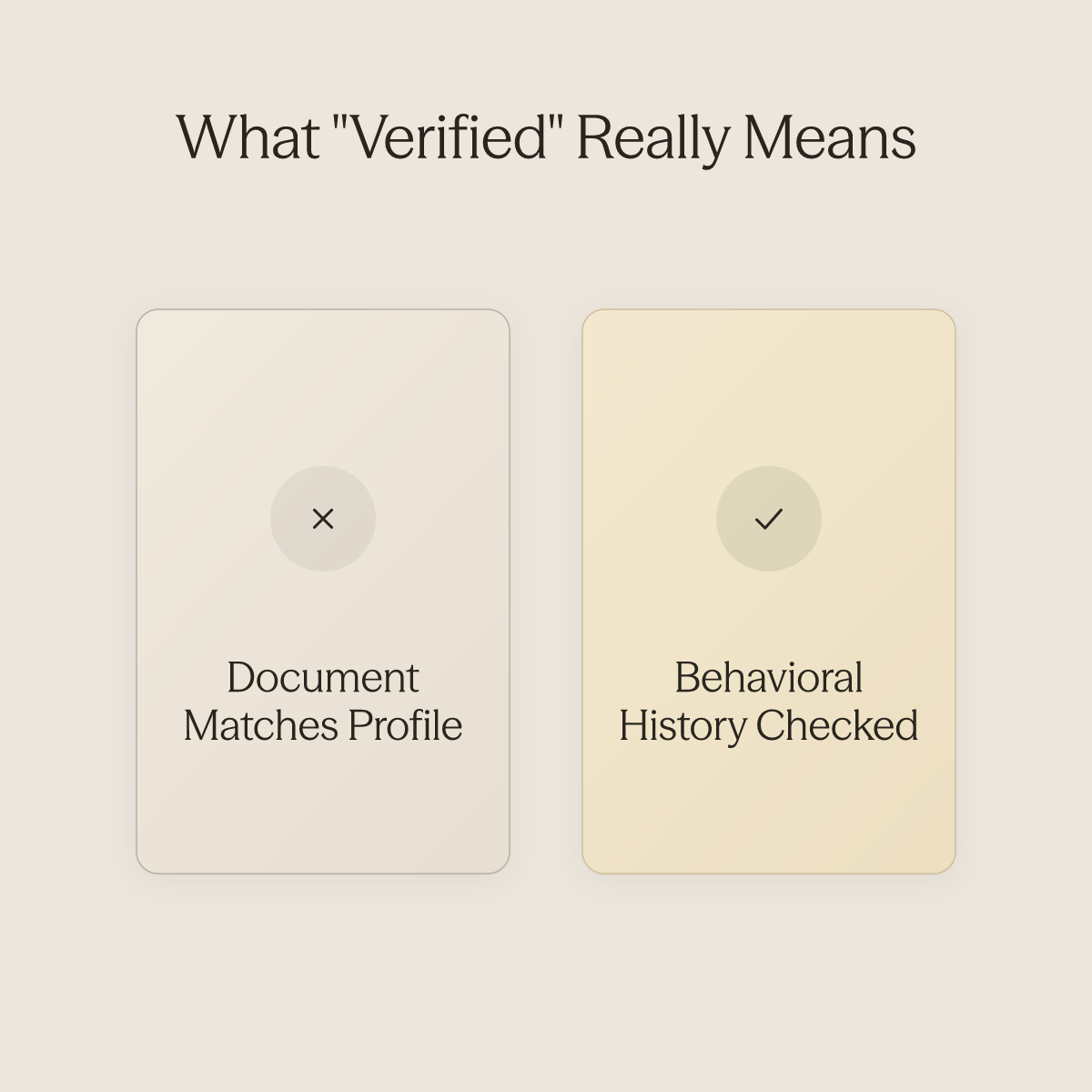
When a guest completes ID verification, Airbnb confirms that a submitted government ID matches the profile attached to the account. That is the full extent of what you receive. Airbnb does not share verified identity details with hosts before a booking is accepted, no legal name, no ID number, no underlying document.
You see a badge that says "verified." A guest with a blank profile, zero reviews, and a recently created account can carry that badge, because the badge confirms document-to-profile matching, not behavioral history. The verification step adds a meaningful layer of identity accountability, but it is not designed to substitute for the profile depth and review history that experienced hosts use as their primary behavioral signal.
What this means operationally: hosts managing multiple properties or platforms find themselves absorbing the screening gap through manual communication, pre-stay message threads designed to surface behavioral signals the platform withheld. That volume compounds fast. A pre-screening conversation for every incoming booking, timed correctly, worded consistently, and followed up on across Airbnb, Vrbo, and direct channels simultaneously, is itself a significant operational bottleneck.
Conduit's AI Agents are built to eliminate that bottleneck, particularly for operations teams that receive high volumes of repetitive guest messages and already have SOPs or FAQs they can use to train the agent on property-specific screening logic.
The Real Scope of Airbnb's Background Checks - US-Only, Opt-In, and Narrower Than You Think
Airbnb's background checks scan public criminal records and sex offender registries, applying only to guests booking properties in the United States, and even then, coverage is not universal. These checks do not approach the scope of formal tenant screening, no credit history, no eviction records, no civil court data. An operator managing a portfolio across multiple markets receives background check coverage for some guests in one country and nothing for the rest.
The practical fallout is that hosts compensate with manual pre-screening outreach, messages sent at odd hours to catch booking windows before check-in deadlines, follow-up threads that fall through the cracks when the team is spread thin, and inconsistent tone that varies by who happened to be on shift. Conduit's Workflows address this directly: after a trigger event such as a booking confirmation, automated touchpoints fire consistently, before, during, or after a stay, so that every guest moving through a portfolio with known screening gaps receives the same structured pre-arrival communication regardless of the time of day or which team member is available.
The Structural Gap - Platform-Level Risk Floor vs. Host-Level Property Filter
According to industry research, Airbnb's built-in tools are applied uniformly across more than 5 million hosts worldwide. That uniformity is the point: the platform sets a floor that works at global scale, not a filter calibrated to your property's specific risk profile. The review system compounds this, guests accumulate a track record only after completing stays, meaning first-time bookers arrive with no reviewable signal at all, and the guests who cause the most damage are often the ones who haven't caused documented damage anywhere yet.
A verified badge tells you a guest exists and hasn't been flagged at the platform level. It doesn't tell you whether they're the right guest for your specific property, and that distinction is exactly where host-level screening, structured, consistent, and signal-responsive, has to pick up where the platform leaves off. Conduit gives the support or operations team a single place to monitor, review, and manage every conversation the AI agent is handling, so screening-oriented pre-stay threads don't slip through platform silos.
And because the AI agent can be trained on existing documentation through Integrations with tools like Notion, Google Drive, or Airbnb without manual re-entry, the institutional knowledge an experienced operator has built about their own properties, the red flags, the house rules, the guest profile that fits, becomes the engine running every first automated reply, typically live within days of connecting your SOPs. Timely, consistent pre-stay communication improves guest experience and review scores; it also means the guests who do book have been qualified against your standards, not just the platform's.
Manual Airbnb Guest Screening - The Signals That Actually Predict a Bad Stay
That judgment, whether a guest is right for your specific property, is one no platform algorithm can make for you, and the gap between what Airbnb verifies and what you actually need to know is where most host risk lives. Airbnb blocks guest contact information until a booking is confirmed, which means you cannot run any additional screening before you are legally locked into the reservation. Every signal you can read has to come from what surfaces inside the platform before you click confirm.
1. Same-Day or Last-Minute Booking Requests
Same-day and next-day booking requests are a reliable risk multiplier. Hosts managing high-volume portfolios consistently find that compressed booking windows correlate with a meaningfully higher rate of house-rule violations and unresolved damage claims, a pattern that holds across property types and markets. The pattern makes sense behaviorally: a guest planning a legitimate trip books with lead time.
A guest planning something they'd rather not disclose books when they calculate you're too close to check-in to ask hard questions. Treat compressed booking windows as a risk multiplier, not just an inconvenience. This is also precisely the scenario where managing guest communications manually across multiple properties simultaneously breaks down, a last-minute inquiry at property #4 arrives while you're resolving a check-in issue at property #2, and the screening question never gets sent.
AI Workflows trigger automatically after a booking request lands, so the pre-screening message goes out the moment the inquiry arrives, regardless of what else is happening in your inbox.
2. Opening Message Demands a Discount or Direct Booking
When a guest's first message is a price negotiation or a push to book off-platform, it signals entitlement and sets a combative tone for the entire stay. Hosts who engage with these requests often report guests who treat the property poorly and dispute charges. The tradeoff is that some budget-conscious guests are genuinely harmless, but the pattern is reliable enough to justify a firm no.
3. Brand-New Account with Zero Reviews and Minimal Verification
A guest profile with no reviews, no photo, and only a phone number verification is one of the most discussed red flags in host communities. While every guest starts somewhere, this combination, especially on accounts created within the past month, correlates with damage incidents and refusal to pay. The real tradeoff is occasionally declining a perfectly fine first-time user, which is a manageable cost for most hosts.
4. Sob-Story Discount Requests with Elaborate Personal Hardship
Guests who craft detailed emotional narratives, sick relatives, financial hardship, special medical needs, to justify deep discounts are a well-documented manipulation pattern. Hosts who yield typically find these guests are also the most demanding during the stay. The tradeoff is that genuine hardship cases exist, but the specificity and pressure of the ask is usually the tell that separates manipulation from honest communication.
5. Third-Party Bookings Where the Stayer Isn't the Account Holder
When hints emerge that the person booking won't actually be staying, a friend, family member, or group organizer is the real occupant, it violates Airbnb's terms and creates serious accountability gaps. Hosts can't communicate effectively with the actual guest, and damage disputes become nearly impossible to resolve. Requiring ID verification at check-in matched to the booking name is the most effective countermeasure.
6. Coded or Suspiciously Vague Guest Reviews on Their Profile
Airbnb's review culture discourages blunt negativity, so past hosts often signal problems through omission or careful phrasing. Reviews that focus entirely on the host's responsiveness without mentioning the guest's behavior, or that are unusually short for a multi-night stay, are worth scrutinizing. The tradeoff is that reading between the lines requires experience, new hosts may miss these signals entirely without deliberate practice.
7. Pre-Booking Requests to Inspect the Property in Person
Guests who ask to visit or have a local contact scout the property before committing to a booking are almost universally a sign of extreme entitlement or, in rarer cases, a security concern. Experienced hosts report these inquiries consistently lead to guests who are impossible to satisfy and who demand discounts for minor imperfections. Politely declining with a reference to accurate photos and verified reviews is the standard best practice.
Airbnb Background Checks and Third-Party Screening Tools - What's Worth Adding
Airbnb's built-in screening sounds reassuring until you understand what it actually covers and, more importantly, what it doesn't. The gap between a guest who passed a background check and one who was never checked at all is often invisible at the point of acceptance, which is where the real risk lives. Getting this right is less about stacking tools and more about knowing where your current setup has blind spots, whether that's Instant Book configuration, cross-channel exposure on Booking.com, or the point in your communication workflow where a red flag should trigger a human review.
SuiteOp - A Checklist-Based Approach for Hosts Building a Layered Manual System
SuiteOp's checklist-based approach works well for operators who want a documented, repeatable screening process without fully automated routing. It provides structured pre-booking question sequences and team-facing checklists that standardize screening decisions across staff, a practical entry point for operations in the 5-to-15 property range that aren't yet ready to route traffic through an AI coordination layer but need to move beyond ad-hoc judgment calls.
1. Conduit.ai - Best All-in-One Airbnb Guest Screening Platform
Most hosts layer in third-party tools because their communication workflow has no structured moment to catch a red flag before acceptance. Conduit's AI for hospitality creates exactly that moment at scale, automatically surfacing anomalous signals (last-minute local bookings, vague trip purposes, mismatched party sizes) to a human reviewer only when they genuinely warrant one. Most beneficial once a portfolio exceeds ten properties and volume makes consistent manual review impossible without adding headcount.
2. Truvi - Best for Hosts Who Also List on Booking.com
Booking.com conducts no native guest vetting, meaning cross-listed hosts face a meaningfully different risk profile on that channel than on Airbnb. Truvi fills that gap by running identity and risk checks outside the Airbnb ecosystem, a meaningful layer for operators whose Booking.com volume is high enough that the friction cost is justified by the exposure. For Airbnb-only hosts, it is almost always redundant.
3. Airbnb's Native Background Check System - Know Its Limits Before You Rely on It
Airbnb's background check covers US-based guests only, screening criminal records and the sex offender registry, with no credit history, no eviction history, and zero coverage for international guests. A guest who "passed" Airbnb's check and one who was never checked can look identical to the host. The fix isn't a third-party tool by default; it's correctly configuring Instant Book filters (verified government ID, positive review history, stated trip purpose) so the platform's own pre-filters do more work before any inquiry reaches you.
4. Authenticate.com - Best for Hosts Prioritizing Deep Identity Verification
Authenticate.com offers biometric identity matching and document verification that goes well beyond what any platform provides natively. The tradeoff is real: external biometric verification introduces meaningful pre-booking friction, particularly for guests unfamiliar with the process. Airbnb's own help documentation notes that adding pre-booking requirements reduces the eligible guest pool and lowers booking rates, a dynamic that external verification flows amplify further. Reserve this for luxury or high-liability properties where potential loss exposure justifies that cost.
5. SuiteOp Guest Screening Checklist Approach - Best for Hosts Who Want a Layered Manual System
Rather than a single tool, SuiteOp advocates a layered screening methodology: communication screening, ID verification, security deposits, and house rules as a pre-selection filter. This approach suits independent hosts who want control over each screening layer without locking into one vendor. The real limitation is time, manually executing each layer across every booking is unsustainable at scale without property management software to automate handoffs.
Related Reading
- Vrbo Management
- Airbnb Self Check In
- Vacation Rental Automation
- Best Apps For Short Term Rentals
- Best Pms For Airbnb
- Best Pms For Short Term Rentals
- Best Accounting Software For Short Term Rentals
- How To Manage A Vacation Rental Property
- Vrbo Smart Pricing
- How To Automate Airbnb Business
Balancing Airbnb Guest Screening With Conversion - The Framework That Threads the Needle
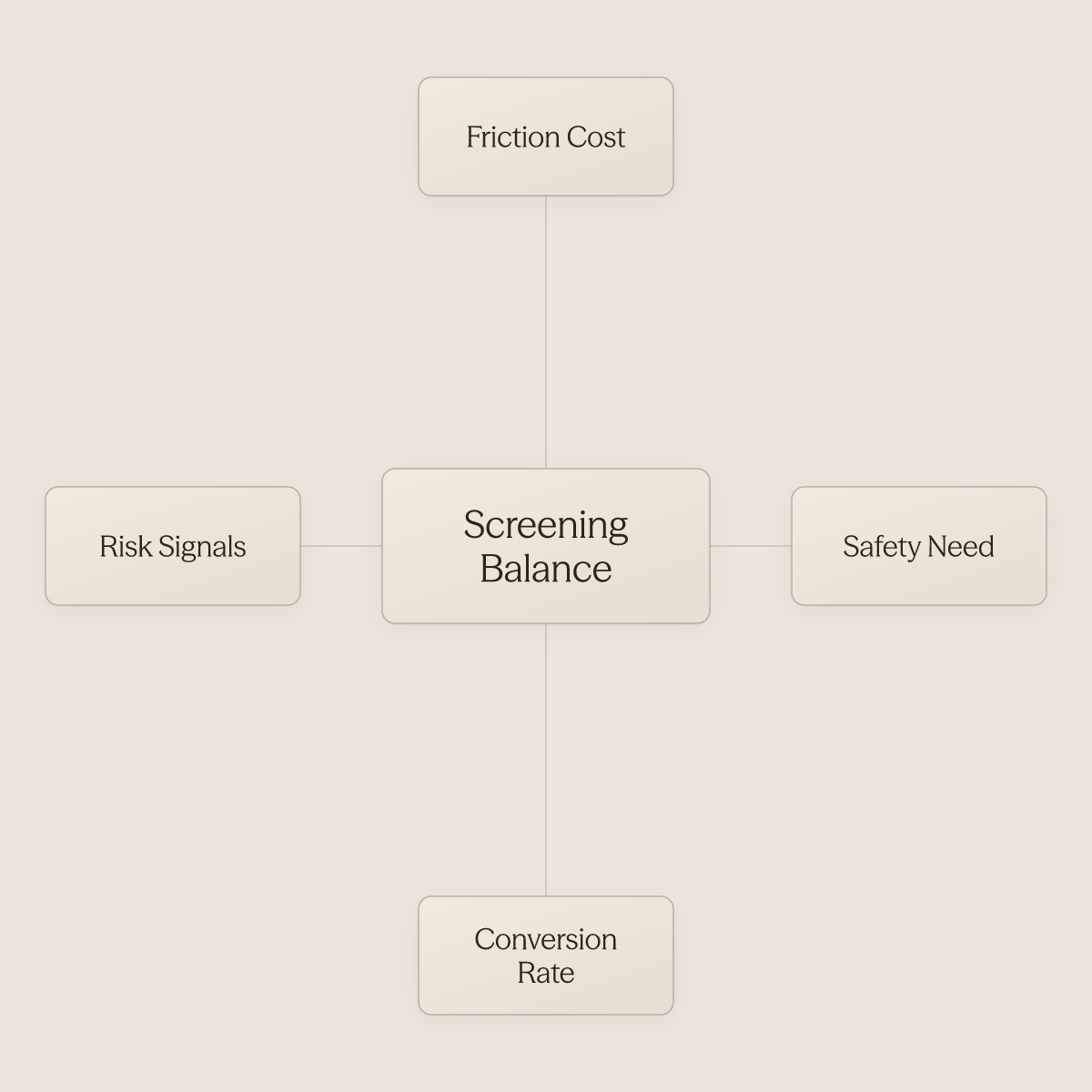
That friction-to-safety ratio sits at the center of every screening decision worth making.
Here is a hard truth most property managers learn too late: the screening process that protects your property and the communication flow that converts inquiries are not naturally at odds. They only feel that way when every booking request lands in the same human inbox, gets the same scrutiny, and waits the same time for a response. That uniform treatment is where the real cost hides.
How Blanket Pre-Booking Requirements Drive Away Good Guests
Airbnb's own help documentation notes that adding too many pre-booking requirements reduces the pool of eligible guests and lowers booking rates. A five-question pre-booking form sent to every inquiry does not filter by risk; it filters by patience. Good guests with options move to the next listing.
The guests most willing to answer extensive questions are often those with the fewest alternatives. There is a subtler problem underneath the obvious one. Hosts who manage properties commercially regularly encounter low-key red flags, a last-minute booking request, a late-night arrival window, a vague message about group size, that create genuine uncertainty about whether to accept or decline.
These signals are not loud enough to justify a full interrogation of every guest, but they are real enough that ignoring them feels reckless. The friction lands on everyone equally because the questions arrive before the host knows anything meaningful about who is asking. Screening should respond to signals, not precede them.
Compounding this: Airbnb blocks contact information until a booking is confirmed, making it structurally impossible to initiate a formal background check before being legally locked into the reservation. That platform constraint means the only leverage operators have is in reading pre-booking message signals correctly and routing them to the right response tier, fast.
The Three-Tier Response Framework - Automate the Majority, Escalate the Signals That Matter
A tiered pre-booking communication workflow matches the level of scrutiny to the level of observable risk. Tier one covers clean-signal inquiries: verified ID, positive review history, clear trip purpose, lead time matching the platform average. These get an immediate, warm acknowledgment that moves the booking forward without delay.
Tier two catches amber signals, a local guest booking a nearby property with no stated purpose, a profile created the same week as the inquiry, or a vague message about group size. Only these inquiries receive a targeted follow-up question. Tier three, genuine red flags, goes to a human decision-maker immediately.
Most inquiries never require human attention, and the ones that do get it faster because the queue is not clogged with routine messages. Conduit's AI Agents are trained directly on your existing SOPs, FAQs, and property manuals, so the routing logic and guest-facing communication reflect the standards you have already documented, not a generic template. The first automated guest reply goes live days after connecting those materials, and the agent responds continuously: before, during, and after a stay, whenever a guest sends a message.
Because Conduit integrates with tools like Notion, Google Drive, and Airbnb directly, that documentation does not need to be manually re-entered, the agent draws from what already exists. The result is standardized guest communication quality and brand voice held consistent across every property in a distributed portfolio, without requiring a human to personally enforce it on each exchange.
Why the Tiered Framework Becomes Non-Negotiable at 10-Plus Properties
At three properties, a sharp operator can hold the screening logic in their head. At fifteen, that same operator makes inconsistent calls because volume compresses time per inquiry. Operators who have documented their manual screening workflows consistently report that even experienced staff spend several minutes per inquiry on routine message-handling, meaning a high-volume portfolio absorbs meaningful staff capacity on communication that carries no elevated risk signal, before a single high-risk booking is ever identified.
Operations running large portfolios can handle the vast majority of guest interactions automatically and near-instantly using Conduit's AI for hospitality platform, preserving human screening capacity entirely for amber- and red-signal bookings where judgment actually changes the outcome. For operators managing a significant number of properties, that is not a convenience; it is the structural condition that makes consistent screening possible. Keeping that operation coordinated across guests, cleaners, contractors, and owners, without the portfolio manager sitting inside every thread, is where Conduit's Inbox and Workflows become load-bearing.
Workflows trigger after defined events in the guest lifecycle: after a booking is confirmed, after check-in, or when a specific keyword is detected in a message. That means the same system that routes a pre-booking amber signal to a human reviewer also handles the post-check-in coordination message without anyone manually queuing it. The operations or support team monitors all of this through the Inbox on an ongoing basis, reviewing and adjusting what the AI agent handles as the portfolio's needs evolve, including adding a custom rule that changes how the agent responds the same day a new pattern is identified.
The deeper insight here is that OTA platforms penalize screening depth by design: the same platforms that offer verification and review tools use response speed as a ranking proxy, meaning any manual, judgment-based screening workflow that adds per-inquiry delay directly erodes search visibility and future booking volume. The structural fix, automated acknowledgment that satisfies platform response-speed signals while a risk-routing layer handles the actual screening, means operators no longer have to choose between ranking visibility and screening depth. Both are achievable when the workflow separates the acknowledgment from the evaluation.
Building a Screening System That Scales - From Gut Instinct to a Repeatable Workflow
Screening one or two listings on instinct works until it doesn't, and the moment you distribute that instinct across a team or a growing portfolio, the inconsistency becomes structural rather than personal. What follows replaces that instinct with a documented, five-stage workflow where every decision has a pass/fail condition and the first three stages require no human involvement at all. That shift is what makes consistent outcomes possible regardless of who opens the inbox.
Why Manual Screening Breaks Down at Portfolio Scale
The breakdown isn't a discipline problem. It's a structural one. Airbnb's platform defaults were built for the owner-operator managing one or two listings, not the professional running 30.
When gut-feel screening gets distributed across a team, the variance in outcomes becomes indistinguishable from having no screening standard at all. Based on what we consistently see in professional host communities, inconsistency emerges not from carelessness but from the absence of a documented decision rubric that any team member can execute the same way, every time. Volume compounds the problem fast.
A shared framework isn't optional at scale. It's the only thing that keeps outcomes consistent.
The Five-Stage Screening Workflow That Replaces Gut Instinct
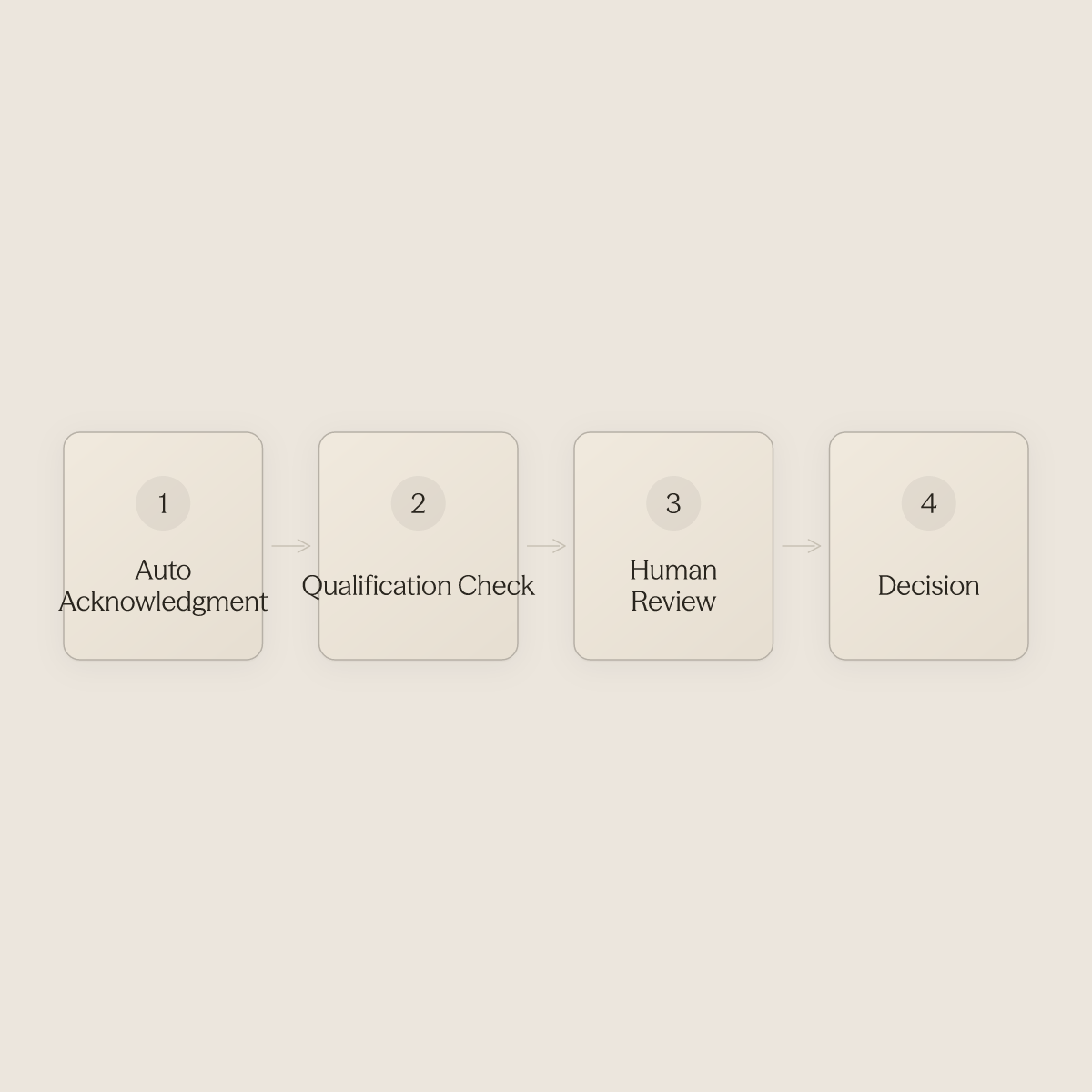
A repeatable screening workflow converts tacit host knowledge into an auditable decision chain. The five stages run in sequence:
- Automated acknowledgment within one minute of inquiry
- Qualification questions triggered by profile completeness signals
- House-rule delivery with a read-receipt prompt
- Risk scoring based on response pattern, message tone, and trip purpose
- Human review reserved for bookings that score above a defined risk threshold
Each stage has a documented pass/fail condition. No stage depends on who opened the inbox. Stages one through three require no human judgment at all. Automating them frees your team to focus entirely on stages four and five, where actual judgment adds value.
Where AI Coordination Sits in the Workflow
AI coordination handles the mechanical majority: routing the acknowledgment, triggering the qualification sequence, delivering house rules, and flagging risk signals for human review. It is not making the accept/reject call. AI for hospitality platforms are most beneficial when a business has recurring, predictable guest touchpoints that currently require manual staff action, precisely stages one through three, where the cost of inconsistency is highest and the value of human judgment is lowest.
The Escalation Trigger Framework
Escalation triggers must be written down before the next inquiry arrives. Conditions that should trigger escalation include: a guest with zero reviews booking a high-value weekend; a local guest booking a property close to their listed home address; any message requesting an exception to a stated house rule; and any response that omits a direct answer to a trip-purpose question. These are documented conditions any team member can identify without experience. The honest trade-off: for a one-person operation with three listings, the overhead of maintaining a five-stage documented workflow may outweigh the benefit, a lighter manual checklist and Instant Book filters handle that volume adequately. The five-stage system earns its keep when volume, team size, or portfolio complexity makes inconsistency the primary risk.
Building the Feedback Loop That Improves the System Over Time
A screening workflow that never updates is a workflow that slowly stops working. Guest behavior patterns shift, platform demographics change, and the risk signals that predicted problems eighteen months ago may no longer be the ones that matter today. The feedback loop closes the gap between what the system was built to catch and what it actually needs to catch right now.
The mechanism is straightforward: every booking that produces a negative outcome, a damage claim, a noise complaint, an early checkout dispute, gets traced back to its screening record. Which stage passed it through? Which trigger failed to fire?
That answer gets folded into the documented rubric before the next review cycle. Positive outcomes matter equally. When a zero-review guest books, checks in without friction, and leaves a five-star review, that data point recalibrates the risk weight assigned to review count.
The workflow is not a policy document filed once. Teams running this loop quarterly find that their stage-four risk scoring tightens considerably within two to three review cycles, reducing the volume of bookings that require stage-five human escalation and compressing the total time cost of screening without reducing its accuracy.
Related Reading
- Lodgify Competitors
- Vrbo Automated Messages
- Guesty Alternatives
- Lodgify Vs Smoobu
- Guesty Vs Hostfully
- Ownerrez Vs Guesty
- Hospitable Vs Hostaway
- Guesty Vs Hostaway
- Guesty Vs Hospitable
Next steps
If your screening process still depends on reading every inquiry carefully and trusting the judgment of whoever opens the inbox first, the path forward starts with converting that tacit knowledge into a documented decision workflow that runs the same way every time. Start with our AI for hospitality.
Airbnb's verification badge is a process receipt, not a trust signal, which means the gap between what the platform confirms and what you actually need to know falls entirely on your communication workflow to close. And because OTA platforms use response speed as a ranking proxy, any manual screening process that adds per-inquiry delay directly erodes search visibility alongside booking volume. Together, these two realities point to the same structural fix: automated acknowledgment that satisfies platform speed signals while a risk-routing layer handles the actual screening, so your team applies judgment only where it changes the outcome.
Start with conduit.ai to see how it routes routine guest communication automatically, escalates genuine risk signals to your team, and holds screening quality consistent across every property in your portfolio.
Frequently Asked Questions
Does Airbnb's verified ID badge actually tell me who my guest is?
No. The badge only confirms that a submitted government ID was matched to the account profile, Airbnb does not share the guest's legal name, ID number, or the underlying document with you before a booking is confirmed. It signals that a guest cleared Airbnb's minimum floor, not that they're the right fit for your specific property.
What happens if I skip screening and just rely on Airbnb's built-in tools?
You're working with a platform-level risk floor designed to protect Airbnb at global scale, not a filter calibrated to your specific property. First-time bookers arrive with no reviewable behavioral history at all, and the guests most likely to cause damage are often the ones who haven't caused documented damage anywhere yet, so the built-in tools won't catch them.
How do I screen guests coming through Vrbo or direct booking channels, not just Airbnb?
The post points out that hosts compensate for platform screening gaps through manual pre-screening outreach across Airbnb, Vrbo, and direct channels simultaneously, and that volume compounds into a significant operational bottleneck. Running that pre-screening communication consistently across all platforms at once is exactly the kind of burden an AI Agent, trained on your property's SOPs, is built to handle.
Which red flag combination should make me most suspicious of a party booking?
The post identifies a local guest booking a nearby property for a two-night Friday stay as a classic party-risk pattern, and notes it becomes most actionable when it combines with other flags like a new account, a same-day request, or a vague trip purpose. Catching that combination requires reading multiple data points in parallel across all your listings and platforms at the same time.
Can I automate the pre-screening questions I send to every new inquiry?
Yes. The post describes training an AI Agent on your existing house rules and screening SOPs so it sends the first qualifying question automatically the moment an inquiry arrives, before you've even opened the thread. This ensures every guest receives the same structured questions in the same order every time, removing the human variability that causes inconsistent screening at scale.
Stay in the loop
Get the latest on AI automation, product updates, and customer stories.

