Vacation Rental Operations Services That Maximize Revenue


Vacation Rental Operations
Services That Maximize Revenue
Vacation rental operations is not a checklist. It is five interdependent systems running at once, and understanding how they break is the only way to scale without breaking with them.
Most vacation rental property managers and operations leads believe that scaling guest communication quality requires proportionally scaling the human team responsible for it, more properties means more staff, and the best available lever is a basic PMS to keep everyone organized. That picture holds at two or three properties. It stops holding the moment your portfolio grows past ten.
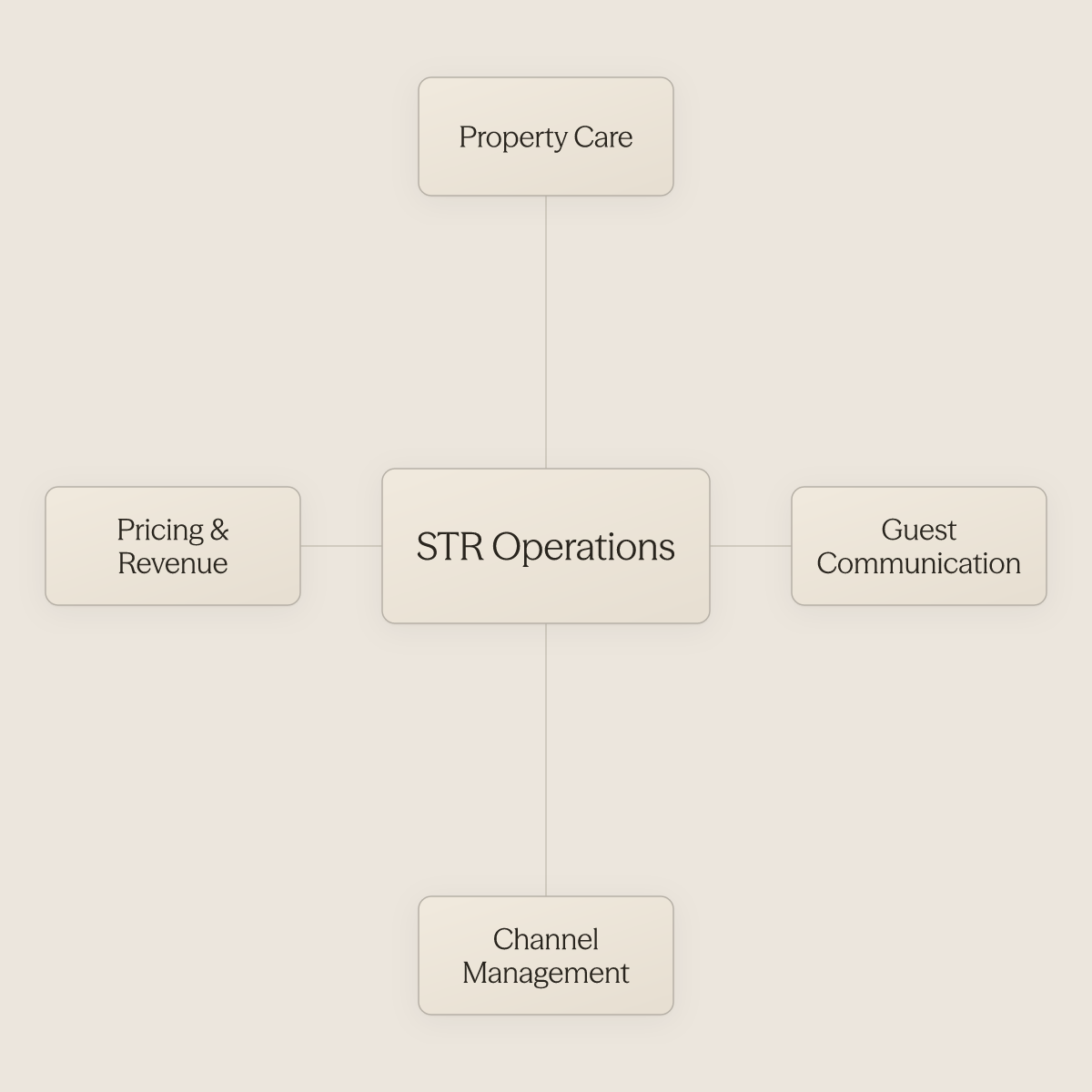
The truth is that vacation rental operations is a multi-layered system, not a to-do list. Every stay requires coordinated activity across property care, guest communication, OTA inventory management, pricing, and compliance, often simultaneously. Understanding that system is the difference between a business that scales and one that quietly breaks under its own weight.
See our AI for hospitality for how this works in practice.
Vacation rental operations covers every decision, workflow, and handoff required to run a short-term rental business from booking confirmation to post-stay review, spanning channels like Airbnb, Vrbo, and Booking.com, dynamic pricing, and revenue reporting. These aren't separate functions that happen to coexist, they are interdependent: a delayed turnover affects check-in timing, which affects the first guest message, which affects the review score, which affects future booking conversion. Short-term rental management requires five domains running in parallel: property care and turnover, guest experience and communication, channel and OTA inventory management, dynamic pricing and revenue strategy, and compliance and reporting. Calendar sync failures across OTAs produce double-bookings that damage host standing on every platform involved.
The difference between a 5-property portfolio and a 20-property portfolio isn't four times the work, it's exponentially more coordination surface. According to published operational benchmarking data, each property generates 2 to 4 hours of manual communication overhead per month without automation. At 20 properties, that compounds to 40 to 80 hours of recurring communication work every month, before a single unexpected issue, double-booking, or late-night lockout call enters the picture.
Key takeaways
- Scaling guest communication quality does not require scaling headcount, it requires a system that carries your operating knowledge so your team never has to reconstruct it from scratch on every shift.
- Cleanliness is the single most cited factor in negative short-term rental reviews, which means turnover logistics are not a back-office function, they are a direct driver of your review score and future revenue.
- The 15-property mark is where manual operations reliably break: routine inquiries, check-in questions, and maintenance flags multiply faster than any small team can absorb, especially outside business hours.
- Pricing tools and channel managers set a ceiling your operational foundation determines whether you actually hit, slow response times and thin review scores will drag occupancy below whatever rate your algorithm sets.
- Erwan Le Roy runs 35 properties with a 96% AI automation rate and sub-1-minute response times around the clock, proof that the bottleneck was never headcount.
- Conduit's AI-powered guest communication tools are what close the loop: they automate the repetitive, time-sensitive touchpoints that otherwise force operators to choose between hiring more staff and letting response quality slip.
Property Care and Turnover Logistics - The Operational Foundation Every Vacation Rental Needs
Property care failures are where five-star runs end. Cleanliness is consistently the number one factor cited in negative Airbnb reviews, a pattern documented across short-term rental guest feedback, and that single statistic reframes what turnover actually is. The property that photographs beautifully but arrives half-stocked, with a missed bathroom, or a pool filter that rattles all night will lose its rating before the guest even unpacks. No amount of polished communication recovers that.
The common assumption is that maintaining quality at scale requires proportionally scaling the human team responsible for it, with a basic PMS as the primary coordination lever. That assumption is wrong. Turnover is not a housekeeping task.
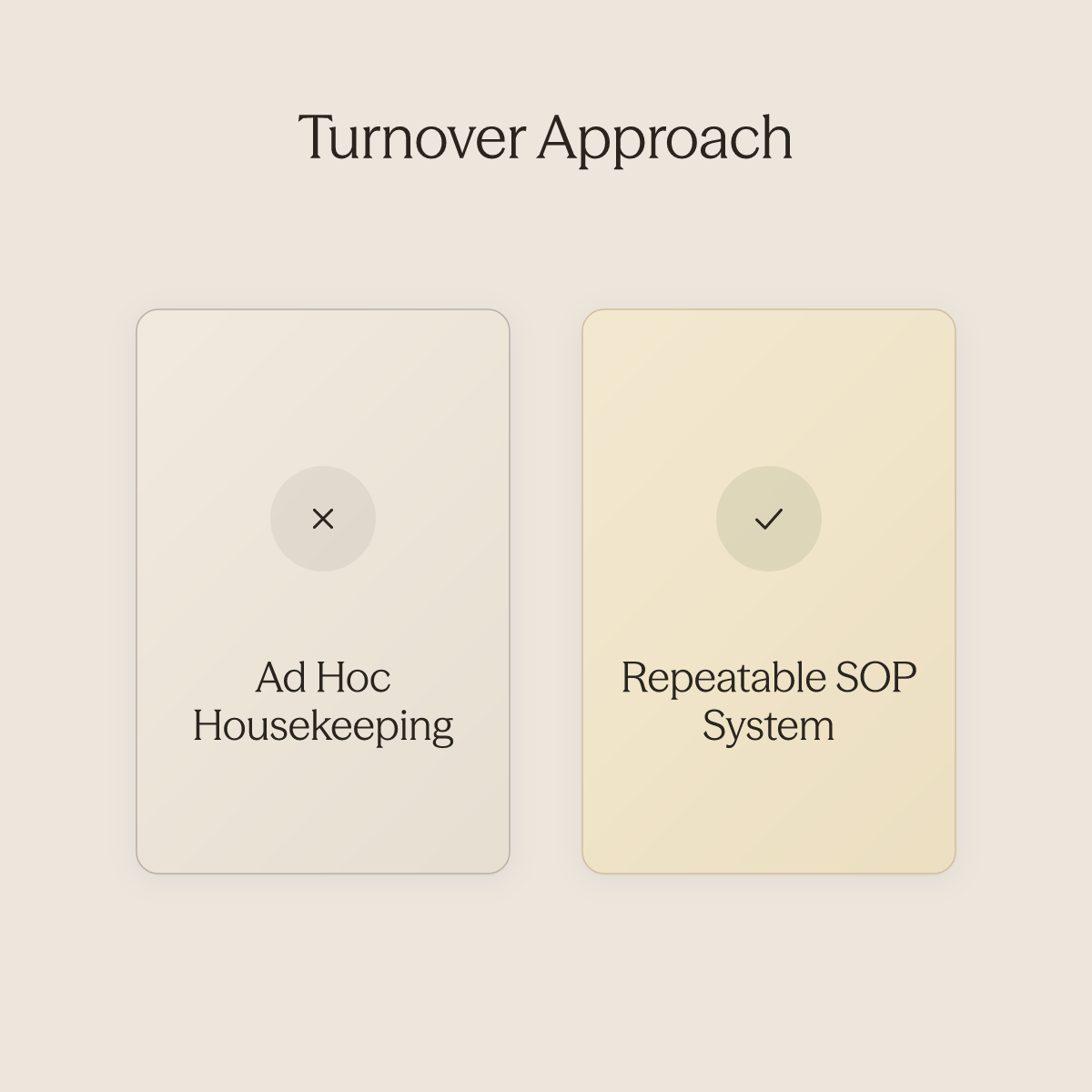
It is a repeatable production system, and the quality of that system sets a hard floor on every review score across the portfolio.
Housekeeping SOPs - The Floor, Not the Ceiling, of Your Review Score
Housekeeping SOPs are documented standards that define exactly how each room is cleaned, staged, and verified before a guest arrives. Without them, quality depends entirely on whoever showed up that day. A new cleaner, a rushed handoff, a substituted crew during peak season: any one of those variables introduces inconsistency, and inconsistency shows up first in guest reviews, not in your inbox.
One pressure point operators consistently underestimate is how little margin a turnover window actually contains. Hosts operating on 3–6 hours between checkout and the next guest check-in have almost no room for ambiguity in the SOP. A single unclear step, a crew member who interprets a task differently, or a missed detail like bedding layers costs the review rather than prompting a quick fix. Guest temperature preferences vary wildly: one guest finds the bed too warm, the next finds it under-layered.
The SOP has to anticipate that variability with explicit staging instructions, not leave it to crew judgment on a tight clock. Platforms like Breezeway are designed so that an operator or ops lead can connect existing docs, SOPs, property manuals, and staging guides without any IT or developer involvement, closing the gap between "SOP lives in a Google Drive folder" and "every crew member is working from the same current standard" in days, not quarters.
AI Agents are most beneficial precisely when a business has existing documentation to train the agent on, meaning the SOPs you've already built become active infrastructure rather than static files. Integrations with tools like Notion and Google Drive mean those updates propagate without manual re-entry across the portfolio. Standardizing brand voice and SOPs across every property and every market is not an aspiration once you have the right connective layer.
It becomes a default operating condition.
Preventative Maintenance Schedules - Stop Failures Before Guests Find Them
Reactive repairs cost significantly more than scheduled ones. A preventative maintenance vacation rental schedule, covering HVAC filter changes, plumbing checks, and pool electronics inspections on a fixed calendar, converts unpredictable emergencies into budgeted line items. The guest who never notices a problem leaves a five-star review.
The guest who wakes up to no hot water leaves something else entirely. The operational breakdown risk is real and underappreciated. Management company transitions, the kind that leave properties unbookable for more than a week during peak season, including late June when nightly rates are at their highest, are among the most damaging events a portfolio can absorb, and they almost always trace back to a failure of documented process rather than a failure of individual effort.
When the outgoing team's tribal knowledge doesn't transfer, maintenance schedules are among the first things that fall through. Guests who experience the downstream effects of that gap are not forgiving. A preventative schedule that lives in connected, accessible documentation, rather than in someone's head or a spreadsheet only one person can find, is the structural answer to that fragility.
Post-Cleaning Photo Inspections - The Last Line of Defense Before a Guest Walks In
Photo-verified checklists dispatched to cleaning crews give managers the ability to confirm property readiness remotely, without placing an on-site supervisor at every unit. Structured quality inspections reduce guest-reported cleanliness and maintenance issues, directly limiting the negative review exposure that most commonly erodes portfolio-wide rating averages. The inspection workflow is most effective when the underlying checklist is itself standardized, which circles back to the SOP.
AI Agents trained on property-specific documentation ensure that the same source of truth driving inspection standards also drives automated guest communication: pre-arrival messaging, mid-stay check-ins, and post-stay follow-ups all reflect the same operational standards the cleaning crew is working from. Automated workflows trigger after events like booking confirmation or check-in, meaning the guest touchpoints that were previously manual staff actions run without requiring a team member to remember to send them, freeing that attention for the inspection itself. The result is a closed loop: consistent documentation, consistent preparation, consistent guest experience, consistent reviews.
Guest Experience and Front Desk Operations - What Vacation Rental Management Requires at Every Touchpoint
That second system is not a hospitality instinct problem. It is a coordination infrastructure problem, and the difference matters most when you are running 15 or more properties across multiple channels at the same time.
A lockout call carries a measurable consequence for review scores and repeat bookings. The instinct to solve this by adding headcount runs into a structural limit: the bottleneck is process architecture, not the capacity or quality of the people filling the roles. The "hire more people for better guest communication" model fails economically before operators reach 30 properties: manual guest messaging already consumes 2–4 hours per property per month without automation (across the market), and what most teams report consistently shows that response delays, not staff effort, are the primary driver of guest dissatisfaction, meaning proportional headcount additions multiply labor cost without resolving the underlying quality failure.
The failure is process architecture, not coverage.
Omnichannel Inquiry Response - Why the First Reply Wins the Booking
Response time is directly correlated with booking conversion rates, with faster replies producing significantly higher booking completion, fast response times can boost bookings by up to 116% for short-term rental operators. A guest comparing three listings will book the first one that replies, regardless of which property is objectively better. Every parallel channel, Airbnb, Vrbo, direct booking, and SMS, adds a separate queue that a manual team cannot drain consistently, especially overnight.
This is precisely where operators managing guest communications across multiple platforms simultaneously gain the most from Conduit's AI Agents and unified Inbox. The AI agent handles the high-volume, repetitive inquiry layer, the availability questions, the parking questions, the pet policy questions, continuously, before, during, and after a stay, on every channel at once. The operations team monitors and reviews conversations through a single Inbox rather than toggling between platform dashboards, which means no inquiry sits unanswered because it landed in the wrong tab at the wrong hour.
The quality concern operators raise first, "will guests notice they're talking to a bot?", is answered directly by the experience of Wynwood House. Mayra, their Global Head of Customer Experience, put it this way: *"The first thing we noticed was the quality of the AI replies.
You cannot tell the difference between an AI agent and a human agent. I work with ChatGPT and other AI tools every day, and sometimes you can immediately tell it's AI. With Conduit, we're not seeing that.
"* That conversation quality is what protects review scores and repeat bookings when the AI is carrying the load at scale. Critically, the AI agent does not require a content build from scratch. If the business already uses Notion, Google Drive, or Airbnb listings, Conduit's Integrations pull that existing documentation, SOPs, FAQs, house manuals, directly into the agent's knowledge base without manual re-entry.
The first automated guest reply typically goes live within days of connecting those materials.
Arrival Coordination Without a Human at the Door
116% Booking boost from fast response times
Contactless check-in has moved from a pandemic workaround to a guest expectation. Schlage smart locks paired with automated check-in messaging eliminate the physical key exchange entirely, removing dozens of manual touchpoints per week for a 20-property operator. Smart lock adoption correlates with higher guest satisfaction scores and measurably lower operational overhead, a pattern visible across the market, because the failure point, a lost key, a delayed host, a miscommunicated code, simply does not exist in the workflow anymore.
Conduit's Workflows extend that logic to every predictable arrival moment. After a booking is confirmed, after check-in occurs, or when a specific keyword appears in a guest message, a workflow fires the appropriate message automatically, without a staff member sitting in the thread. Guests, cleaners, contractors, and owners stay coordinated without a human manually brokering every exchange.
Delays at arrival touchpoints register with guests as a service failure even when every other element of the stay is flawless. Automating the predictable moments removes the delay entirely.
Digital Welcome Guides Replace the Printed Binder
A digital welcome guide does more than list the Wi-Fi password and restaurant recommendations. The vacation rental welcome guide becomes a self-service layer covering house rules, appliance instructions, parking details, and local recommendations, accessible on any device. When that content is also loaded into the AI agent's knowledge base via Conduit's Integrations, the guide stops being a static document and becomes a live resource the agent can draw on to answer guest questions in real time, consistently, at any hour, across every property. The reduction in inbound "how do I work the TV" messages directly frees the team for issues that actually need judgment, improving guest experience and review scores through timely, consistent communication without adding headcount to achieve it.
Listing and Revenue Operations That Maximize Vacation Rental Profitability
Pricing tools and channel managers are necessary but not sufficient. The yield your rate algorithm captures is a ceiling set by your operational foundation. A listing with slow response times, thin review scores, or content that undersells its amenities will underperform regardless of how precisely the nightly rate is calibrated, because occupancy, conversion rate, and review scores all feed the inputs that pricing models depend on.
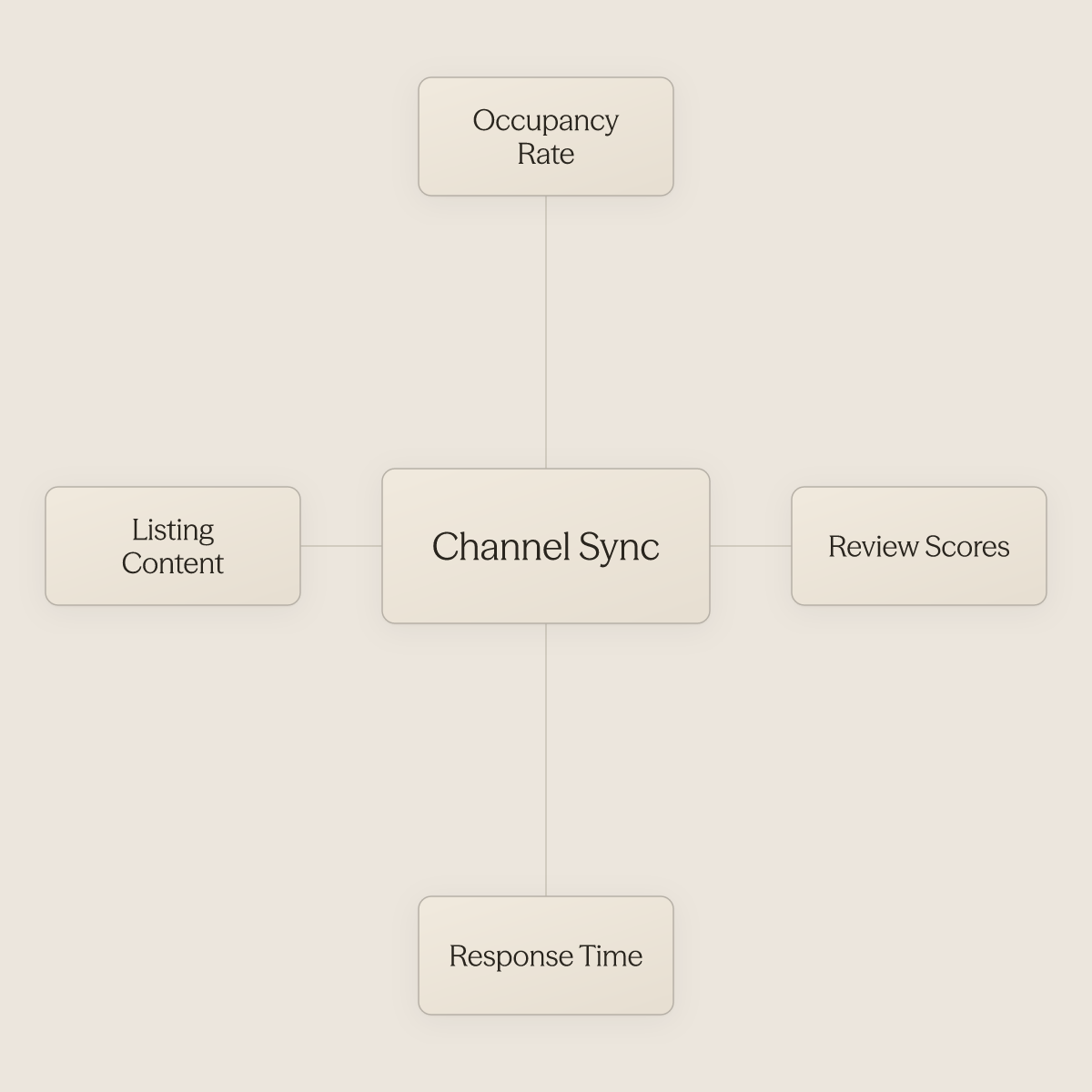
Channel Synchronization Prevents the Double-Booking Tax
Multi-channel distribution is the accepted best practice for maximizing booking volume, but each additional OTA multiplies the per-property communication load that already consumes 2 to 4 hours monthly per unit. One of the sharpest operational pressures vacation rental owners face is simply time: managing multiple OTA channels simultaneously, keeping calendars current, and fielding guest messages across platforms is a workload that quietly compounds until something breaks. Without centralized calendar sync updating in real time, a confirmed reservation on one platform can collide with an open window on another.
Property managers running simultaneous OTA listings without centralized calendar sync face meaningful double-booking exposure, and the downstream cost, covering a displaced guest, absorbing a penalty cancellation, and absorbing the review damage, far exceeds the commission savings from any single booking. This is precisely where AI-assisted inbox management changes the equation. ai's Inbox is most beneficial when you are managing guest communications across multiple platforms or properties simultaneously; the operations or support team uses it on an ongoing basis to monitor, review, and manage every conversation the AI agent handles, so nothing falls through the cracks between channels.
The first automated guest reply goes live within days of connecting your existing SOPs and manuals, meaning the system learns your operation and starts working before the next booking window opens. As Erwan Le Roy of Cash Flow Street puts it: "Right now you don't have an option anymore. We see a divergence of hosts now: the hosts that use AI and the hosts that don't use AI. If you compete human versus AI, I'm sorry, you lost the game. It's not an option anymore." Channel synchronization stops the double-booking tax; AI-managed communications stops the response-time penalty that follows.
Dynamic Pricing With PriceLabs and Wheelhouse
Right now you don't have an option anymore. We see a divergence of hosts now: the hosts that use AI and the hosts that don't use AI.
The best channel mix still leaves money on the table if nightly rates are set by gut feel or a static seasonal calendar. PriceLabs and Wheelhouse pull hyperlocal demand signals, event calendars, competitor occupancy, and booking lead times to adjust rates automatically. Operators relying on rule-based adjustments alone typically leave a meaningful share of achievable average daily rate unrealized during peak demand windows.
Dynamic pricing closes that gap most reliably when the property's review score is already strong enough to win the booking once the rate is right. Sustaining that review score depends on operational consistency that most owners cannot maintain manually at scale. ai's AI Agents are most beneficial when the business receives a high volume of repetitive guest or customer messages and already has documentation, SOPs, FAQs, and property manuals, to train the agent on.
Those agents run continuously, responding to guests before, during, and after a stay, so every inquiry gets a fast, accurate reply regardless of the time of day or how many properties are active. Faster responses and more consistent pre-arrival communication directly improve guest satisfaction scores, which are the same scores that determine whether your optimized nightly rate converts into a confirmed booking. Maximizing revenue per property by improving occupancy and guest satisfaction is not two separate goals; they are the same operational loop, and AI closes it without adding headcount.
Workflows extend this further. ai's workflow layer is most beneficial when the business has recurring, predictable guest touchpoints that currently require manual staff action. Each workflow fires after a trigger event in a conversation or guest lifecycle, after a booking is confirmed, after check-in, or when a specific keyword is detected, automating the follow-up sequences that keep guests informed and reviews positive.
The first custom rule that changes how the agent responds can go live the same day it is configured, which means operators can adapt messaging to demand-season nuances just as quickly as their pricing tools adapt rates.
Direct Booking Infrastructure Converts Commission Spend Into Owned Revenue
Booking.com charges hosts a meaningful per-reservation commission, and Airbnb's combined host and guest fees can reach 17 to 19% of total booking value. Operators who build even a modest direct booking channel, through a branded website, email capture at check-in, and repeat-guest incentives, convert a portion of that commission spend into owned revenue that compounds across every future stay. That direct channel only works if the guest experience it delivers matches or exceeds the OTA experience.
Ai's Integrations layer is most beneficial when the business already uses tools like Notion, Google Drive, or Airbnb and wants the AI agent to leverage existing content without manual re-entry. Property guides, house rules, and local recommendations that live in your existing documentation become the knowledge base the AI agent draws from, so direct-booking guests receive the same informed, responsive communication they would expect through any major platform. The result is a systemized, scalable business that does not depend entirely on owner involvement, one where the direct channel compounds in revenue value rather than collapsing under the weight of manual communication overhead.
The Technology Stack Essential for Vacation Rental Operations: and What Each Layer Actually Does
Most vacation rental operators don't fail because they chose the wrong tools. They fail because they don't have a clear picture of what each tool in their stack is actually built to do, where its architecture ends, and where a different layer needs to pick up. Understanding that distinction, particularly around where systems like a PMS genuinely excel and where they leave operational gaps, is what separates operators who scale cleanly from those who patch problems reactively.
Those five tools surface in almost every serious vacation rental tech conversation, yet the more useful frame is not which ones to add but what breaks when any single layer goes missing, and why that gap reliably forces humans to fill it by hand.
1. Property Management Software (PMS): The Central Command Layer
The vacation rental property management system is the operational spine. Platforms like Guesty centralize booking calendars, process payments, and route guest messages into a single inbox, while Hostfully layers digital guidebooks and pipeline management on top of core PMS functions. The core synthesis worth naming here: a PMS is the right center of gravity for reservations and accounting, that is exactly what it is built for, but operators who treat it as their primary communication backbone are leaving a measurable gap.
Fast response times are consistently linked to significantly higher booking conversion rates, and a PMS inbox is not architecturally designed to enforce the response timing and quality standards that drive those gains at scale. Operators relying on it as a communication backbone are leaving real revenue on the table.
2. Channel Manager - The Distribution and Calendar Sync Layer
A channel manager synchronizes your calendar across Airbnb, Vrbo, and Booking.com in real time. Without two-way sync, double-bookings become a near-inevitable outcome for any operator running three or more platforms simultaneously. A single calendar conflict triggers manual guest rebooking, a likely negative review, and a platform penalty that suppresses future listing visibility. For single-platform operators, this layer is optional. For anyone distributing across multiple OTAs, it is not.
3. Dynamic Pricing Engine - The Revenue Optimization Layer
A dynamic pricing engine evaluates local events, competitor occupancy, and seasonal demand signals to adjust nightly rates automatically. Operators using dynamic pricing tools commonly report meaningful revenue lifts compared to static rate strategies, with gains materializing primarily during high-demand compression periods that manual pricing consistently misses. The tradeoff is setup time: the tool is only as accurate as the market data and base-rate logic an operator feeds into it at the start.
4. Automated Guest Messaging Platform - The Communication Layer
Most operators assume templated auto-replies inside their PMS solve guest communication. They handle the easy 20%. The remaining volume is unscripted: mid-stay maintenance requests, early check-in negotiations, upsell moments, and noise complaints that templated logic cannot process, a breakdown pattern consistently observed across operator experience. This is where a dedicated guest communication platform closes the gap, handling the full conversational range across properties without requiring a human router for every thread.
5. Smart Home IoT Layer - The Physical Property Automation Layer
Smart home technology for vacation rentals includes remote digital access via smart locks, noise-monitoring devices, and automated thermostat controls. Together these tools reduce the physical touchpoints required per stay, give operators real-time visibility into property status without an on-site visit, and create a guest-facing experience that reads as premium without adding to staff workload.
Related Reading
- How To Automate Airbnb Business
- Vrbo Management
- Airbnb Self Check In
- Vacation Rental Automation
- Best Apps For Short Term Rentals
- Best Pms For Airbnb
- Best Pms For Short Term Rentals
- Best Accounting Software For Short Term Rentals
- How To Manage A Vacation Rental Property
- Vrbo Smart Pricing
Self-Managed vs. Outsourced Vacation Rental Management - How to Choose the Right Operating Model
The decision to self-manage or outsource a vacation rental portfolio looks straightforward: keep the revenue or keep your sanity. But that framing misses the actual variable. The real question is how much operational output your system produces per staff hour spent, not who technically signs the management contract.
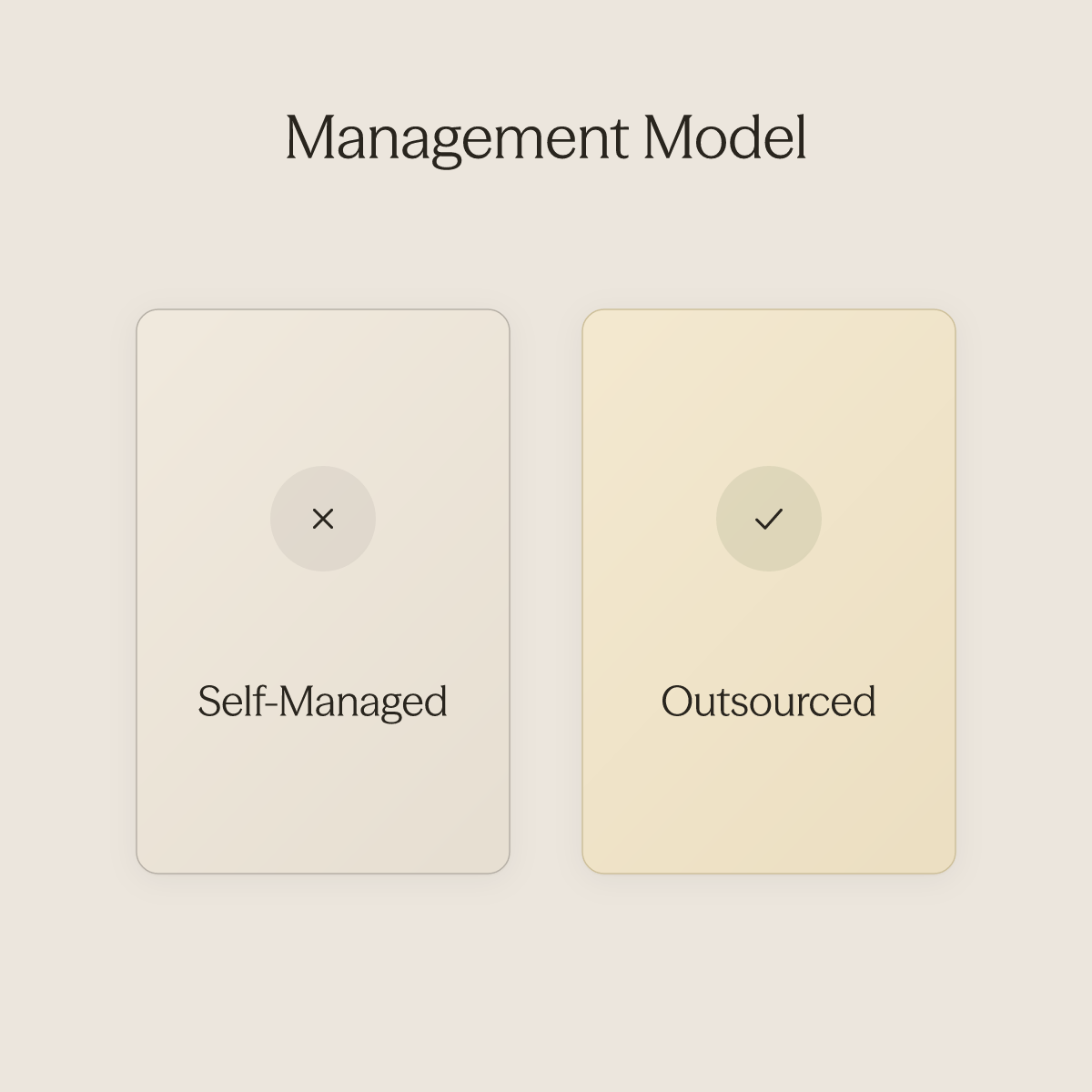
Self-Management Means 100% Revenue Retention and 100% of the Operational Weight
"Outsourced property management companies can make unilateral decisions, such as last-minute cancellations, that damage both guest experience and owner reputation, exposing a key risk of outsourcing control."
Self-managed vacation rental operators keep every dollar of booking revenue and maintain direct control over guest screening, cleaner selection, and vendor relationships. According to Vacasa's homeowner guides, that control comes with a straightforward trade: the owner absorbs every operational responsibility personally. At two or three properties, that trade feels manageable.
At ten or fifteen, the coordination load compounds faster than most operators expect, and the hours required to sustain response quality start to eat into the margin advantage the model was supposed to protect. The communication burden alone is underestimated. Guest messages arrive across Airbnb, Vrbo, direct booking channels, and SMS simultaneously, often asking the same questions about check-in codes, parking, or early arrivals.
Managing that inbox manually across multiple platforms or properties is where self-management begins to quietly break. Noel Poler, a multi-property operator, cycled through multiple support models, including Jurny's PMS and call center service, plus other hospitality call services, spending up to $4,000 per month, and still faced guest wait times of up to 57 minutes, mounting refunds, and found himself personally answering questions on Slack. The infrastructure cost was real; the passive income was not.
Ai's AI Agents and Inbox are most beneficial when a portfolio reaches the point where guest communications span multiple platforms or properties simultaneously. The AI Agent handles the high volume of repetitive incoming messages, check-in questions, parking instructions, house rules, drawing on existing SOPs, FAQs, and manuals the operator already has. The first automated guest reply can go live within days of connecting those documents.
The Inbox then gives the operations team a single place to monitor, review, and manage every conversation the agent is handling, so nothing falls through without human visibility.
What Outsourced Firms Like Vacasa and AvantStay Actually Charge
Outsourced property management transfers the daily operational burden to a full-service firm in exchange for a commission. Vacasa's published guidance puts the industry range at 10 to 40 percent of gross booking revenue. AvantStay's fees run 25 to 35 percent of gross revenue, according to Rove Travel's 2026 analysis.
The problem is that OTA commissions already extract a significant share of gross revenue before a single operational cost is counted. Stack a 25 to 35 percent management fee on top, and an operator surrenders a substantial majority of gross revenue to solve what is, at its core, a systems problem. Beyond the fee math, outsourcing introduces a control risk that the revenue numbers don't capture.
When a full-service management company makes a unilateral operational decision, such as a last-minute cancellation, the damage lands on the owner's listing: a scarred review record, a guest who won't return, and a reputation the owner had no hand in protecting. The management company absorbs none of that long-term cost. The operator does.
The False Binary - Why Self-Managed vs. Outsourced Is the Wrong Question
The real variable is operational leverage, not the label on the management relationship. A self-managed portfolio running on documented, automated workflows can outperform an outsourced arrangement on both revenue retention and guest satisfaction. Outsourcing is still the right call when an operator lacks the system infrastructure to absorb volume, not because it is inherently better, but because the alternative is a disorganized guest experience that damages review scores faster than any management fee compounds.
The path out of the binary is building infrastructure that makes the outsourcing decision optional rather than necessary. Ai's Workflows address this directly: they are most beneficial when a portfolio has recurring, predictable guest touchpoints that currently require manual staff action, booking confirmations, check-in instructions, post-stay follow-ups. A workflow fires automatically after a trigger event in the guest lifecycle, such as a confirmed booking or a detected keyword in a message thread, without a staff member needing to initiate anything.
Ai's Integrations let the AI agent pull from that existing content without manual re-entry, so the system is informed by documentation the operator has already built. The result is a self-managed operation that responds like a staffed one, at a fraction of the cost, and without surrendering the revenue margin or the control that outsourcing would require.
The Operational Ceiling Most Growing Portfolios Hit: and the System That Breaks Through It
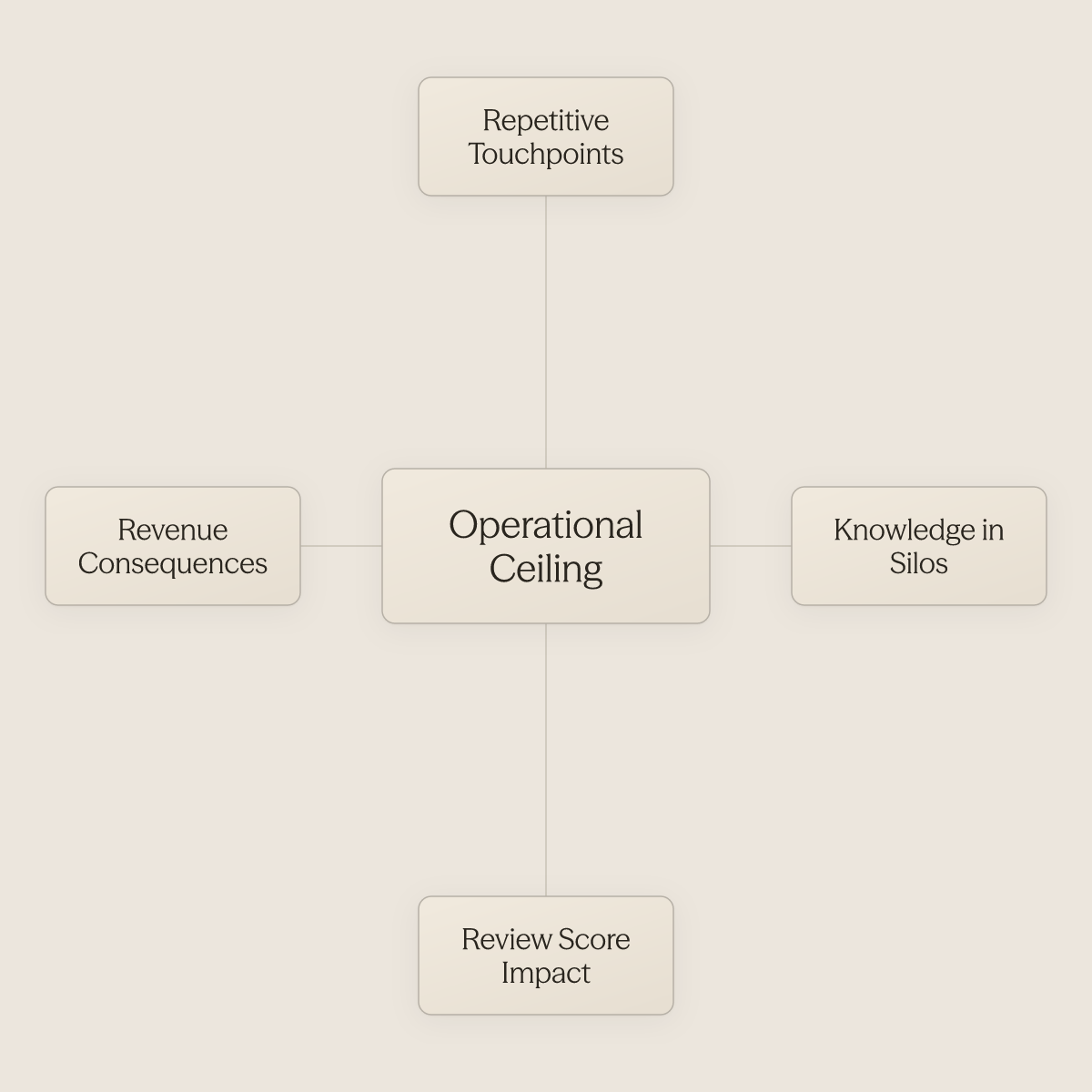
At a certain portfolio size, the way most operators run their business stops working, not because the team isn't capable, but because the underlying system was never built to scale. The pressure point shows up in two places: the volume of repetitive guest touchpoints that compound with every new property added, and the inconsistency that creeps in when the knowledge needed to handle those touchpoints lives in people's heads rather than in a reliable process. Both problems have measurable consequences for review scores and revenue, and both are exactly what Conduit is built to solve.
Why the 15-Property Mark Is Where Manual Operations Break
The math turns against you faster than it feels like it should. Each property generates a steady stream of routine guest inquiries, check-in questions, and maintenance flags every month. Multiply that across 15 properties and a small team is fielding hundreds of repetitive touchpoints, most arriving outside business hours.
Operators managing guest communications across multiple platforms simultaneously feel this acutely. The same question lands from Airbnb, a direct booking channel, and a third OTA in the same hour, each requiring a manual response pulled from someone's memory or a buried Notion doc. The volume isn't the only problem. The real problem is that the knowledge required to answer those touchpoints correctly lives inside individual team members, not inside a system.
When that person is off shift or overwhelmed, the quality of every response becomes a coin flip. This is the operational ceiling that scales poorly with door count. It is not a people problem in the ordinary sense; it is a knowledge-routing problem that compounds with every door added to the portfolio.
Inconsistent Guest Responses as a Silent Review-Score Eroder
Inconsistency is the quietest revenue leak in short-term rental operations. A guest who receives a fast, accurate answer books with confidence and leaves a five-star review. A guest who waits 40 minutes for a vague reply writes a 3-star note about "communication issues."
Industry data on AI-driven guest communication tools, including operator benchmarks published by StayFi, documents automation rates as high as 96% with response times under one minute, around the clock. The gap between that benchmark and a manually routed inbox is not a staffing gap. It is a systems gap.
Conduit's AI Agents are most beneficial precisely in this scenario: when a business receives a high volume of repetitive guest messages and already has existing documentation, SOPs, FAQs, property manuals, that can train the agent. The first automated guest reply can go live within days of connecting those materials. From that point forward, the agent responds continuously, before, during, and after a stay, without requiring a team member to be on call.
The False Binary - Hire More Staff or Let Quality Slip
The default response to hitting this ceiling is to hire. In practice, adding headcount to a workflow where operating knowledge lives in people's heads doesn't raise the ceiling; it replicates the same fragile dependency at greater expense. A growing portfolio can scale without proportionally increasing headcount, but only when the knowledge that drives responses is embedded in the system rather than distributed across individuals. That distinction matters most for operators building toward an exit or a valuation event, where labor-to-revenue ratios are scrutinized directly. The goal is not to eliminate the coordination headcount entirely; it is to eliminate the bottleneck of around-the-clock guest communication as something that requires constant human intervention.
Related Reading
- Lodgify Competitors
- Vrbo Automated Messages
- Guesty Alternatives
- Lodgify Vs Smoobu
- Guesty Vs Hostfully
- Guesty Vs Hospitable
- Ownerrez Vs Guesty
- Hospitable Vs Hostaway
- Guesty Vs Hostaway
Next steps
If your portfolio has outgrown the hours available to manage it manually, the path forward starts with recognizing that the bottleneck is process architecture, not headcount. Start with our AI for hospitality.
The "hire more people for better guest communication" model fails economically before operators reach 30 properties, where manual messaging already consumes 2 to 4 hours per property per month without resolving the underlying quality failure. That means adding staff replicates the fragile dependency at greater cost. At the same time, operators who outsource to escape that weight may be surrendering 25 to 35 percent of gross revenue to solve what is, at its core, a systems problem. Together, those two realities point to the same next step: building communication infrastructure that carries operational knowledge without requiring a human router at the center of every exchange.
Start by exploring conduit.ai's AI Agents and Workflows to see how they connect to the SOPs and manuals you already have. The operators who break through the 15-property ceiling are the ones who stopped treating guest communication as a staffing problem and started treating it as a system design problem.
Frequently Asked Questions
Why does a missed cleaning slot cause so much damage beyond just a dirty room?
A delayed turnover creates a chain reaction across the entire stay: it pushes back check-in timing, which triggers an unanswered guest message, which can become a one-star review if no one responds by 11 p.m. The five operational domains, property care, guest communication, channel management, pricing, and compliance, are interdependent, so a failure in one ripples through all the others.
What should a housekeeping SOP actually include to hold up during a busy season?
A housekeeping SOP needs to define exactly how each room is cleaned, staged, and verified before a guest arrives, specific enough that a new or substituted crew member can execute it consistently without interpretation. It should anticipate variables like guest bedding preferences with explicit staging instructions rather than leaving those details to crew judgment on a tight turnover clock.
Is a preventative maintenance schedule really worth the effort, or is reactive repair just easier to manage?
Reactive repairs cost significantly more than scheduled ones, and guests who experience the downstream effects, like waking up to no hot water, are not forgiving in their reviews. A preventative schedule covering HVAC filters, plumbing checks, and pool electronics on a fixed calendar converts unpredictable emergencies into budgeted line items, and the guest who never notices a problem is the one who leaves a five-star review.
How do post-cleaning photo inspections actually work in practice for a growing portfolio?
Photo-verified checklists are dispatched to cleaning crews so managers can confirm property readiness remotely, without placing an on-site supervisor at every unit. The inspection checklist works best when it is grounded in the same standardized SOP the crew is already working from, creating a closed loop where consistent documentation drives consistent preparation and consistent guest reviews.
At what point does manually handling guest messages across multiple OTA channels stop being manageable?
The post cites published benchmarking data showing that each property generates 2 to 4 hours of manual communication overhead per month without automation, at 20 properties, that compounds to 40 to 80 hours of recurring communication work every month before a single unexpected issue enters the picture. Every additional OTA channel adds a separate message queue a manual team cannot drain consistently, especially overnight, which is why the bottleneck is process architecture rather than staff effort.
Stay in the loop
Get the latest on AI automation, product updates, and customer stories.

