How to Maximize Your Hotel Revenue: 10 Smarter Guest Strategies


Maximize Your Hotel Revenue
Maximize your hotel revenue
Balancing occupancy rates, pricing strategies, and guest satisfaction is a daily reality for hotel operators, and the margin for error is slim. The right approach to revenue management combines dynamic pricing, smart upselling, and disciplined distribution channel management to move beyond guesswork and drive consistent growth.
Technology has made this significantly more accessible. Tools built around AI communications for hotels analyze booking patterns, guest behavior, and market demand to surface opportunities that manual review often misses. Operators no longer need a data science background to make informed, timely decisions about rate adjustments or ancillary revenue. For hotels ready to put data to work, AI for hospitality offers a practical starting point.
Table of Contents
- Why Increasing Hotel Revenue Is Becoming More Difficult
- Understand Where Hotel Revenue Actually Comes From
- 10 Strategies to Maximize Hotel Revenue Throughout the Guest Journey
- Why Operational Bottlenecks Limit Revenue Growth
- Why Guest Experience and Revenue Growth Go Hand in Hand
- How Conduit Helps Hotels Maximize Revenue Across the Guest Journey
- Book a Demo to See Conduit's AI for Hospitality Customer Service in Action
Summary
Hotel operating expenses rose approximately 4% in 2025, according to CBRE Trends in the Hotel Industry, outpacing revenue growth in the same period. U.S. hotel RevPAR grew only 1.4% that year, well below the pace needed to offset expense inflation.
This gap confirms that filling rooms at a steady rate is no longer enough to protect margins, and that properties that rely on occupancy as their primary performance signal are measuring the wrong thing.
OTA commissions typically run between 15% and 30% per reservation, meaning a large share of booking revenue disappears before operations even begin. Repeat guests, by contrast, spend 67% more than new guests according to RateGain, and a 5% increase in guest retention can boost profits by 25% to 95%. The math strongly favors shifting the focus from volume-based acquisition to retention and direct-booking strategies.
Pre-arrival communication is one of the most underused revenue windows in the guest journey. Pre-arrival upsell emails achieve open rates of up to 60%, roughly three times the average marketing email benchmark, according to the Oaky Blog. That level of attention exists because guests have already committed to the stay and are actively thinking about their experience, making the 48-to-72 hours before arrival the highest-conversion window for upgrade offers, packages, and ancillary services.
Review scores have a direct and measurable connection to pricing power. A 1-point increase in a hotel's review score can lead to an 11.2% increase in average daily rate, according to the inHotel Blog. This means the quality of service delivered during one stay shapes the rates a property can command in future ones, and guest satisfaction functions as a revenue strategy, not just a hospitality goal.
Operational bottlenecks quietly eliminate revenue before staff is even aware the opportunity existed. Research from LinkedIn's analysis of strategic planning frameworks found that leaders spend over 20% of their workday approving routine exceptions rather than making strategic decisions. In hotels, this pattern appears as delayed upgrade responses, stalled room status updates, and inquiries that land in the wrong inbox, each one small but collectively representing a consistent drag on ancillary revenue capture.
Ancillary revenue categories outside rooms, including food and beverage and other operated departments, represent the area of the business where margin improvement is most achievable in the current environment. Properties that measure only RevPAR and miss total revenue per available room are leaving an entire layer of performance unmanaged.
AI for hospitality helps teams run proactive guest communication workflows across email, WhatsApp, and OTA messaging so that dining, spa, and upgrade opportunities reach guests at the right moment rather than depending on staff availability.
Why Increasing Hotel Revenue Is Becoming More Difficult
Rising costs are the first wall most operators hit. According to CBRE Trends in the Hotel Industry via LODGING Magazine, hotel operating expenses rose 4% in 2025, growing faster than revenue. You can fill every room and still lose money if the cost of running those rooms climbs faster than your room rates.
"Hotel operating expenses rose approximately 4% in 2025, outpacing revenue growth and squeezing operator margins across the board." — CBRE Trends in the Hotel Industry via LODGING Magazine, 2025
🚨 Warning: A high occupancy rate does not guarantee profitability. If your operating costs rise faster than your room rates, you're moving backward even when fully booked.

Guest acquisition costs make the problem worse. Most hotels rely on online travel agencies for bookings, with OTA commissions typically running between 15% and 30% per reservation. Filling rooms through OTAs can feel like progress while quietly reducing how much profit you make from each stay.
| Booking Channel | Typical Commission Rate | Impact on Profit |
|---|---|---|
| OTA (e.g., Booking.com, Expedia) | 15% – 30% per reservation | Significant margin erosion |
| Direct Booking (hotel website) | 0% – low processing fees | Maximum profit retention |
| GDS / Travel Agents | 10% – 15% | Moderate cost |
🔑 Takeaway: When OTA commissions consume up to 30% of every reservation, a hotel can be technically full while remaining financially strained — making direct-booking strategies not just preferable but essential for long-term profitability.
How does labor pressure create hidden revenue leaks?
Labor pressure creates problems beyond payroll costs. Understaffed teams respond slowly to guests and miss revenue opportunities: delayed upgrade offers, unanswered dining questions, and forgotten late-checkout requests. These missed moments accumulate into steady revenue loss that price increases cannot offset.
Most teams try to fix this by asking staff to do more with less, but guests notice the friction before operators do. By the time it shows up in review scores or repeat booking drops, the damage is already done. AI for hospitality solves this by automating guest communication across all channels, enabling proactive outreach about upgrades, dining, and ancillary services on schedule.
Why is incremental rate growth no longer enough to close the gap?
The deeper issue is structural. According to CBRE's Trends in the Hotel Industry, as reported in LODGING Magazine, U.S. hotel RevPAR grew only 1.4% in 2025, far below the growth needed to offset rising costs. Small rate increases alone cannot solve this problem. Long-term revenue growth now depends on extracting value from every touchpoint of the guest experience, not just room bookings.
Understand Where Hotel Revenue Actually Comes From
Room revenue is the foundation, but not the whole building. According to CBRE's Trends in the Hotel Industry, as reported in LODGING Magazine, room revenue accounts for the largest share of total hotel revenue, with food and beverage and other operated departments making up the rest. Departments outside rooms are where margin improvement is most achievable right now.
"Departments outside rooms are where margin improvement is most achievable right now." — CBRE Trends in the Hotel Industry via LODGING Magazine
| Revenue Department | Role in Total Revenue | Margin Opportunity |
|---|---|---|
| Rooms | Largest share | Foundational — already optimized |
| Food & Beverage | Secondary contributor | High improvement potential |
| Other Operated Departments | Remaining share | Greatest untapped margin gains |
🔑 Takeaway: While room revenue dominates the top line, the real opportunity for profit growth lives in F&B and ancillary departments — where costs are controllable and gains are immediately impactful.
💡 Tip: If your hotel is only focused on RevPAR optimization, you may be leaving significant margin on the table in departments that are far easier to improve right now.

Why occupancy is the wrong starting point
Operators optimize for occupancy because it's visible on every dashboard. But a hotel running at 90% occupancy with weak ADR and no ancillary revenue strategy leaves significant money on the table nightly. Revenue Per Available Room tells a more honest story by forcing consideration of both occupancy and actual earnings per room.
Most properties track RevPAR. Far fewer track total revenue per available room, which includes spa bookings, dining spend, activity packages, and transportation. This measurement gap becomes a management gap: what you don't measure, you don't grow.
The guest journey as a revenue map
The reactive approach to extra revenue—mentioning upgrades at check-in, leaving paper menus in rooms, offering late checkout only when asked—misses significant opportunities. Guest expectations now favor digital-first communication and planning before arrival, particularly the 48 to 72 hours before arrival when guests are most engaged and likely to spend.
AI for hospitality, like Conduit, transforms this window into a structured revenue opportunity. Proactive workflows send personalized upgrade offers, dining suggestions, and experience packages through channels guests already use: email, WhatsApp, and OTA messaging. The result is measurable improvement in response rate, upsell conversion, and guest satisfaction scores.
Lifetime value changes the entire calculation
According to CBRE Trends in the Hotel Industry via LODGING Magazine, total hotel revenue in the U.S. grew about 2% in 2025, while operating costs grew faster. Repeat guests who recommend the property and spend across multiple departments generate significantly more value than their initial visit suggests. Treating each stay as a separate transaction is the hotel industry's biggest mistake.
The shift from "how do we sell more rooms" to "how do we maximize every guest relationship" is a practical revenue strategy with clear execution. Properties making this change uncover opportunities that were always there. Knowing where the money comes from is only half the answer; the other half is knowing when and how to reach for it.
Related Reading
- Hotel Revenue Generating Ideas
- Best Hospitality Management Software
- How To Improve Guest Experience in a Hotel
- What is RevPAR
- How To Increase Hotel Occupancy Rate
- Self-Service Hotel
- Hotel Operating Costs Breakdown
10 Strategies to Maximize Hotel Revenue Throughout the Guest Journey
Timing is everything in hospitality revenue. Reaching guests at the right moment, through the right channel, with the right offer, determines whether properties win or leave money behind.
"Reaching guests at the right moment, through the right channel, with the right offer determines whether properties capture revenue — or miss it entirely." — Hospitality Revenue Principle
💡 Tip: The guest journey presents multiple touchpoints — pre-arrival, on-property, and post-stay — and each one is a revenue opportunity waiting to be captured.
🎯 Key Point: Hotels that align their outreach strategy with precise guest timing consistently outperform those relying on passive or untargeted approaches.
| Guest Journey Stage | Revenue Opportunity | Key Channel |
|---|---|---|
| Pre-Arrival | Upsells, upgrades, add-ons | Email, SMS |
| On-Property | F&B, spa, experiences | In-app, front desk |
| Post-Stay | Loyalty, rebooking | Email, retargeting |

1. Send Personalized Pre-Arrival Offers
The 48- to 72-hour window before arrival is one of the most underused revenue moments in the guest journey. Guests have already committed to the stay, anticipation is high, and they are open to enhancing their experience, making them far more receptive to offers than during booking, when price sensitivity peaks.
Why do pre-arrival emails outperform standard marketing messages?
According to the Oaky Blog, pre-arrival emails promoting extra services achieve open rates of up to 60%, roughly three times higher than those of average marketing emails. However, this attention converts to revenue only if your offer is specific enough.
How does personalization determine whether a pre-arrival offer converts?
Personalization distinguishes pre-arrival emails that generate bookings from those that are ignored. A couple celebrating an anniversary responds to champagne-and-late-checkout packages. A business traveler wants fast Wi-Fi confirmation and parking sorted before arrival. Generic offers lower conversion rates; specific ones build them.
2. Upsell Room Upgrades Before Check-In
Room upgrades are a lucrative revenue stream: they cost little to deliver but are highly valued by guests. Offering upgrades 24 to 48 hours before arrival gives guests time to consider without feeling pressured at check-in.
Why do timing and channel determine whether upgrade offers convert?
The failure point is timing and channel. Offers sent too early feel transactional; offers at check-in feel rushed. The sweet spot is the pre-arrival window, delivered through the guest's preferred channel: email, WhatsApp, or SMS. Properties that organize this process see more consistent conversion and predictable ancillary revenue.
How does automating pre-arrival outreach remove the dependency on staff memory?
Most teams handle pre-arrival messages via manual email or front-desk reminders. This system breaks down when the hotel is busy, and staff juggle arrivals, departures, and requests simultaneously. AI for hospitality platforms like Conduit automates these touchpoints across email, WhatsApp, and OTAs, sending the right offer at the right moment without adding front desk workload, so upgrade revenue no longer depends on whether someone remembered to send the message.
3. Promote Packages and Experiences
Bundled packages simplify decisions in ways individual add-ons cannot. A guest uncertain about booking a spa treatment, dinner reservation, and late checkout separately often books none of them. Presenting them as a single package at a single price makes the decision straightforward.
Packages built around a clear occasion or identity—honeymoon experience, family adventure weekend, corporate wellness retreat—consistently outperform generic bundles. Specific packages sell because they tell guests exactly who the experience is for, rather than asking guests to imagine the fit themselves.
4. Offer Early Check-In and Late Checkout
Flexibility has monetary value for travelers, and most hotels underprice it. Early check-in and late checkout require minimal resources but rank among the highest-satisfaction extra purchases guests make.
The operational key is real-time room availability. Selling late checkout when housekeeping has already committed the room to an early arrival creates a service failure that costs more in goodwill than the fee earned. Properties that connect availability data to upsell workflows avoid this by offering only when the room can support it.
5. Recommend Add-Ons During the Stay
Once guests settle in, their spending mindset shifts from budget-focused to experience-focused, creating an opportunity to generate revenue through well-matched recommendations.
In-stay add-ons that work well solve problems guests already know about: premium Wi-Fi for failed video calls, dinner reservations for unplanned evenings, laundry service on day four of a trip. Offers that arrive before guests ask for them generate both revenue and satisfaction.
6. Increase Dining Revenue Through Reservations and Promotions
The restaurant and bar inside a hotel are often the biggest missed opportunity to generate revenue. Guests walk past the dining room and leave to find somewhere nearby, costing the hotel customers, drink sales, and the chance to create lasting memories through quality dining.
Proactive communication changes that pattern. A mid-afternoon message mentioning the evening's signature dish and offering to hold a table can entirely shift a guest's dinner plans. Happy hour promotions at 4:30 PM or Saturday brunch specials serve as timely reminders that the best option is already on-site.
7. Encourage Spa and Amenity Usage
Spa and wellness facilities generate some of the highest profits on the property, yet few guests use them because they don't know what's available or find booking difficult. The discovery problem is the revenue problem.
Proactive messaging that highlights specific treatments, poolside cabana availability, or fitness classes removes friction between awareness and action. A guest who receives a message about a 60-minute massage slot available tomorrow morning is far more likely to book than one who sees a spa brochure in the elevator lobby.
8. Communicate Proactively Throughout the Stay
Being proactive about communication is better than waiting to respond. If you wait for guests to ask about transportation, event tickets, or extended stays, they've already found solutions elsewhere, often outside the hotel.
Being proactive about communication creates a measurable metric: response time. Hotels that track how fast they answer questions find that faster responses correlate directly with higher satisfaction scores. A guest who asks about late checkout at 9 AM but doesn't receive an answer until 2 PM has already made other plans. Speed matters for both service quality and revenue.
9. Build Loyalty Beyond a Single Visit
RateGain's research shows that repeat guests spend 67% more than new guests. The question isn't whether a loyalty program is worth the cost, but whether hotels can afford to treat every guest as a first-time visitor.
Loyalty programs that work feel earned rather than transactional. Exclusive rates, remembered room preferences, and genuine recognition at check-in build relationships that make guests feel like regulars, not rewards card numbers. That feeling drives repeat bookings.
10. Use Post-Stay Re-Engagement Campaigns
The checkout moment is not the end of the revenue relationship; it is the beginning of the next booking cycle. Properties that let guests go quiet after departure restart the acquisition process from scratch each time, paying OTA commissions and marketing costs to win back someone who has already chosen them.
What makes a post-stay campaign actually convert?
Post-stay campaigns work when they are specific and purposefully timed: a thank-you email within 24 hours, while the experience is fresh; a return offer tied to a seasonal event the guest might enjoy; or a birthday discount arriving three weeks before the date. The difference between a campaign that converts and one that gets unsubscribed is whether it feels like it was sent for the guest or for the hotel's occupancy targets.
Why does execution speed determine revenue at scale?
Every strategy above depends on execution speed and operational consistency to generate revenue at scale.
Why Operational Bottlenecks Limit Revenue Growth
How fast you act makes a significant difference between the money you make and the money you miss out on. Hotels that struggle to respond quickly, work across different departments, or maintain consistent communication face a delivery problem costing far more than most managers realize.
"Hotels struggling with cross-departmental communication and slow response times face a delivery problem that silently erodes revenue — far beyond what most managers account for."
⚠️ Warning: If your team can't respond quickly and communicate consistently across departments, you're losing direct revenue with every missed opportunity.
🔑 Takeaway: Operational bottlenecks aren't merely an internal inconvenience — they are a measurable drag on your bottom line that compounds over time if left unaddressed.

| Operational Challenge | Revenue Impact |
|---|---|
| Slow response times | Missed bookings and guest dissatisfaction |
| Poor cross-department coordination | Service delays and lost upsell opportunities |
| Inconsistent communication | Guest complaints and reduced repeat business |
How do slow response times eliminate upsell opportunities before they begin?
The failure point is invisible until measured. A guest messages about a suite upgrade at 9 PM; nobody sees it until morning. By then, the guest has decided the standard room is fine. Multiply this across dozens of guests per week, and the revenue leak becomes significant. Slow response times eliminate upsell opportunities before staff know they exist.
Most teams assign one person to monitor incoming messages across email, OTA platforms, WhatsApp, and text. As occupancy climbs and inquiries multiply, that single point of contact becomes a bottleneck. Requests pile up, response times stretch, and the guest who asked about a spa package at noon receives a reply at 4 PM, by which point they've already made other plans.
AI for hospitality platforms like Conduit routes guest communication automatically across every channel, ensuring no inquiry goes unanswered and giving staff a unified view of every active conversation.
How do approval delays and inbox errors quietly drain hotel revenue?
According to LinkedIn's analysis of strategic planning bottlenecks, leaders spend over 20% of their day on routine exceptions rather than strategic decisions. In hospitality, a front desk agent needs manager approval to offer a free late checkout, a housekeeping request stalls without room-status confirmation, and a dining reservation goes unbooked because the inquiry landed in the wrong inbox. Each delay is small; collectively, they represent a system too slow to capture revenue at the pace guests expect.
How does fragmented department communication reduce a guest's willingness to spend?
Broken department communication exacerbates this problem. When the front desk, housekeeping, and food and beverage teams use separate systems without a shared guest record, they cannot access the same information simultaneously. A guest who mentions a food allergy at check-in shouldn't repeat it at the restaurant. A room marked for early arrival shouldn't remain in the cleaning queue an hour later. These coordination failures reduce both efficiency and guest spending.
Operational bottlenecks are a revenue-strategy problem that look like process problems. Fixing them requires removing friction so existing teams handle every upgrade offer, inquiry, and service request at the speed guests expect. But here is what most operators miss: fixing the bottleneck is only half the equation.
Related Reading
- Hospitality Operations Management
- Hotel Revenue Management Strategies
- Automated Hotel Reservation System
- Hospitality Automation
- Hotel Upselling
- Hotel Demand Forecasting
- Hotel Guest Messaging
- How To Increase Revpar
- How To Improve Hotel Operations
- Adr Vs Revpar
- Hotel Budgeting And Forecasting
Why Guest Experience and Revenue Growth Go Hand in Hand
When a guest feels you care about them, they spend more money, come back sooner, and tell other people about their stay. When they feel like another booking, they leave without comment and take their future visits elsewhere.
"When guests feel genuinely valued, they don't just return — they recruit new guests for you through word of mouth and online reviews." — Guest Experience Principle
🎯 Key Point: The difference between a guest who books again and one who never returns often comes down to a single feeling: did this property care about me?

The money side of this is real and measurable. According to the inHotel Blog, when a hotel's review score goes up by just 1 point, the average room rate can jump by 11.2% — which means the quality of experience you give guests today directly affects the prices you can charge tomorrow.
| Guest Experience Level | Business Impact |
|---|---|
| Guest feels genuinely valued | Higher spend, repeat visits, referrals |
| The guest feels like just another booking | Silent churn, lost future revenue |
| Review score increases by 1 point | Room rate increase of 11.2% |
💡 Tip: Don't treat guest experience as a soft metric — it is one of the most direct levers you have for revenue growth.
🔑 Takeaway: A +1 point review score improvement translating to an 11.2% room rate increase means every interaction with a guest is, in effect, a pricing decision.
Why do most hotels treat satisfaction and revenue as separate goals?
Most operators treat guest satisfaction as a hospitality goal and revenue as a finance goal, keeping the two in separate conversations. This split creates blind spots: a front desk team focused on check-in speed misses upgrade opportunities; a revenue manager focused on rate optimization overlooks that slow response times on dining inquiries cost the property repeat guests.
Repeat business reveals the same pattern. Acquiring a new guest through an OTA is expensive, with commission costs eroding margins before arrival. Manish Gupta, Hotel Finance Professional, notes that a 5% increase in guest retention can boost profits by 25% to 95%, reflecting how dramatically repeat business transforms hotel unit economics. Teams treating every guest interaction as a retention opportunity operate under fundamentally different financial models.
How does proactive AI communication shift guest satisfaction into revenue?
Most teams handle guest communication reactively, responding when guests ask rather than anticipating their needs. AI for hospitality like Conduit changes this by running proactive workflows before guests need to ask, across email, WhatsApp, OTAs, and voice. The result is measurable: faster response times, higher resolution rates, and guest satisfaction scores that connect to revenue outcomes.
Ancillary revenue follows the same logic. Guests who trust the property are more receptive to spa packages, dining reservations, activity bookings, and stay extensions. Hotels that optimize only for room revenue often overlook this layer, even though it can represent a significant share of total revenue per available room.
That gap between what guests experience and what they are willing to spend is where the next conversation becomes interesting.
How Conduit Helps Hotels Maximize Revenue Across the Guest Journey
There are chances to make money from guests at every step of their stay: before they arrive, during their visit, and after they leave. However, catching all these opportunities becomes difficult when the team lacks sufficient staffing.

💡 Tip: The guest journey is packed with revenue opportunities at every touchpoint — from pre-arrival upsells to post-stay re-engagement. Missing even one stage means leaving real money on the table.
"Revenue opportunities exist before, during, and after every guest stay — but capturing them all requires the right tools, not just more headcount." — Hospitality Revenue Insight
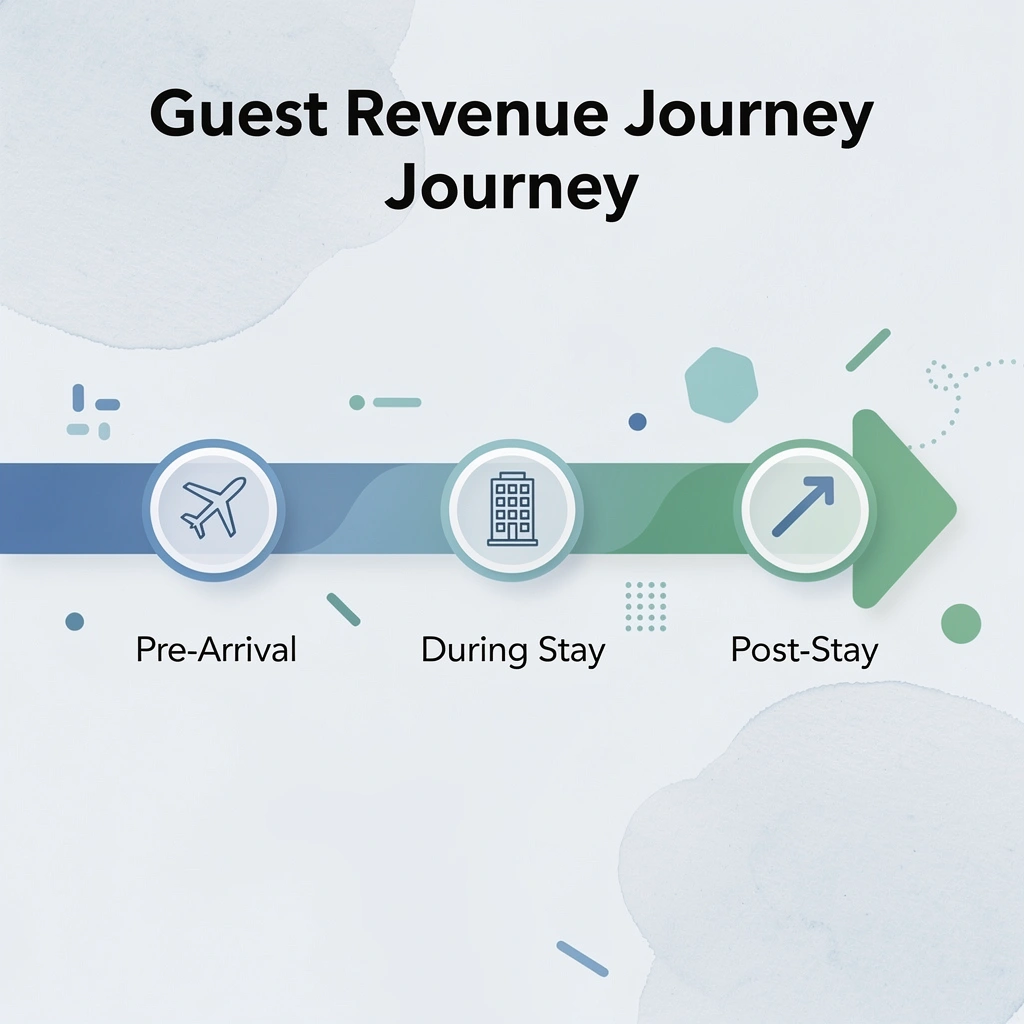
🎯 Key Point: Understaffed teams cannot manually capture every upsell moment across the full guest journey — which is exactly why automated revenue tools like Conduit are essential for modern hotels.
| Stage of Stay | Revenue Opportunity | Common Challenge |
|---|---|---|
| Pre-Arrival | Room upgrades, add-ons | Missed outreach due to low staffing |
| During Visit | Dining, spa, experiences | Manual follow-up too time-consuming |
| Post-Stay | Loyalty, return bookings | Forgotten without automated touchpoints |
How does Conduit help hotel teams respond faster and serve more guests?
Conduit automates hospitality customer service across every channel, enabling teams to respond faster, resolve more guest requests, and deliver excellent experiences without adding headcount. By integrating with the hospitality tech stack, Conduit pulls reservation and property data to ensure responses are accurate and context-aware. Guests receive timely answers while staff spend less time on repetitive requests and more time on high-value interactions.
How does Conduit proactively generate revenue throughout the guest journey?
Beyond responding to guest needs, Conduit helps hotels generate additional revenue throughout the guest's stay. Teams can set up automatic workflows triggered by key moments—bookings, check-ins, and purchases—to offer room upgrades before arrival, promote early check-in and late checkout options, recommend dining and spa services, encourage stay extensions, and send personalized messages after departure. These interactions increase ancillary revenue while enhancing the guest experience.
How does Conduit improve operational efficiency across hotel departments?
Conduit improves operations by automatically routing requests and exceptions with complete information, reducing interdepartmental communication gaps and enabling swift action. Human staff retain control of critical decisions while AI handles repetitive tasks that create bottlenecks.
How does Conduit help hotels unlock more value from every guest relationship?
Instead of depending solely on higher occupancy to grow revenue, hotels unlock more value from every guest relationship. By combining faster service, proactive engagement, and streamlined operations, Conduit captures revenue opportunities often missed when processes are manual and teams are overextended.
Book a Demo to See Conduit's AI for Hospitality Customer Service in Action
If your team is manually tracking upgrade requests and fielding add-on questions across multiple channels, you're losing money to slow response times. Booking a demo with AI for hospitality reveals exactly where those gaps exist and how our automated guest workflows can close them without hiring more people.
"Teams relying on manual tracking across multiple channels are leaving measurable revenue on the table with every slow or missed response." — Conduit
💡 Tip: A single demo session identifies your highest-impact revenue gaps with no lengthy onboarding or commitment required.
In your first session, you'll see how Conduit fits with your existing tools and identifies which touchpoints generate the most missed revenue. Upgrades, extensions, dining reservations, and spa bookings move total revenue per available room in ways occupancy rate alone cannot.
| Revenue Touchpoint | Impact on Total RevPAR |
|---|---|
| Room Upgrades | Increases average booking value per stay |
| Stay Extensions | Captures revenue from otherwise empty nights |
| Dining Reservations | Drives on-property spend beyond the room |
| Spa Bookings | Unlocks ancillary revenue at high margins |
🎯 Key Point: Occupancy rate is only one piece of the puzzle — automated ancillary workflows are where real RevPAR growth happens.
✅ Best Practice: Use your Conduit demo to map every guest touchpoint where a timely, automated message could convert into incremental revenue.
Related Reading
- Cloudbeds Alternatives
- Hotel Distribution Management
- Hospitality Chatbot
- Best Revenue Management Software For Hotels
- Hospitality Conferences
- Digital Concierge Software
- Canary Technologies Competitors
- Siteminder Competitors
- Best Hotel Channel Manager Software
Stay in the loop
Get the latest on AI automation, product updates, and customer stories.


