You're Managing Five Inboxes and Mastering None of Them


Five Inboxes, One Fix
Unify Airbnb, SMS, WhatsApp, more
TL;DR
Managing guest communication across Airbnb, VRBO, direct bookings, WhatsApp, and phone creates five separate workflows with five separate norms. Your team context-switches constantly. They don't master any of them. The fix isn't more staff or better SOPs per channel. It's one conversation engine that handles all of them with the same knowledge, tone, and escalation logic.
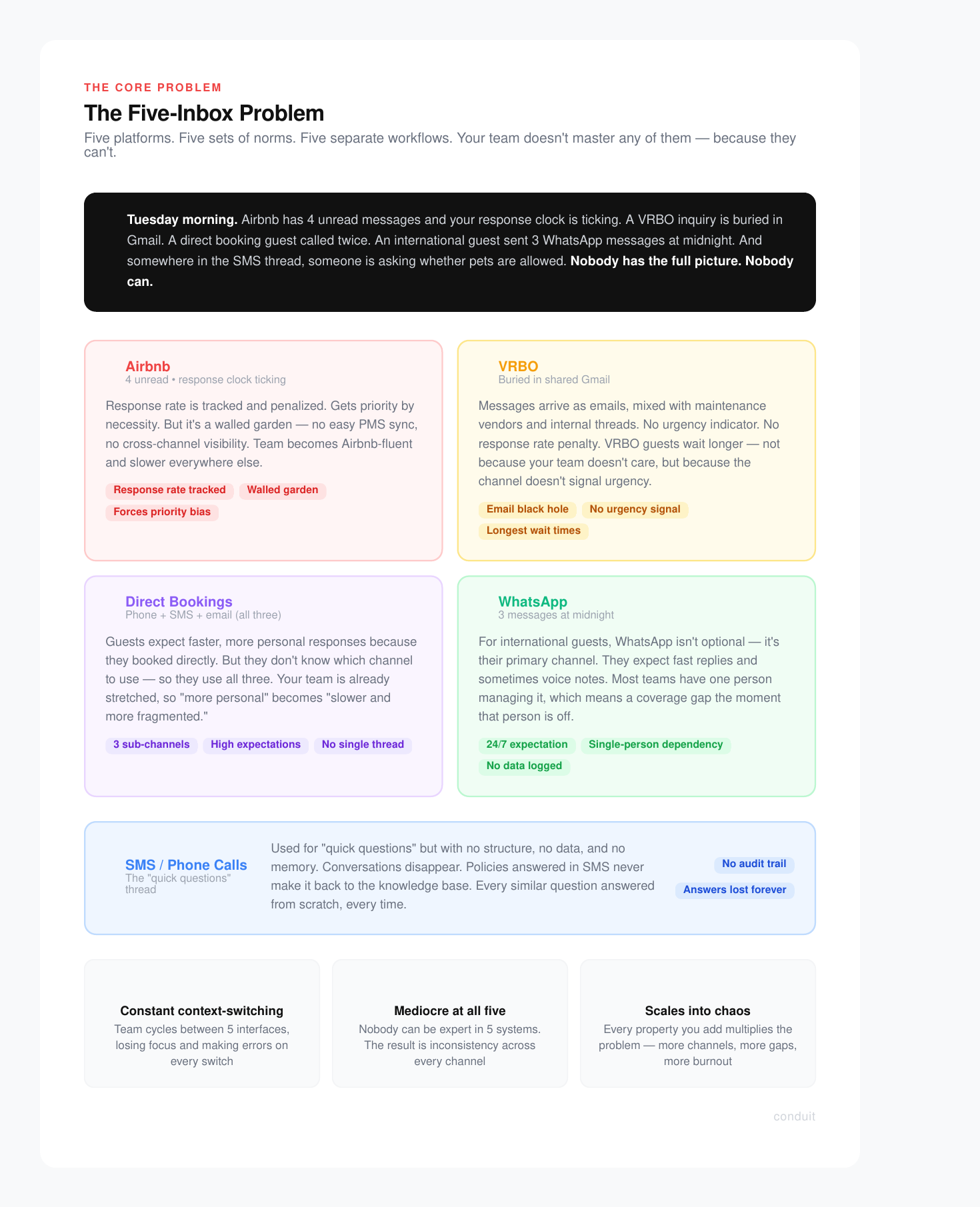
Picture your team on a Tuesday morning. Airbnb has four unread messages, and your response rate clock is ticking. A VRBO inquiry landed in the shared Gmail inbox sometime yesterday, buried under a thread about the cleaning schedule. A direct booking guest called twice and left a voicemail. An international guest sent three WhatsApp messages at midnight asking about early check-in. And somewhere in the SMS thread your team uses for "quick questions," a guest is asking whether pets are allowed.
That's five active conversations across five different platforms, each with its own interface, its own norms, and its own expectations. Nobody on your team has the full picture. Nobody can, because the picture is scattered across five different screens.
This is the five-inbox problem, and it 's quietly destroying your guest experience.
Every Channel Has Its Own Rules (And They Don't Play Nice Together)
The problem isn't that you're using multiple channels. That's unavoidable in 2026 when guests book wherever they want. The problem is that each channel comes with its own set of demands. Those demands are fundamentally incompatible with a single, coherent workflow.
Airbnb: The Response Rate Trap
Airbnb measures your response rate and response time, and it penalizes you for missing the window. Your team knows this, so Airbnb gets priority. But Airbnb's inbox is a walled garden. You can't pull guest data into your PMS easily. You can't see reservation details without switching tabs. Every message lives inside Airbnb's interface. Your team becomes Airbnb-fluent by necessity. Every message from another channel forces a context switch.
VRBO: The Email Black Hole
VRBO sends guest messages as emails. They land in a shared inbox alongside maintenance vendor threads, owner statements, and internal team updates. There's no urgency indicator. There's no response rate metric. So VRBO guests wait longer. Not because your team doesn't care. Because the channel itself doesn't signal urgency.
Direct Bookings: The Phone and Text Problem
Direct booking guests often don't know they should use a specific channel. They call. They text a number they found on your website. They email a general inbox. They expect faster responses because they booked directly. That carries an implicit promise of a more personal experience. But your team is already stretched across Airbnb and VRBO. "More personal" often means "slower."
International Guests: WhatsApp as the Default
For guests booking from Europe, Latin America, or Southeast Asia, WhatsApp isn't an alternative channel. It's the primary one. They'll message you there before they check email. They expect fast replies, often with voice notes. Most STR teams have a WhatsApp number managed by one person. The moment that person is off, coverage disappears.
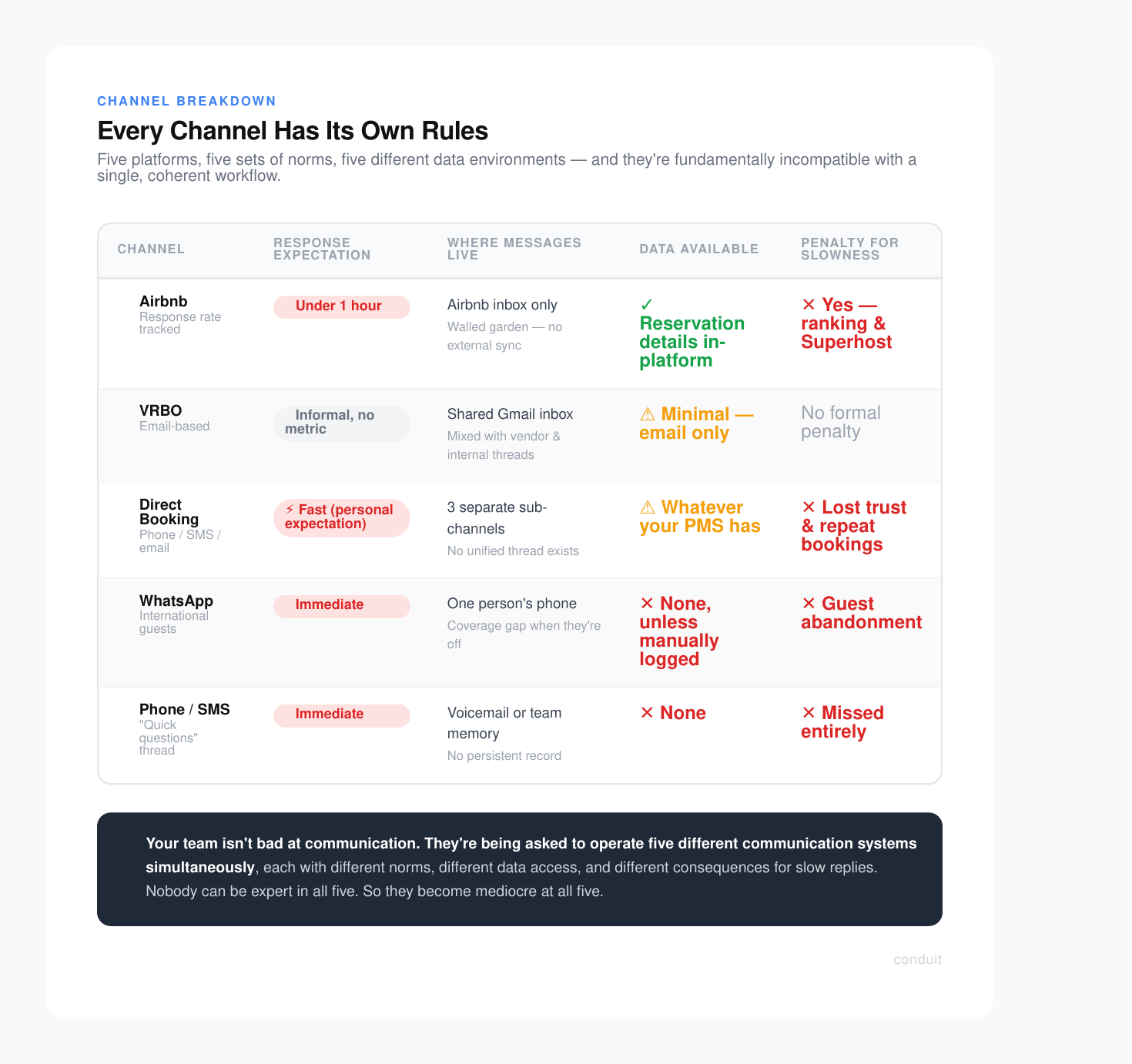
Here's what this adds up to in practice:
- Channel: Airbnb — Response expectation: Under 1 hour (rate tracked) — Where messages live: Airbnb inbox only — Data available: Reservation details in platform
- Channel: VRBO — Response expectation: Informal, no penalty — Where messages live: Shared Gmail — Data available: Minimal, email only
- Channel: Direct booking — Response expectation: Fast (personal expectation) — Where messages live: Phone / SMS / email — Data available: Whatever your PMS has
- Channel: WhatsApp — Response expectation: Immediate — Where messages live: One person's phone — Data available: None, unless manually logged
- Channel: Phone calls — Response expectation: Immediate — Where messages live: Voicemail or memory — Data available: None
Your team isn't bad at communication. They're being asked to operate five different communication systems at once. Each has different norms, different data access, and different consequences for slow replies. Nobody can be expert in all five. So they become mediocre at all five.
The Framework: One Conversation Engine, Every Channel
The answer isn't a better SOP for each channel. It isn't hiring a dedicated WhatsApp person or building a separate Airbnb response team. Those are channel-specific patches on a structural problem.
The answer is treating guest communication as a single operation with multiple entry points, not five separate operations that happen to involve the same guests.
Think of it like this: a guest who books through Airbnb and a guest who books directly through your website both want the same things. They want fast answers. They want accurate information. They want a consistent tone that matches your brand. They want to feel like they're dealing with a team that knows what it's doing. None of those expectations change based on which app they used to reach you.
The conversation engine concept is simple: one AI, one knowledge base, one set of escalation rules, deployed across every channel.
What "Same Knowledge" Actually Means
The knowledge base is the foundation. It includes your property details, check-in instructions, house rules, local recommendations, pricing policies, and anything else a guest might ask. When that knowledge lives in one place and every channel draws from it, you get consistency. The Airbnb guest and the WhatsApp guest get the same accurate answer to "what's the parking situation?" The AI pulls from the same source every time, not from whatever your team member happens to remember.
This is where most STR operators fall short. The knowledge is scattered across Airbnb listing descriptions, a Google Doc someone made in 2023, a few pinned Slack messages, and a team member's head. That's not a knowledge base. That's a liability.
What "Same Tone" Actually Means
Your brand voice shouldn't change because a guest messaged you on WhatsApp instead of Airbnb. If your properties are positioned as premium, your responses should feel premium everywhere. If your brand is warm and local, that warmth should come through in every channel.
A good conversation engine holds the tone constant. It doesn't become robotic on SMS or overly formal on email. The guest experience is consistent, and consistency is what builds the kind of trust that leads to repeat bookings and five-star reviews.
What "Same Escalation Rules" Actually Means
Not every message should be handled automatically. A guest reporting a leak needs a human. A complaint about noise from a neighboring unit needs judgment. A question about extending a stay by two nights probably doesn't.
The escalation layer is what separates a conversation engine from a simple chatbot. The rules define which situations get routed to a human, how fast, and with what context. A well-configured escalation system means your team only touches the conversations that actually need them. It doesn't matter which channel the message came from.
This is the job of a true conversation engineer : not just setting up auto-replies, but designing the full decision tree so the AI handles what it should, escalates what it must, and never leaves a guest without a response.

What This Looks Like in Practice
When the conversation engine is running well, the channel becomes invisible to the guest. They message you on WhatsApp, they get a fast, accurate, on-brand response. They message through Airbnb, same thing. They call your direct booking line. The AI answers, pulls their reservation details, and handles the question or routes it appropriately.
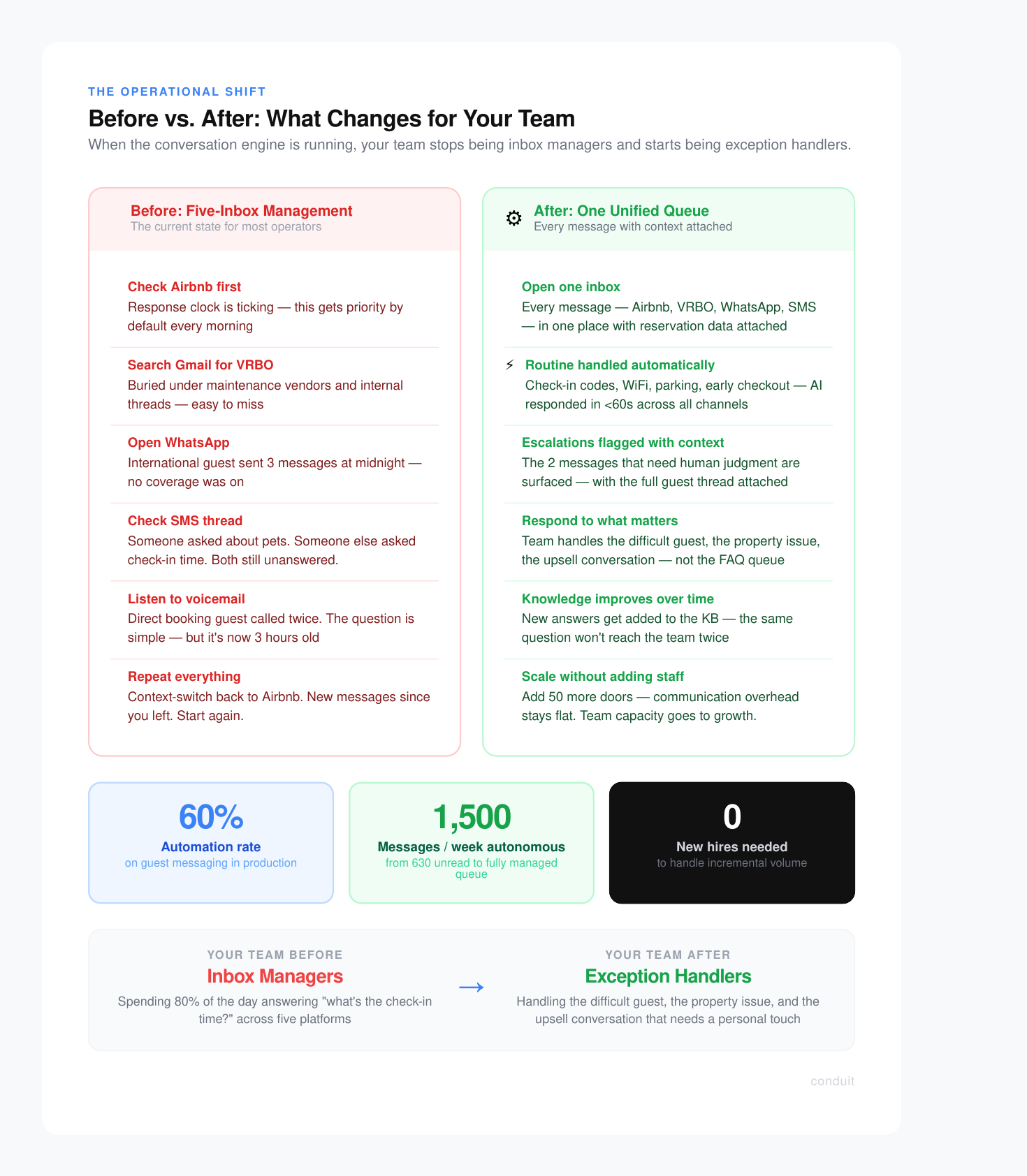
Your team stops being inbox managers and starts being exception handlers. They're no longer spending 80% of their day answering "what's the check-in time?" across five platforms. They're handling situations that actually require human judgment. The difficult guest. The property issue. The upsell conversation that needs a personal touch.
The operational shift looks like this:
- Before: Team checks Airbnb, then Gmail for VRBO, then SMS, then WhatsApp, then voicemail. Context-switches constantly. Misses messages. Responds inconsistently. Burns out.
- After: One queue. Every message, regardless of source, comes in with the guest's reservation context attached. The AI handles the routine. The team handles the meaningful.
One operator we work with put it plainly: " My team gives the AI the knowledge it needs so they don't have to answer the same question ten times." That's the shift. From reactive inbox management to proactive knowledge curation.
The unified AI inbox is the infrastructure layer that makes this possible. But the real leverage isn't the inbox itself. It's the decision to treat every guest conversation, regardless of channel, as part of one coherent operation.
See It Running on Your Portfolio
If your team is still juggling five inboxes, the problem compounds with every property you add. More listings mean more channels, more messages, and more moments where something slips.
Conduit is built specifically for operators who've hit this wall. The platform connects to Airbnb, VRBO, WhatsApp, SMS, and your direct booking channels. Every guest conversation comes into one place with your PMS data attached. The same AI handles the routine across all of them, using the same knowledge base, the same tone you define, and the same escalation rules you set. When a human needs to step in, they get the full context, not a fragmented thread from a channel they weren't monitoring.
" What Conduit has built is as good as anything we've used before, but finally tailored to hospitality." Nick Curtis, Founder at Bacobay
STR operators using Conduit have reached 60% automation on guest messaging, handling thousands of conversations per week without adding headcount. One team went from 630 unread messages to a fully managed queue where the AI sends 1,500 messages per week autonomously.
That's not a communication tool. That's a conversation engine.
Ready to see what this looks like for your properties?Book a demo with Conduit and walk through how the platform unifies your guest communication across every channel you're already using.
Stay in the loop
Get the latest on AI automation, product updates, and customer stories.

