Automating Check-In: The Highest-ROI Workflow in Hospitality


The Check-In Workflow
Save 16+ hours a month on check-ins
Every time we talk to operators about where to start with AI automation, the answer is almost always the same: check-in.
Not upsells. Not maintenance routing. Not review requests. Check-in.
And it makes sense. The pre-arrival and check-in window is the most time-intensive, most repetitive, and most consequential stretch of the entire guest journey. Get it right and you set the tone for a 5-star stay. Get it wrong and you're fielding frantic calls at 10pm from guests who can't find the lockbox.
The good news: this is also the easiest workflow to fully automate. Here's exactly how to build it.
TL;DR
- Check-in automation is the highest-ROI first workflow for STR operators
- A fully automated flow covers 4 touchpoints: booking confirmation, 48-hour pre-arrival, day-of access codes, and post-arrival check-in
- At 5 minutes per guest and 200 check-ins/month, that's 16+ hours of staff time recovered every month
- Every guest gets the same clear, complete instructions, every time
Why Check-In Is Always the First Workflow Operators Automate
Most operators come to us with a long list of things they want to automate. But when we dig into their actual operations, one pattern surfaces every time: the check-in flow is being handled manually, it's eating hours every week, and the quality is inconsistent.
One team member sends a thorough, warm confirmation. Another fires off a bare-bones message with a link. A third forgets the 48-hour reminder entirely because they were handling a maintenance issue.
The problem isn 't effort. It's that manual processes don't scale.
When you're managing 50 properties, you can catch the gaps. At 200 properties, those gaps become guest complaints. At 500, they become your reputation.
Check-in automation solves this at the root. It's not about replacing the hospitality in your operation. It's about making sure every guest receives the same warm, complete, professional experience. Regardless of who's on shift or how many properties checked in that day.
The 4-Step Automated Check-In Flow
A fully automated check-in flow covers four touchpoints. Each one serves a distinct purpose in the guest experience, and together they eliminate nearly every reason a guest would need to reach out before arriving.

Step 1: Booking Confirmation (Immediately After Booking)
This is the first impression. The moment a reservation is confirmed, an automated message goes out that does three things: acknowledges the booking warmly, sets expectations for what's coming, and gives the guest a reason to feel excited.
A strong booking confirmation message includes:
- A warm welcome that references the property by name
- The confirmed check-in and check-out dates and times
- A note that detailed arrival instructions are coming closer to the date
- A point of contact for any questions in the meantime
This message isn't just courtesy. It reduces inbound "just confirming my booking" messages, which are a surprisingly large share of pre-arrival volume.
Step 2: Pre-Arrival Message (48 Hours Before Check-In)
Two days out, guests start thinking about logistics. This is the moment to send everything they need to arrive confidently.
The 48-hour pre-arrival message should include:
- Full check-in instructions (parking, building entry, unit access)
- House rules and any important property-specific notes
- Local recommendations (restaurants, grocery stores, things to do)
- A direct contact number or chat channel for last-minute questions
Sending this 48 hours out gives guests time to read it without the pressure of being in the car. It also cuts the flood of "how do I get in?" messages on check-in day.
Step 3: Day-Of Message (Morning of Check-In)
This is the most operationally critical message in the sequence. On the morning of check-in, guests get a concise, friendly message with the access codes and any final logistics.
Keep this one short and scannable. Guests are traveling. They don't want to read a wall of text while navigating an unfamiliar city. The goal is to give them exactly what they need to walk in the door without a single phone call.
"Hi [Guest Name], today's the day! Your access code for [Property Name] is [CODE]. Check-in is anytime after [TIME]. Everything you need is in yesterday's message, but don't hesitate to reach out if anything comes up. Enjoy your stay!"
Step 4: Post-Arrival Check-In (2-4 Hours After Check-In Time)
A few hours after check-in, an automated message goes out asking a simple question: is everything good?
This one message does more for your review score than almost anything else. It catches issues early, before they fester into a negative review. It signals to guests that you're attentive and care about their experience. And it opens the door for questions they might have been hesitant to ask.
Most guests who have a minor issue won 't mention it unless asked. This message asks.

The Math: What This Is Actually Worth to Your Operation
Here's where it gets concrete. Let's look at what manually managing this flow actually costs.
- Variable: Average time per check-in (manual) — Number: 5 minutes
- Variable: Check-ins per month — Number: 200
- Variable: Total staff time per month — Number: 1,000 minutes
- Variable:Hours recovered with automation — Number:16.7 hours/month

That's more than two full workdays every month, spent on messages that follow the exact same pattern every single time. Messages that an AI can send better than a tired team member at 9pm on a Friday.
And that 's just the time savings. The quality improvement is harder to quantify but just as real.
With manual messaging, quality varies by person, by day, and by workload. With an automated flow, every guest gets the same clear, complete instructions. No missed access codes. No forgotten parking notes. No check-in instructions that were written for a different property and never updated.
Think of it like having a dedicated conversation engineer on your team whose only job is making sure every guest arrives informed, welcomed, and ready to enjoy their stay. They never have an off day. They never forget a step. They scale to 500 check-ins a month just as easily as 20.
What a Good Automated Flow Actually Feels Like to a Guest
There's a common concern we hear from operators: "Won't guests know it's automated? Will it feel impersonal?"
The honest answer is: only if it's done poorly.
A well-built check-in flow doesn't feel like a drip campaign. It feels like a thoughtful host who anticipated everything the guest needed before they had to ask. The messages are warm, specific to the property, and timed to land exactly when they're most useful.
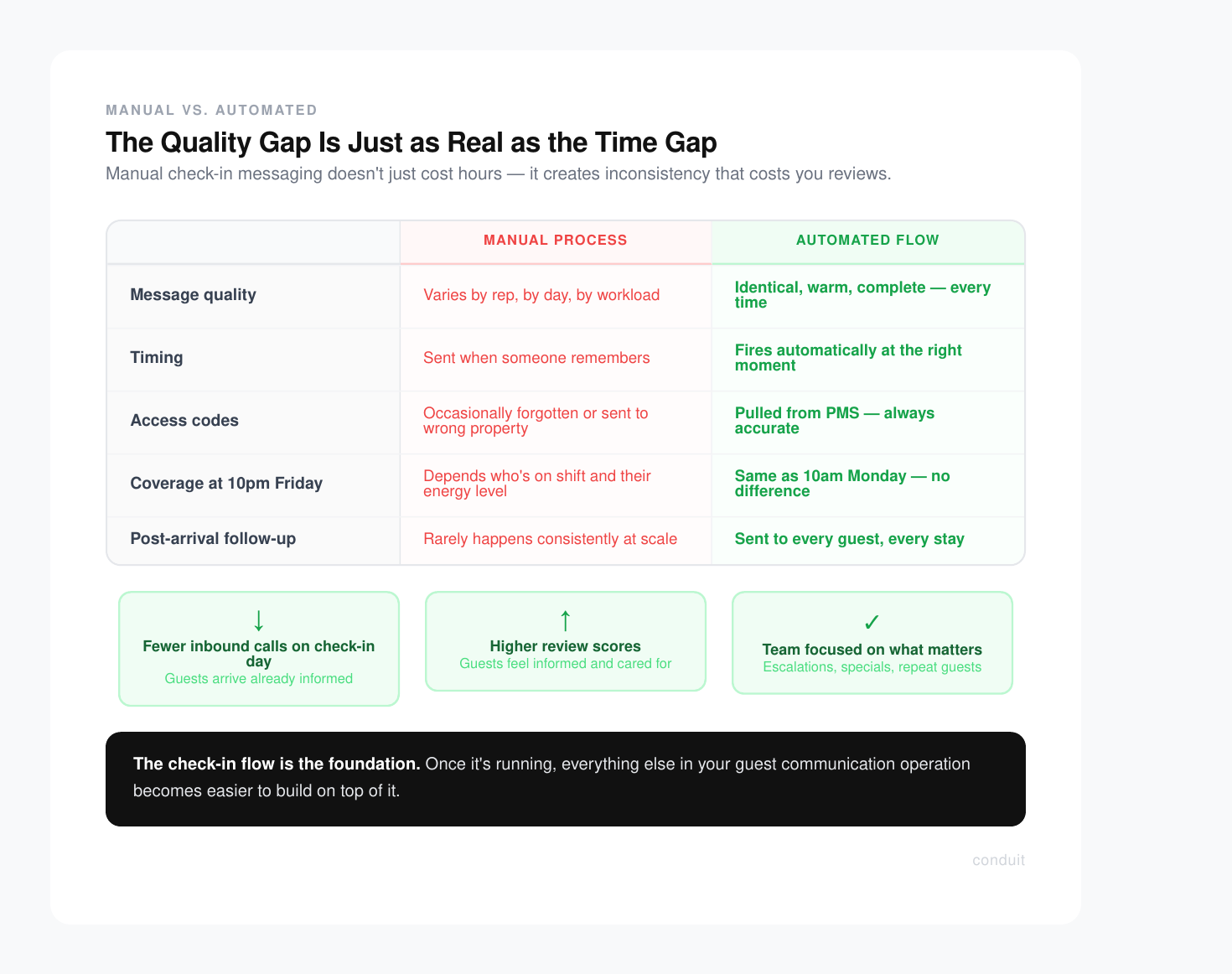
Guests don't care whether a human or an AI sent the message. They care whether the message was helpful, timely, and accurate. Automation, done right, delivers all three, more consistently than any manual process can.
The operators we work with who have built this flow consistently report the same outcomes:
- Fewer inbound "how do I get in?" messages on check-in day
- Higher review scores, driven by guests who felt informed and cared for
- Staff who can focus on the conversations that actually require a human touch: escalations, special requests, and relationship-building with repeat guests
The check-in flow is the foundation. Once it's running, everything else in your guest communication operation becomes easier to build on top of it.
Build This Flow With Conduit
Conduit is built specifically for operators who want to automate guest communication without sacrificing quality. The check-in flow we described above is one of the first workflows our team helps operators configure, and most have it live within a single implementation session.
Here's what Conduit brings to the check-in flow:
- PMS-native triggers : Messages fire automatically based on reservation data from your property management system. No manual scheduling. No copy-pasting guest information.
- Dynamic personalization : Every message pulls in the guest's name, property details, access codes, and check-in timing automatically.
- Omnichannel delivery : Send via SMS, email, or in-app messaging, wherever your guests are most likely to see it.
- AI-powered responses : When a guest replies to any automated message, Conduit's AI handles the response, answering questions, resolving confusion, and escalating to a human when the situation calls for it.
- Full conversation history : Every touchpoint lives in a single unified inbox, so your team has complete context on every guest, always.
If you're managing 50 or 500 properties and still handling check-in communication manually, this is the first place to start. The ROI is immediate, the setup is fast, and the impact on your guest experience is real.
Book a demo with Conduit and we'll show you exactly how to build this flow for your operation.
Stay in the loop
Get the latest on AI automation, product updates, and customer stories.

