How Conduit Customers Are Using AI to Win More Direct Bookings


More Direct Bookings
Cut OTA fees with AI guest chat
TL;DR
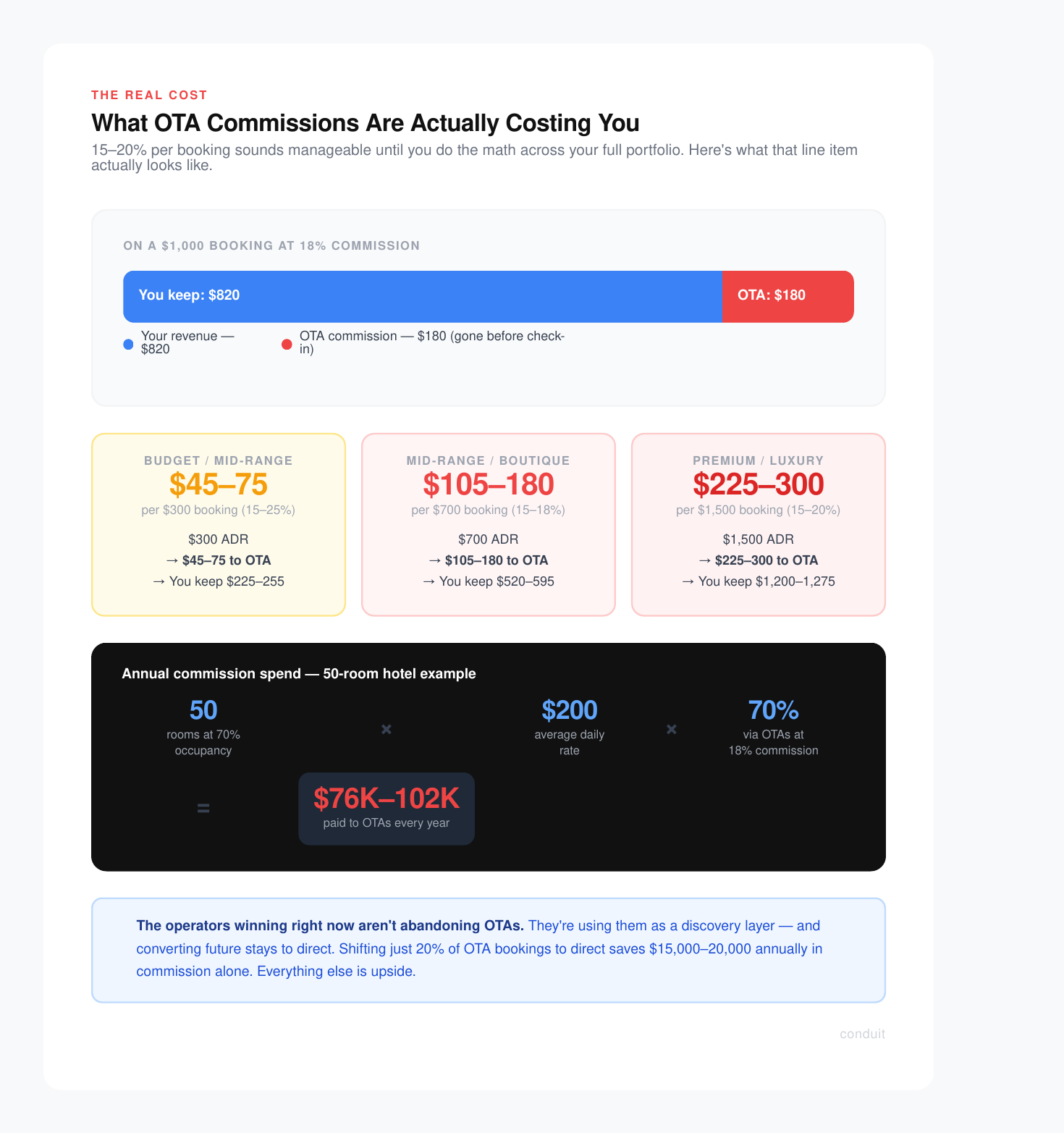
OTA commissions eat 15-20% of every booking. A single $1,000 reservation costs you $150-300 in fees. Hospitality operators using AI on their direct booking channels are recapturing those commissions at scale, without adding headcount. This post walks through the three-part strategy and the real numbers behind it.
OTAs are a necessary evil. They fill rooms, move inventory, and handle distribution at a scale no independent operator can replicate on their own. But you already know the trade-off: every booking that comes through Booking.com, Expedia, or Airbnb costs you 15-20% of the reservation value in commission.
On a $1,000 booking, that's $150-300 gone before you've checked the guest in.
The operators who are winning right now aren't abandoning OTAs entirely. They're using them as a discovery layer, and then converting future stays to direct. The mechanism making that possible? AI on every direct booking touchpoint.
Here's how three anonymized Conduit customers built that system, and what it did to their commission spend.

Step 1: The AI Chat Widget That Converts Browsers Into Bookers
The first place guests go after discovering a property on an OTA is Google. They search the property name, find the direct website, and then they hesitate. Questions pile up: Is the price the same? What's the cancellation policy? Is the pool heated in March?
If no one answers those questions instantly, they go back to the OTA and book there. The OTA gets the commission. You get the reservation minus 18%.
One Conduit customer, a boutique hotel group operating four properties in the Southeast, deployed Conduit's AI chat widget directly on their booking site. Conduit's AI was trained on their full property details, policies, and seasonal availability, and connected to their PMS so answers were always accurate and live. When a prospective guest asked "do you allow early check-in?" at 11pm on a Tuesday, Conduit responded in seconds with an accurate answer and a direct booking link, no front desk staff required.
The result: Within 90 days, the property attributed 22% of its new direct bookings to chat-assisted conversions. At an average ADR of $280, those bookings represented roughly $41,000 in reservations that would have otherwise gone through an OTA. That translated to approximately $6,000-8,000 in commission saved in a single quarter.
The AI didn't replace their front desk. It acted as a conversation engineer, handling the pre-booking friction that was silently sending guests back to Booking.com.
Why Speed Is the Conversion Variable
Most direct booking sites lose guests not because of price, but because of response latency. A guest comparing two properties will book the one that answers first. AI chat eliminates that latency entirely, 24 hours a day, with zero staffing cost.
Step 2: AI Voice That Handles Phone Inquiries in Real Time
Phone calls are still a significant booking channel in hospitality, especially for longer stays, group bookings, and older demographics. The problem is that phones require people to answer them. Miss a call, and that guest books somewhere else.
A vacation rental management company with 60+ units across two markets was losing an estimated 15-20% of inbound call volume to voicemail. Guests calling about availability and pricing weren't leaving messages. They were hanging up and booking on VRBO.
After deploying Conduit's AI voice agent on their direct booking line, Conduit answered every call instantly, pulled live availability from their PMS, quoted accurate pricing, and walked callers through the booking process start to finish, without hold music, without a reservations agent on the clock.
What the Numbers Looked Like

- Metric: Calls answered within 10 seconds — Before AI Voice: ~40% — After AI Voice: 100%
- Metric: Calls resulting in direct booking — Before AI Voice: 28% — After AI Voice: 47%
- Metric: Estimated monthly commission saved — Before AI Voice: Baseline — After AI Voice: +$4,200/mo
The AI handled availability and pricing inquiries with the same accuracy as a trained reservations agent, pulling live data rather than working from a static script. Complex requests, like group bookings requiring custom quotes, were escalated to a human. Everything else was handled and closed.
The key insight here: You don't need to eliminate OTA traffic. You need to capture the guests who were already motivated to book direct but hit a friction point. A missed phone call is that friction point. AI removes it.
Step 3: Post-Stay Sequences That Turn OTA Guests Into Direct Repeat Bookers
The highest-leverage moment in the direct booking shift isn't before a guest arrives. It's after they leave.
A guest who booked through an OTA already knows your property. They had a good stay. They're the most likely person on earth to book with you again. The OTA knows this too, which is why they send their own post-stay marketing. If you don't send yours first, you lose the rebooking to the platform.
A mid-sized boutique hotel in the Mountain West plugged Conduit into their PMS and activated post-stay sequences for every OTA-sourced checkout. Conduit handled the full sequence automatically, no manual follow-up, no separate email tool:
- Day 1 after checkout: Personalized thank-you message via SMS, with a direct booking link and a first-time direct booking discount (10% off next stay)
- Day 14: Follow-up with a loyalty incentive: free early check-in or late checkout on the next direct booking
- Day 45: Seasonal availability alert for upcoming high-demand dates, direct booking link only
The messaging was warm, specific to the property, and offered something the OTA couldn't match: a direct relationship with real perks.
The Commission Math on Repeat Guests
A guest who originally booked through an OTA at $1,100 cost you $165-220 in commission. If they rebook direct at the same rate, that commission is fully recovered on the second stay. Three more direct bookings after that, and you've recouped four stays' worth of OTA fees from a single guest relationship.
The property running this sequence saw 18% of their OTA-sourced guests rebook direct within six months. On a portfolio averaging 200 OTA checkouts per month, that's 36 recovered direct bookings every 30 days.
At a $1,000 ADR, that's $36,000/month in direct revenue that previously carried a $5,400-7,200 commission load. That load dropped to zero.
The ROI Case: Commission Savings Alone Justify the Platform
Here's the argument in its simplest form.
OTA commissions are a recurring, unavoidable cost for most hospitality operators. The industry average sits between 15-20%, and on properties with higher ADRs, that's a substantial line item. A 50-room hotel running at 70% occupancy with a $200 ADR pays roughly $76,000-102,000 per year in OTA commissions, assuming 70% of bookings come through OTAs.
An AI communication platform that shifts even 20% of those bookings to direct saves $15,000-20,000 annually in commission alone. That figure doesn't include the higher guest lifetime value of a direct relationship. It also doesn't count the reduced dependency on OTA algorithm changes, or the operational efficiency of automated messaging.

The math is simple: If your AI platform costs less than the commission you're saving, it's already profitable. Everything else, better guest experience, faster response times, reduced front desk workload, is upside.
The three operators described in this post didn't implement AI because it sounded innovative. They did it because the ROI was measurable in a line item they were already tracking: commission expense. When the platform cost is $500-1,500/month and the commission savings are $4,000-8,000/month, the conversation isn't about whether to invest. It's about how quickly you can get it running.
For more on building a direct booking channel that actually converts, see Conduit's guide to direct booking websites and how AI is reshaping hotel booking and guest service revenue.
Ready to Stop Paying OTA Commissions on Guests Who Already Know You?
Conduit is built specifically for hospitality operators who are tired of paying OTA commissions on guests they've already earned. The platform handles the full guest communication stack: Conduit Chat on your direct booking site, Conduit Voice on your reservation line, and automated post-stay sequences that pull OTA guests back into a direct relationship.
It connects natively to the PMS systems operators already use, so setup is fast and the data is always live. No duct tape, no third-party integrations cobbled together.
The operators in this post aren't waiting for guests to stumble onto their direct site. They're using Conduit to engineer every touchpoint so that direct booking is the easiest and most rewarding choice, every time.
Book a demo with Conduit and find out exactly how much commission you could be keeping.
Stay in the loop
Get the latest on AI automation, product updates, and customer stories.


