Guest Communication Isn't a Cost Center. It's Your Most Underutilized Revenue Channel.


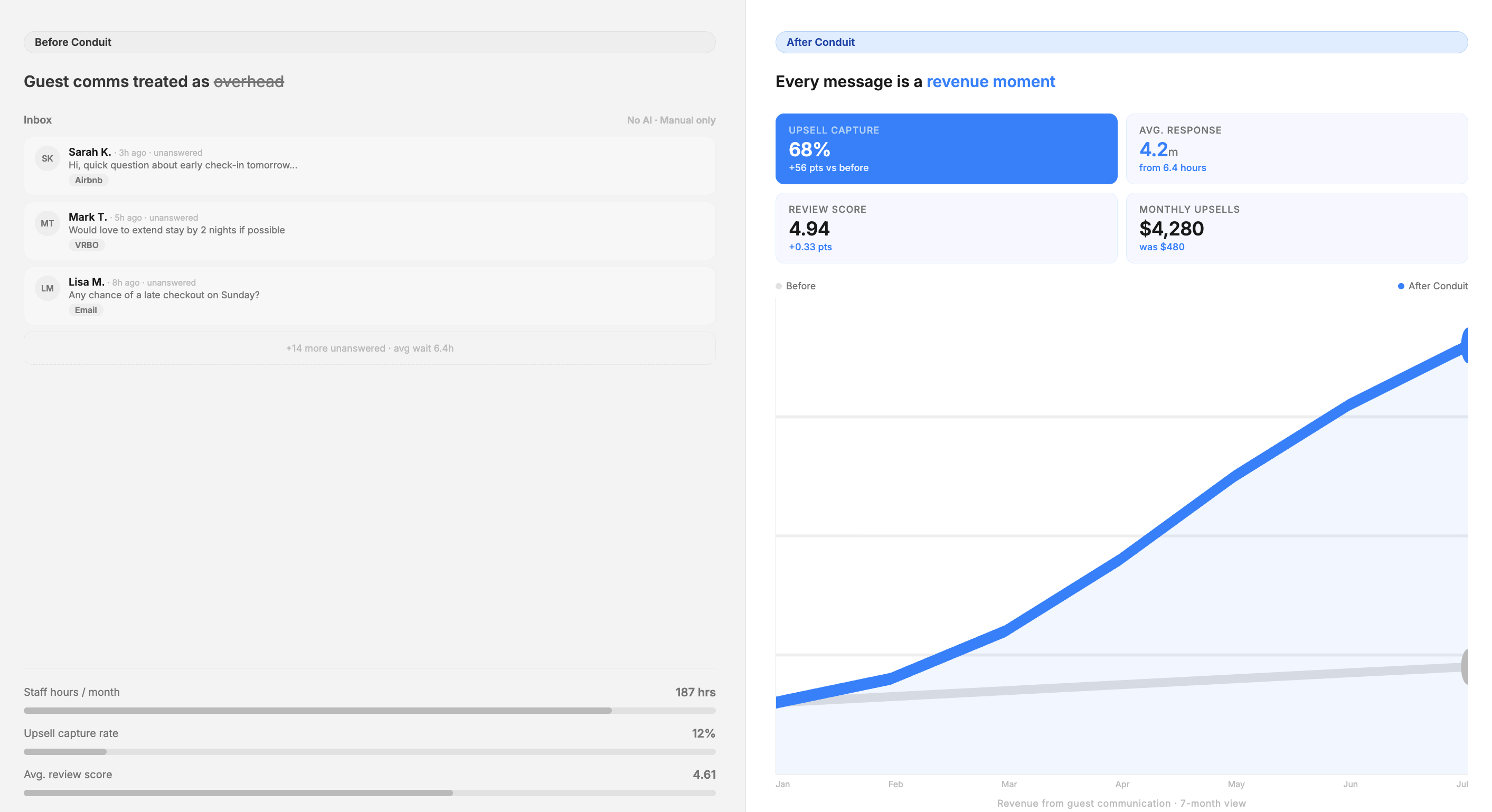
Comms Is Revenue
Turn every message into a booking
Every hospitality operator I've ever talked to treats guest communication the same way: as an operational expense to minimize. Hire fewer agents, send templated messages, close tickets faster. The whole mental model is about cost reduction.
That's the wrong frame entirely.
Guest communication is the only touchpoint that exists at every stage of the guest journey, from the first inquiry to the post-stay review. It's the moment a potential guest decides whether to book. It's the moment a confirmed guest decides whether to add an early check-in. It's the moment a happy guest decides whether to leave a five-star review or come back next year. When you treat that touchpoint as overhead, you're leaving serious money on the table.
The shift worth making: stop thinking of your messaging team as a support function and start treating it as a growth function. Because that's exactly what it is, when it's built right.
TL;DR: Guest communication touches every stage of the guest journey. Operators who automate it with AI see 15-30% higher booking conversion, consistent upsell revenue, stronger review scores, and more direct rebookings. For a 200-listing STR company, that adds up to ~$38,596 in incremental annual revenue, conservatively.
Let's do the math.
1. Faster Responses = More Bookings
When a guest sends an inquiry, they're not just asking your property a question. They're asking three or four properties simultaneously. The first one to respond with a clear, helpful answer wins the booking.
This isn't anecdotal. Response speed is one of the most consistent predictors of direct booking conversion in short-term rental operations. Operators who implement AI-powered response systems typically see 15 to 30% improvements in direct booking conversion rates by simply eliminating the lag between inquiry and reply.
Think about what that means at scale. For a 200-listing STR company averaging $200/night and a 4-night average stay, a single additional booking is worth roughly $800 in gross revenue. If faster AI responses capture just two additional bookings per month, that's $1,600/month. That's $19,200 per year , from response speed alone.
The math gets uncomfortable fast when you realize your competitors are already automating this.
2. Pre-Arrival Messages Are a Revenue Channel, Not a Courtesy
Most operators send a pre-arrival message because it's standard practice. Check-in instructions, door code, WiFi password. Done.
That's a missed opportunity worth thousands of dollars a month.
A well-timed pre-arrival message sequence is one of the highest-converting upsell moments in the entire guest journey. The guest is already committed, already excited, and already thinking about their stay. They're far more receptive to relevant add-ons than they'll ever be during the booking flow.
Here's what a proactive pre-arrival strategy actually looks like:
Gap Night Fills
If a guest checks in on Thursday and your calendar shows Wednesday is open, a targeted message offering a discounted Wednesday arrival can convert a 3-night stay into a 4-night stay. At $200/night, that's found revenue on a night that was going to sit empty anyway.
Early Check-In
Guests who want to arrive before the standard 3pm window will pay for it. A simple automated message offering early access at $50-$75 converts consistently, especially for families and business travelers.
Amenity Packages
Local experience add-ons, welcome baskets, mid-stay cleans, grocery stocking. These feel premium to the guest and carry strong margins for the operator.
The most common amenity upsells that convert:
- Welcome baskets and curated local goods
- Mid-stay cleaning services
- Grocery pre-stocking and pantry packages
- Local experience vouchers and activity bundles
If your 200-listing operation captures just five upsells per month at an average of $75 each, that's $375/month, or $4,500 per year , in revenue that requires no additional inventory, no additional staff, and no additional marketing spend.
That's the definition of a revenue channel.
3. In-Stay Communication Builds the Review Score That Wins Future Bookings
Here's the compounding effect most operators overlook: how you communicate during the stay directly determines the review score, and the review score determines how much future revenue your listings generate.
A guest who has an issue during their stay and hears nothing will leave a 3-star review. A guest who has the same issue and gets a fast, empathetic response that resolves it will often leave a 4 or 5-star review. The outcome of the stay didn't change. The communication did.
The real lever: On platforms like Airbnb and Vrbo, a 0.1-point improvement in average review score can meaningfully shift your search ranking and conversion rate. Properties with scores above 4.8 consistently outperform those hovering at 4.5, even when the underlying product is comparable.
This is where the role of a skilled conversation engineer becomes critical. It's not just about sending messages fast. It's about designing the right message, at the right moment, with the right tone, to keep the guest feeling cared for throughout their stay. AI makes this scalable across hundreds of properties simultaneously, without requiring a 24/7 human team.
Better in-stay communication means fewer unresolved complaints, fewer negative reviews, and a higher average score across your portfolio. At scale, that's a compounding revenue advantage that grows every quarter.
4. Post-Stay Follow-Up Turns One Booking Into a Relationship
The average STR operator does nothing after a guest checks out beyond hoping for a review. That's another significant revenue leak.
Post-stay follow-up is one of the highest-ROI communication touchpoints in the entire guest lifecycle. Almost no one does it well. A personalized message sent 24-48 hours after checkout, thanking the guest and inviting them to return with a direct booking incentive, converts at a meaningfully higher rate than any cold acquisition channel.
Direct rebookings eliminate OTA commission (typically 15-20% of the booking value) and build a guest list that becomes a compounding asset over time. A 200-listing operation that converts even a small percentage of past guests to direct rebookers is generating revenue that costs almost nothing to acquire.
The math compounds further when you factor in lifetime value. A guest who books twice a year at $800 per stay is worth $1,600 annually, not $800. Post-stay communication is how you turn the first transaction into the first of many.
The Revenue Math for a 200-Listing STR Operation
Let's put it all together with conservative numbers. No optimistic projections, no best-case scenarios.
- Revenue Driver: Faster responses (booking conversion) — Assumption: 2 additional bookings/month @ $800 avg. — Monthly Value: $1,600 — Annual Value: $19,200
- Revenue Driver: Pre-arrival upsells — Assumption: 5 upsells/month @ $75 avg. — Monthly Value: $375 — Annual Value: $4,500
- Revenue Driver: Review score improvement — Assumption: 0.1-point lift across portfolio (conservative booking uplift) — Monthly Value: Varies — Annual Value: $10,000+
- Revenue Driver: Post-stay rebooking — Assumption: 3 direct rebookings/month, saving 17% OTA commission on $800 stays — Monthly Value: $408 — Annual Value: $4,896
- Revenue Driver:Total (conservative) — Assumption: — Monthly Value:~$2,383/month — Annual Value:~$38,596/year
That's nearly $40,000 in incremental annual revenue for a 200-listing operation, and that's before accounting for the compounding effect of a stronger review score on future bookings, or the long-term value of building a direct guest database.
The cost of doing nothing is not zero. Every month you run manual, reactive communication is a month you're losing bookings to faster competitors, leaving upsell revenue uncaptured, and sending guests home without a reason to come back directly.
How Conduit Turns This Into Reality
This is exactly the problem Conduit was built to solve.
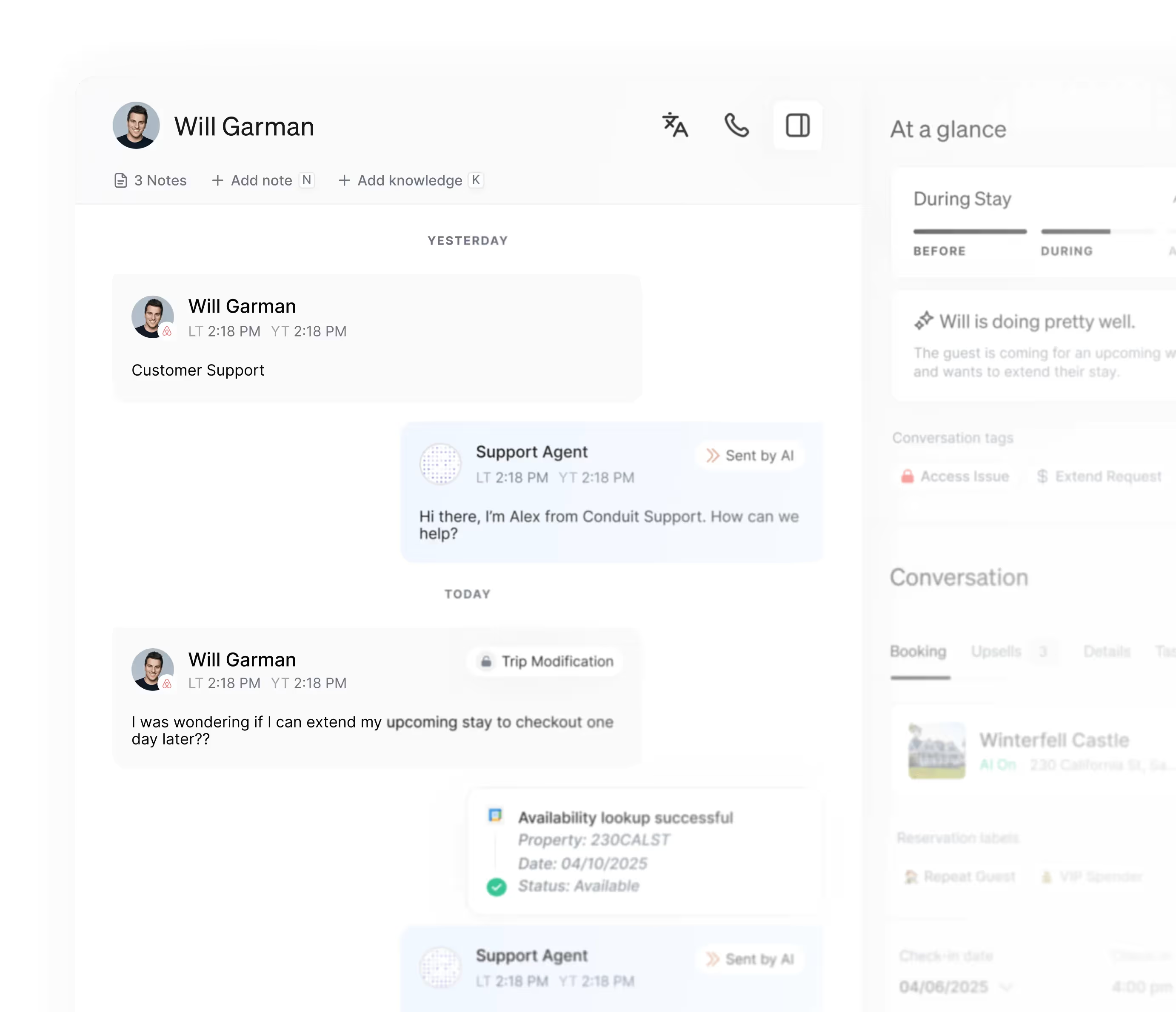
Conduit is an AI-powered guest communication platform built for hospitality operators. It's designed to turn your messaging stack into a growth function. It handles inquiry responses in seconds, triggers pre-arrival upsell sequences automatically, monitors in-stay sentiment to flag issues before they become bad reviews, and sends post-stay follow-ups that drive direct rebookings, all without adding headcount.
Operators like Arbio have reached 60% automation, sending over 15,000 guest messages fully autonomously. The Poler Group replaced their call center entirely and added $500,000 in property value through better NOI. These aren't edge cases. They're what happens when you stop treating communication as overhead and start treating it as the revenue channel it actually is.
If you manage 50 listings or 500, the math above applies to your portfolio. The only question is whether you're capturing that revenue or leaving it for someone else.
Ready to see what this looks like for your operation?
Book a demo with Conduit and we'll walk through exactly how AI-powered guest communication can add measurable revenue to your portfolio, using your numbers, your average nightly rate, and your current booking volume. No generic pitch. Just the math applied to your business.
Stay in the loop
Get the latest on AI automation, product updates, and customer stories.


