Why Your Overnight Staff Is Your Most Expensive and Least Effective Investment


The Overnight Tax
Why overnight staff cost so much
Most hotel operators I talk to have never actually run the math on their overnight front desk coverage. They know it's expensive. They know turnover is high. But they treat it as a fixed cost of doing business, a line item that just exists.
It doesn't have to. And once you see the full picture, it's hard to unsee.
TL;DR
- Overnight shifts carry a 15-30% wage premium on top of base pay, before benefits or management overhead
- Staff disengagement and turnover are highest on the overnight shift, compounding the true cost
- Roughly 80% of overnight guest messages are repeat FAQs and status checks, the same questions fielded during the day
- STRs typically have zero overnight coverage, meaning guest issues go unresolved until morning
- The core framework: if 90% of overnight contacts are pattern-matching work, you're paying premium labor rates for a low-complexity function
The Shift Differential Nobody Talks About
Let's start with the wage structure. Overnight shifts, typically running 11 PM to 7 AM, command a shift differential that ranges from 15% to 30% above base pay. For a front desk agent earning $20/hour during the day, that means $23 to $26/hour overnight. Multiply that across 365 nights per year, factor in benefits, and you're looking at a meaningful cost premium just to keep the lights on at the desk.

That premium is baked into your labor budget whether one guest calls or fifty.
The Hidden Cost of High Turnover
The compounding problem: overnight agents are also your most likely to leave. Hospitality consistently reports its highest voluntary turnover rates among overnight and graveyard shift workers. Every departure means recruiting costs, onboarding time, and weeks of reduced productivity from someone still learning the property.
Some operators estimate the true cost of replacing a single front desk agent at 1.5 to 2 times their annual salary. That figure accounts for lost productivity, management time, and the ramp period before a new hire is fully effective.
So you're paying a wage premium for the shift, and a hidden tax every time someone quits it.
Engagement Drops After Midnight
Wage cost is only part of the story. Overnight staff are also, on average, less engaged than their daytime counterparts. This isn't a character flaw; it's biology. Working against the body's natural circadian rhythm produces measurable drops in alertness and decision-making quality. Emotional regulation suffers too, which matters more than most operators realize.
For guest services, that matters. A tired agent is slower to respond and more likely to make errors in reservations or billing. De-escalating a frustrated guest at 2 AM takes composure that fatigue directly undermines. The guest experience you're paying a premium to provide is delivered by your least-resourced shift.
What Overnight Guests Actually Need
Here's where the economics get really interesting. When you audit overnight guest contacts, a clear pattern emerges across properties of every size and type.
The breakdown typically looks something like this:

- Contact Type: WiFi password / network help — Share of Overnight Volume: 20-25%
- Contact Type: Check-in instructions or access codes — Share of Overnight Volume: 15-20%
- Contact Type: Amenity hours (pool, gym, breakfast) — Share of Overnight Volume: 10-15%
- Contact Type: Noise complaints or maintenance requests — Share of Overnight Volume: 10-15%
- Contact Type: Billing questions or reservation status — Share of Overnight Volume: 10-15%
- Contact Type: Genuine emergencies requiring judgment — Share of Overnight Volume: 5-10%
The vast majority of these contacts have a known, repeatable answer. They don't require empathy training, local expertise, or the ability to improvise. They require access to the right information and the ability to deliver it quickly.
If 90% of overnight messages are FAQs and status checks, you 're paying premium rates for pattern-matching work.
The Pattern-Matching Problem
That's the framework worth internalizing. Not as a criticism of your team, but as a structural observation about how overnight labor is being deployed. A skilled front desk agent is capable of handling a medical emergency, managing a double-booking dispute, or calming a genuinely distressed guest. Spending that capacity on "what's the pool code?" is a misallocation.
A good conversation engineer will tell you the same thing: the goal isn't to eliminate human judgment from overnight operations. It's to stop burning premium labor on work that doesn't require it. The Bureau of Labor Statistics consistently shows accommodation and food service among the highest-turnover sectors in the U.S. economy, and the overnight shift is where that churn concentrates.
The STR Version of This Problem Is Worse
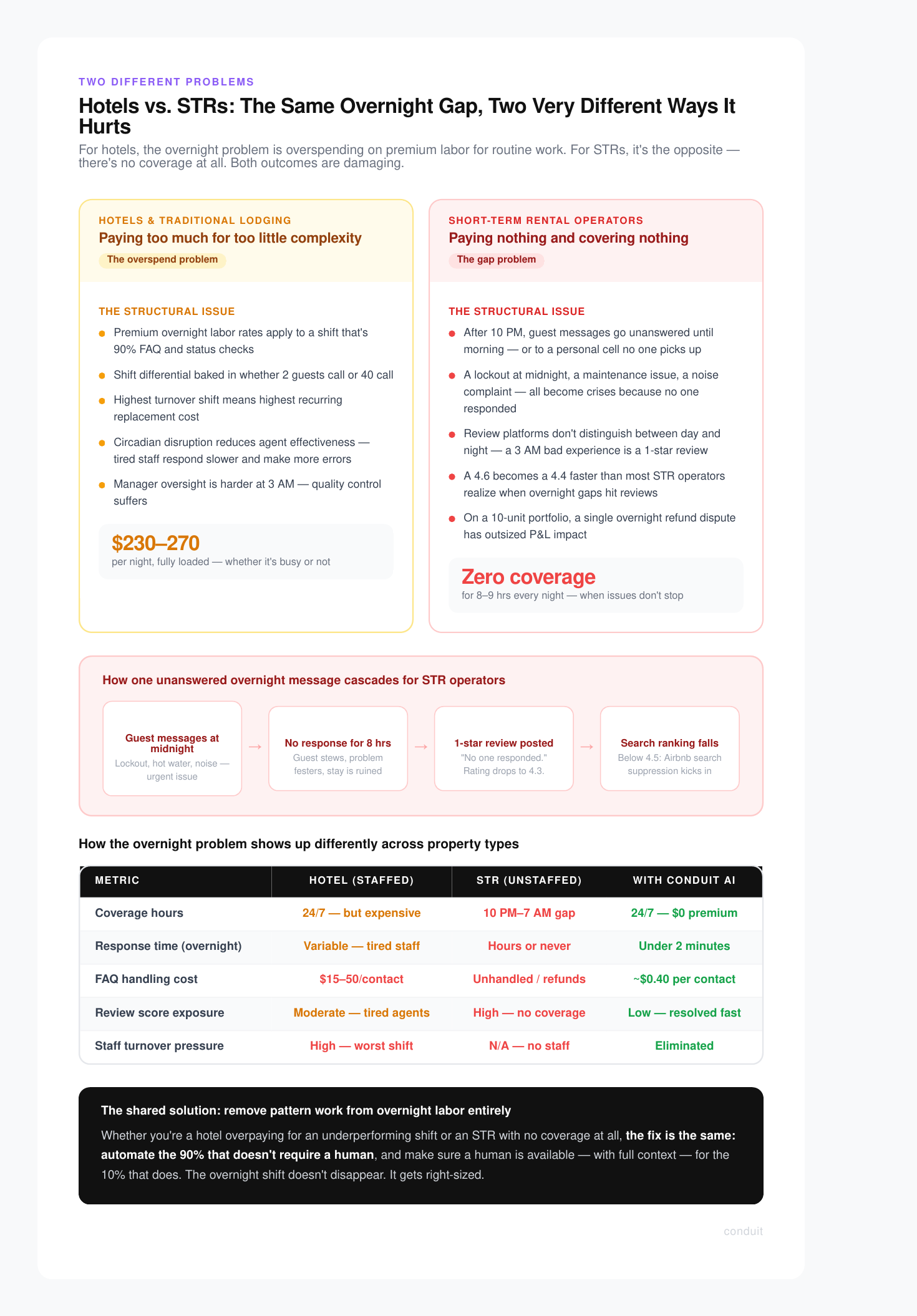
For short-term rental operators, the overnight coverage problem doesn't look like overspending. It looks like zero coverage.
Most STR managers aren't running a 24/7 desk. They're running a lean operation where guest messages after 10 PM either go unanswered until morning or get routed to a personal cell phone that someone may or may not pick up. Neither outcome is acceptable when a guest is locked out of the property at midnight or their hot water isn't working.
Consequences of Zero Coverage
The consequences stack up:
- Guest satisfaction drops when response times stretch past 30-60 minutes on urgent issues
- Review scores suffer , and in the STR world, a 4.6 becomes a 4.4 faster than most operators realize
- Refund requests increase when problems aren't resolved promptly, often costing more than a single month of coverage would have
- Repeat bookings erode because guests remember how they felt at 1 AM when no one answered
The irony is that STR operators often have tighter margins than hotels, making the cost of bad overnight coverage even harder to absorb. A single bad review or refund dispute on a 10-unit portfolio has a proportionally larger impact than it would on a 200-room hotel.
The overnight gap isn't just a staffing inconvenience. For STRs, it's a direct threat to revenue and reputation.
How to Audit Your Own Overnight Coverage
Before you can fix the problem, you need to measure it. Here's a simple framework for understanding what your overnight operation actually costs and what it actually does.

Step 1: Pull Your Overnight Contact Data
Most property management systems and messaging platforms can filter by time of day. Pull 30 days of guest contacts between 10 PM and 7 AM. Tag each one by type: FAQ, status check, maintenance, complaint, or genuine emergency.
If you don't have a tagging system, a manual review of 100 overnight messages takes about two hours and tells you most of what you need to know.
Step 2: Calculate the True Hourly Cost
Take your overnight agent's base hourly rate and apply the shift differential. Add benefits (typically 25-30% of base wages for full-time employees). Divide total overnight labor spend by the number of guest contacts handled.
Most operators are surprised by the result. A shift that costs $250 in labor and handles 15 contacts is costing $16.67 per interaction, often for questions with a one-sentence answer.
Step 3: Separate Pattern Work from Judgment Work
Go back to your contact log and mark every message that had a known, repeatable answer at the time of contact. That percentage is your pattern-matching rate. If it's above 80%, your overnight coverage model has a structural mismatch between cost and complexity.
This isn't about cutting corners on guest service. It's about making sure your most expensive labor hours are doing work that actually requires them.
The overnight shift has always been the hardest part of hospitality operations to get right. High cost, high turnover, low engagement, and a contact mix that's mostly routine. Recognizing that mismatch is the first step toward building something that actually works, for your guests and your bottom line.
Want to see how other operators have restructured their overnight coverage model?Book a demo with Conduit and we'll walk through what the numbers look like for your specific property type and volume.
Stay in the loop
Get the latest on AI automation, product updates, and customer stories.

