Why Your Guest Response Time Is Costing You More Than You Think


The 60-Second Standard
What slow replies really cost
TL;DR
Slow guest response times don't just frustrate guests. They suppress your Airbnb search ranking, tank review scores, kill rebooking rates, and spike cancellations. For an operation managing 100+ listings, the compounding cost can run into hundreds of thousands of dollars annually. The fix is an operational standard, not a staffing headcount increase.
Most operators know that slow responses are bad. What they don't fully account for is how bad, and specifically how each hour of delay triggers a separate, measurable loss across four different revenue and reputation vectors simultaneously.
If you're running 100+ doors, your team is fielding upward of 500 guest messages per week. That's a conservative estimate. During peak season, it's often double. Every one of those messages is a ticking clock, and the penalties for missing that clock aren't linear. They compound.
The math is worse than you think. A 3-hour average response time doesn't cost you 3x what a 1-hour response time costs. It costs you a search ranking hit, a review score hit, a rebooking probability drop, and a cancellation risk increase, all at once, on every message.
Let's break down exactly what's happening.
The Four Compounding Costs of a Slow Response

1. Search Ranking Suppression
Airbnb's algorithm explicitly factors response rate and response time into search placement. Listings that maintain a sub-1-hour response time qualify for Superhost status and receive preferential ranking in search results. Listings that fall below that threshold get pushed down, regardless of how strong their reviews are.
This isn't a soft penalty. The top three search results capture the overwhelming majority of bookings. A ranking drop of even five to ten positions translates directly into occupancy loss. For a portfolio of 100+ listings, that's not one problem, it's a systemic revenue leak.
2. Review Score Erosion
Guests don't separate "responsiveness" from "overall experience" in their minds. When they write a review, a slow response during their stay colors everything. It signals that the operator doesn't care, even if the listing itself was spotless.
A 2025 hospitality study published in the CMSR Journal found that faster response times in hotel guest communication directly increased satisfaction scores from 3.8 to 4.5 out of 5, with a correlation coefficient of -0.89 between response time and guest satisfaction. Response speed is consistently one of the top drivers of guest scores. In the STR context, a single-star drop in your average rating can reduce your booking conversion rate significantly. On platforms where social proof is everything, that's a compounding disadvantage.
3. Rebooking Rate Decline
Direct rebookings and repeat guests are the highest-margin revenue in any STR or boutique hotel operation. Guests who had a friction-free communication experience are dramatically more likely to return. Guests who waited 4+ hours for a reply to a check-in question are not.
This is the hidden cost most operators never track. It doesn't show up as a lost booking in your PMS. It shows up as a new guest booking instead of a returning one, with all the acquisition cost that implies.
4. Cancellation Rate Increases
Pre-arrival is the highest-anxiety window for guests. They have questions about check-in logistics, parking, early access, local recommendations. When those questions go unanswered for hours, doubt creeps in. Some guests cancel. Others arrive frustrated, which accelerates the review score erosion described above.
Airbnb's own documentation confirms that host responsiveness directly factors into search ranking and Superhost eligibility, with the algorithm explicitly rewarding hosts who respond quickly and penalizing those who don't. The causal link is intuitive: a guest who feels heard and informed before arrival is a guest who shows up confident, not anxious.
Why Hiring More Staff Is Not the Answer

The instinctive response to a response-time problem is a headcount response. Hire another guest experience coordinator. Add a night shift. Expand the team.
Here's the operational reality: at 500+ messages per week across 100+ listings, you're looking at an average of 70+ messages per day. Those messages are distributed unevenly across time zones, platforms, and urgency levels. Some days it's 40 messages. Some days it's 120. A human team sized for the average is perpetually overwhelmed during peaks and underutilized during troughs.
The cost of that model compounds too:
- Hiring and training costs for guest-facing roles in hospitality are significant, with high turnover rates in the industry
- Night coverage requires either premium pay or an offshore team with its own coordination overhead
- Consistency degrades as team size grows — a guest messaging at 2am gets a different quality of response than one messaging at 2pm
- Scaling is linear — every 50 new doors you add requires proportional headcount, which destroys your NOI margin
The operators who are winning on response time aren't the ones with the biggest teams. They're the ones who have built systems where the default response is instant, and human judgment is reserved for situations that actually require it.
That's a structural shift, not a staffing shift. And it starts with a clear operational standard.
The 60-Second Standard: An Operational Framework

The 60-Second Standard is simple to define and hard to execute without the right infrastructure: every guest message receives a substantive, accurate response within 60 seconds, 24 hours a day, 7 days a week, across every listing and every platform.
Here's what it takes operationally to actually hit that bar.
Layer 1: Unified Message Inbox
You cannot respond in 60 seconds if your team is toggling between Airbnb, VRBO, Booking.com, direct booking email, and SMS. The first infrastructure requirement is a single unified inbox where every guest message, regardless of channel, appears in one place with full listing context attached.
Without this, your response time is constrained by the slowest platform your team remembers to check.
Layer 2: Intelligent Message Triage
Not every message requires the same response. A guest asking for the WiFi password and a guest reporting a broken HVAC are both urgent, but they require completely different handling. Your system needs to categorize messages by type and urgency automatically, routing routine inquiries to instant responses and flagging operational issues for immediate human escalation.
This is where the role of a skilled conversation engineer becomes critical. Someone needs to design the logic: which messages get automated responses, which ones escalate, and what those responses actually say. That's not a set-it-and-forget-it task. It's an ongoing function.
Layer 3: Automated First Response for High-Volume Inquiry Types
Across a typical STR portfolio, the majority of guest messages fall into a small number of repeatable categories:
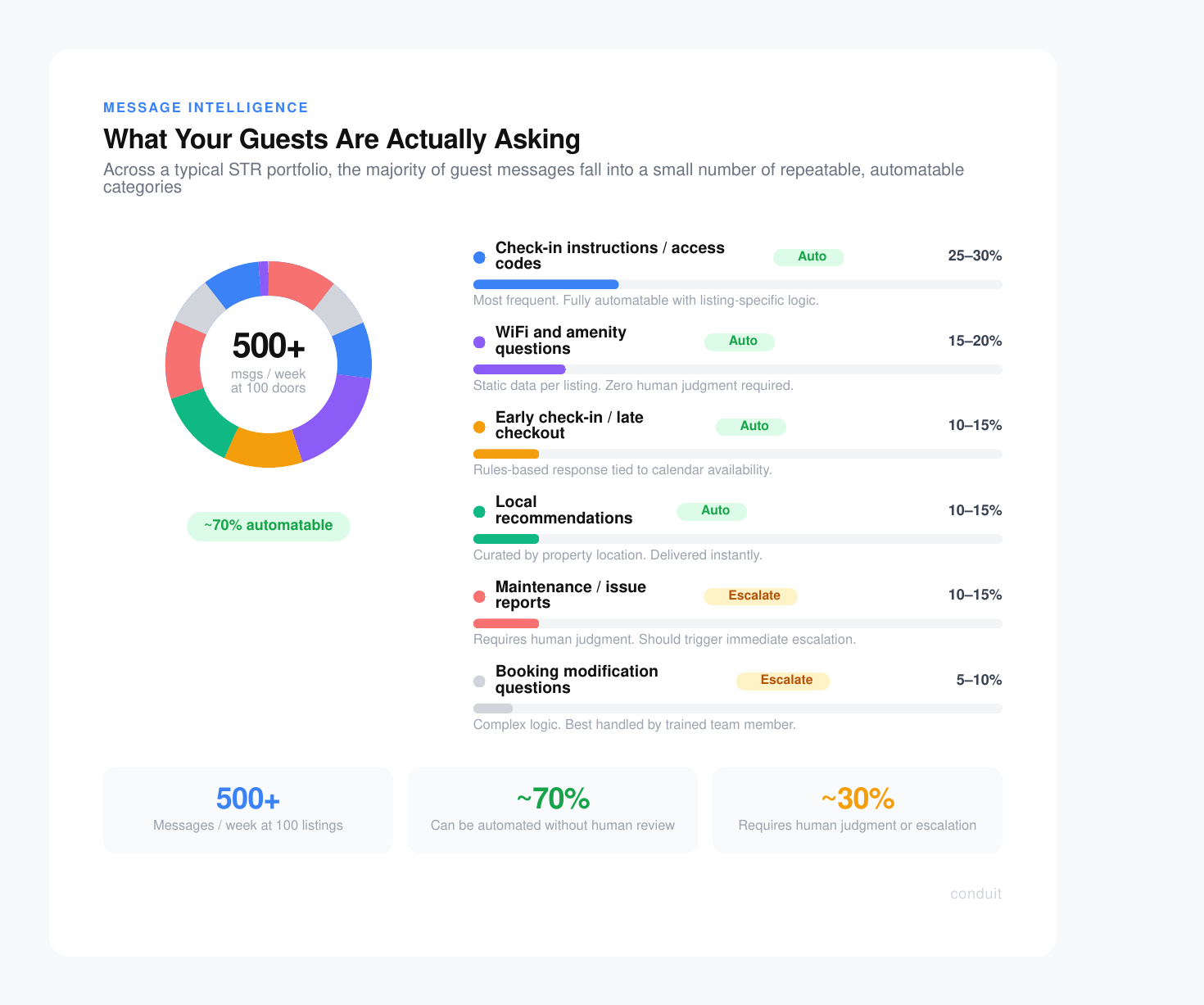
- Message Type: Check-in instructions / access codes — Approximate Share of Volume: 25-30%
- Message Type: WiFi and amenity questions — Approximate Share of Volume: 15-20%
- Message Type: Early check-in / late checkout requests — Approximate Share of Volume: 10-15%
- Message Type: Local recommendations — Approximate Share of Volume: 10-15%
- Message Type: Maintenance or issue reports — Approximate Share of Volume: 10-15%
- Message Type: Booking modification questions — Approximate Share of Volume: 5-10%
These categories are predictable. They can be responded to instantly with accurate, listing-specific information, without a human in the loop for the first response. The 60-Second Standard is achievable for the majority of your message volume through automation alone.
Layer 4: Human Escalation Protocols That Actually Work
Automation handles the volume. Humans handle the exceptions. But the escalation path has to be fast and clear, or the 60-Second Standard breaks down on the messages that matter most.
Effective escalation protocols include:
- Defined trigger conditions : What types of messages bypass automation entirely and go straight to a human? (Safety concerns, complaints, complex booking changes)
- On-call coverage with hard SLAs : Someone is always reachable, with a defined maximum response time for escalated messages
- Shift handoff documentation : The overnight team knows exactly which guests are in active conversations and what context exists
Layer 5: Measurement and Accountability
You can't manage what you don't measure. The 60-Second Standard requires a dashboard that tracks:
- Average first response time by listing, channel, and time of day
- Response rate (percentage of messages receiving a reply within 1 hour)
- Escalation rate (what percentage of messages require human intervention)
- Correlation tracking between response time and review scores over time
If your current tooling doesn't surface these metrics, you're operating blind. And you're almost certainly not hitting the standard, even if you think you are.
The Standard Is the Strategy
Response time isn't a guest experience metric. It's a revenue metric. Every hour your team takes to reply is an hour Airbnb's algorithm is penalizing your listings. It's an hour a pre-arrival guest is second-guessing their booking. It's an hour a post-stay guest is forming the opinion they'll put in their review.
For operators at scale, the compounding effect of slow responses across 100, 200, or 500 doors isn't a minor inefficiency. It's a structural drag on your entire business.
The 60-Second Standard is achievable. But it requires treating guest communication as an infrastructure problem, not a staffing problem. Build the layers above, measure relentlessly, and the ranking, review, and rebooking numbers will follow.
Want to see what it looks like to run the 60-Second Standard at scale?Book a demo with Conduit and we'll walk through how operators like yours are responding to every guest message in under 60 seconds, without adding headcount.
Stay in the loop
Get the latest on AI automation, product updates, and customer stories.


