"We Tried AI Before and It Didn't Work" — What's Different Now


Why AI Works Now
LLM agents vs. old decision trees
TL;DR
Early AI tools for guest messaging were rigid, rule-based decision trees that broke the moment a guest asked something unexpected. Large language models (LLMs) are a fundamentally different technology. They understand context, hold multi-turn conversations, pull live data from your systems, and work across every channel at once. If your last experience left you frustrated, that frustration was earned. But the gap between then and now is larger than most people realize.
I hear some version of this on almost every discovery call.
"We tried something like this before. It was a disaster. Guests hated it. We ended up turning it off after two weeks."
It's a fair reaction. And honestly, if you implemented an AI messaging tool two or three years ago, you probably should have turned it off. What was being sold as "AI" back then was, in most cases, a glorified phone tree. A decision tree dressed up in a chat window. The technology wasn't ready, and a lot of operators paid the price in guest satisfaction scores and staff morale.
But here's what I need you to understand: the technology that failed you two years ago is not the technology available today. The gap is that large.
This isn't a marketing claim. It's a structural change in how these systems work, what they can access, and what they're capable of doing in a real conversation.
What the Old Tools Actually Were
Let's be specific about what broke, because vague reassurances aren't useful.
The tools most operators tried between 2019 and 2023 were built on rule-based logic. A developer (or a vendor's onboarding team) mapped out a flowchart: if the guest says X, respond with Y. If they say Z, show them a menu. These systems had no real understanding of language. They matched keywords and triggered pre-written responses.
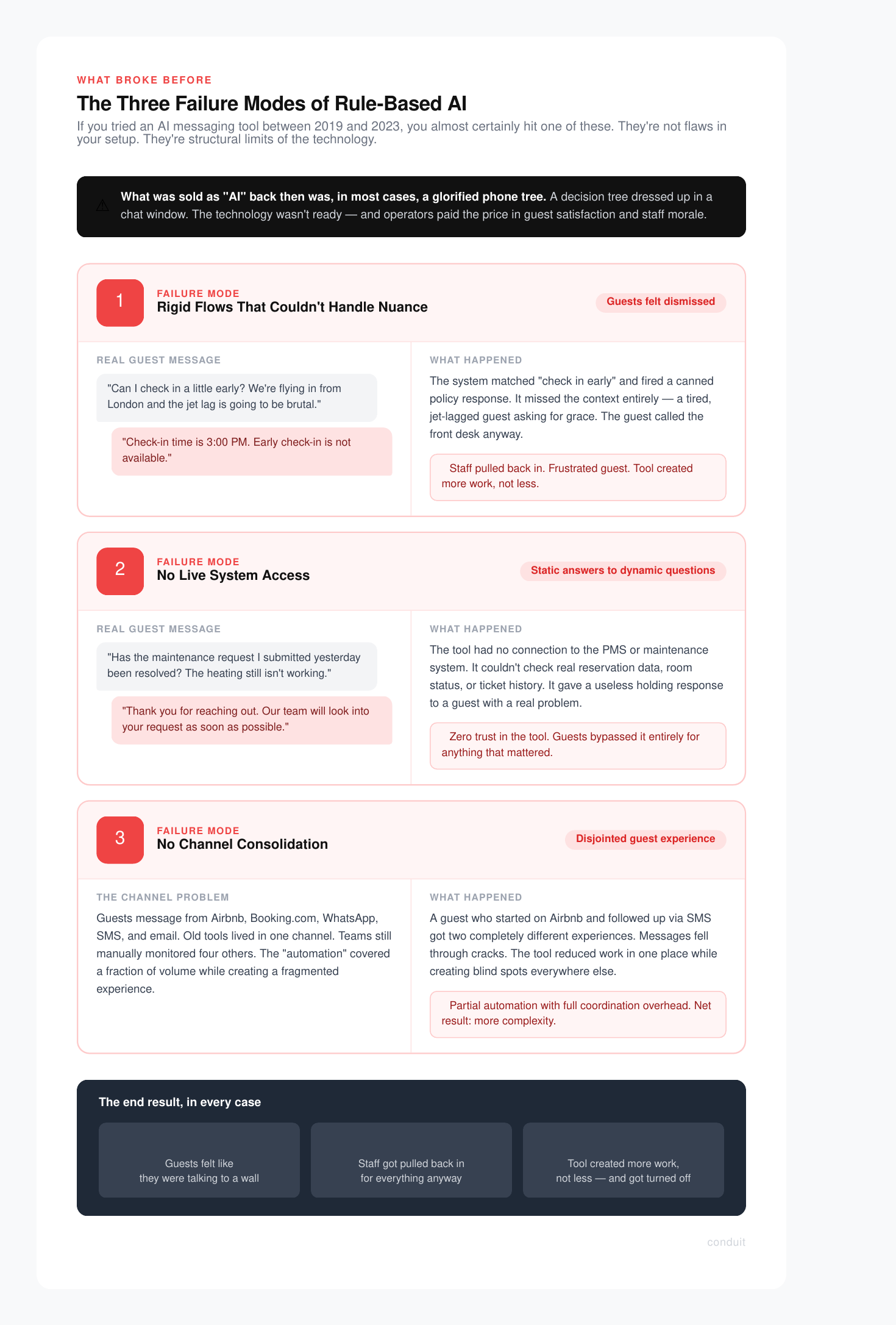
The three failure modes that burned you
1. Rigid flows that couldn 't handle nuance. A guest asks: "Can I check in a little early? We're flying in from London and the jet lag is going to be brutal." A rule-based system sees "check in early" and fires back a canned response about your 3 PM policy. It misses the context entirely. The guest feels dismissed. They call the front desk anyway. Your staff is now handling a frustrated guest instead of a simple early check-in request.
2. No live system access. Early tools couldn't connect to your property management system in real time. They couldn't tell a guest whether their room was ready, what their reservation balance was, or whether the maintenance request from yesterday had been resolved. They gave static answers to dynamic questions, which made them useless for anything beyond the most generic FAQs.
3. No channel consolidation. Guests message from everywhere: Airbnb, Booking.com, WhatsApp, SMS, email. Old tools typically lived in one channel. Your team still had to manually monitor four others. The "automation" only reduced a fraction of the workload while creating a disjointed guest experience across platforms.
The result: guests felt like they were talking to a wall. Staff got pulled back in anyway. The tool created more work, not less.
What LLMs Actually Changed (And Why It's Not a Minor Upgrade)
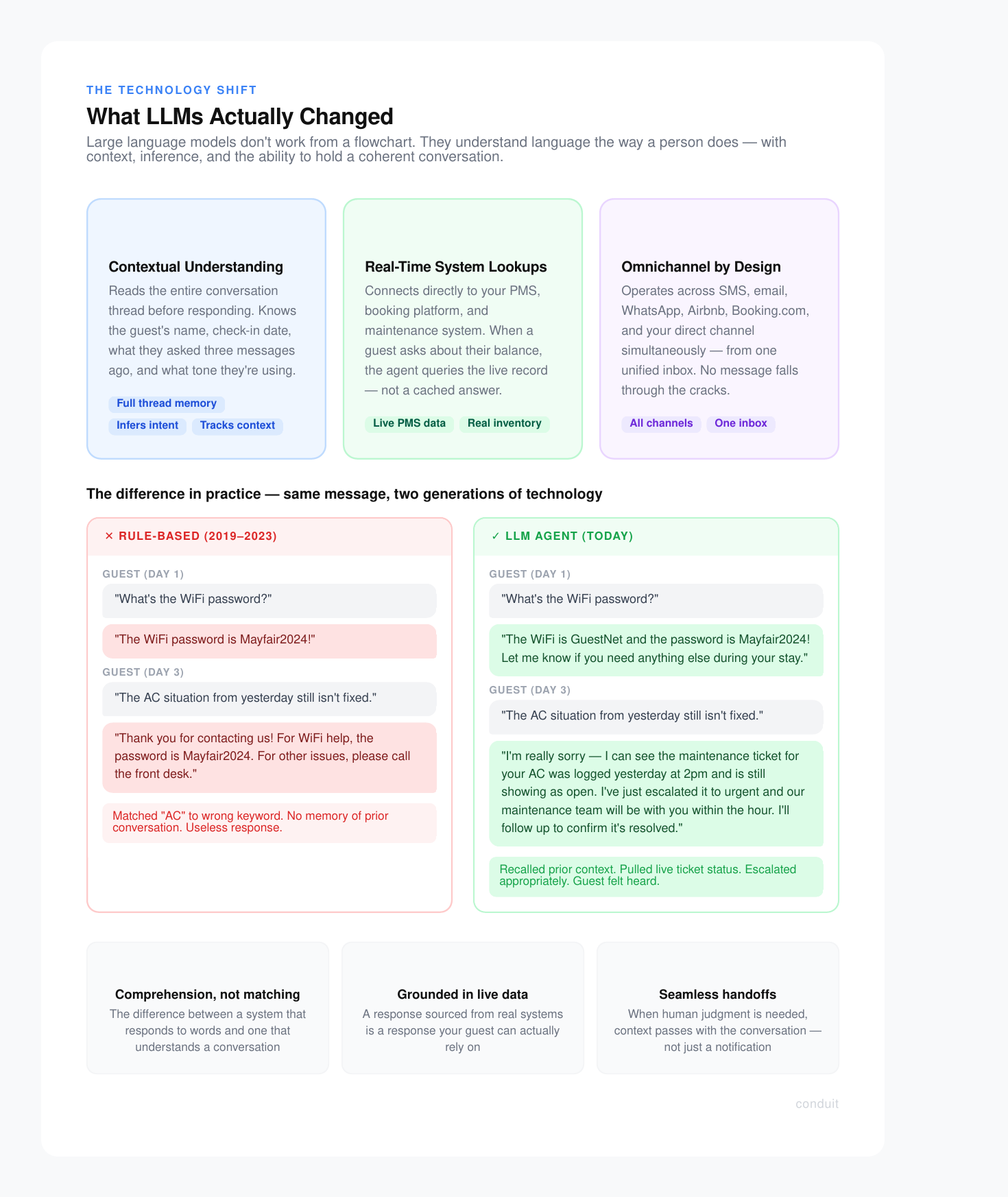
Large language models don't work from a flowchart. They understand language the way a person does: with context, inference, and the ability to hold a coherent conversation across multiple messages.
That's not a small improvement. It's a different category of technology.
Contextual understanding across a full conversation
An LLM-powered agent reads the entire conversation thread before responding. It knows the guest's name, their check-in date, what they asked three messages ago, and what tone they're using. If a guest says "the AC situation from yesterday still isn't fixed," the agent doesn't need a keyword match for "air conditioning." It understands what "the AC situation" refers to because it has the prior context.
This is the difference between a system that responds to words and one that actually comprehends a conversation.
Real-time system lookups
Modern AI agents connect directly to your PMS, your booking platform, your maintenance ticketing system. When a guest asks about their reservation balance, the agent queries the live record and responds with the actual number. When they ask if early check-in is available, the agent checks real-time room availability. The response is accurate because it's sourced from the same data your staff would look at.
This is what makes automation trustworthy. A response that's grounded in live data is a response your guest can rely on.
Omnichannel by design
A well-built AI agent today operates across SMS, email, WhatsApp, Airbnb, Booking.com, and your direct booking channel simultaneously, from a single unified inbox. A guest who starts a conversation on Airbnb and follows up via SMS gets a coherent, continuous experience. Your team sees everything in one place. Nothing falls through the cracks.
The role of a skilled conversation engineer is to design the logic, escalation paths, and tone that make all of this feel seamless rather than automated. The technology provides the capability; the configuration determines whether it actually works for your operation.
Then vs. Now: The Honest Comparison
Here's how the two generations of technology stack up across the dimensions that actually matter for guest operations:
- Capability: Language understanding — Rule-Based Tools (2019-2023): Keyword matching only — LLM-Powered Agents (Today): Full contextual comprehension
- Capability: Multi-turn conversations — Rule-Based Tools (2019-2023): No (each message treated in isolation) — LLM-Powered Agents (Today): Yes (full conversation memory)
- Capability: PMS / live data access — Rule-Based Tools (2019-2023): Rarely, and never in real time — LLM-Powered Agents (Today): Native integrations, real-time lookups
- Capability: Channel coverage — Rule-Based Tools (2019-2023): Single channel — LLM-Powered Agents (Today): Omnichannel from one inbox
- Capability: Handles nuance and edge cases — Rule-Based Tools (2019-2023): No (breaks or gives wrong answer) — LLM-Powered Agents (Today): Yes (infers intent, escalates when needed)
- Capability: Improves over time — Rule-Based Tools (2019-2023): No — LLM-Powered Agents (Today): Yes (feedback loops, continuous tuning)
- Capability: Escalation to human — Rule-Based Tools (2019-2023): Manual, clunky — LLM-Powered Agents (Today): Intelligent, context-aware handoffs
The tools that burned you sit entirely in the left column. What's available now lives in the right one. These aren't incremental improvements to the same product. They're built on different foundations.
What Conduit Does Differently
Conduit is built on this generation of technology, not the last one.
Our AI agents handle guest conversations across text and voice, connected directly to your PMS so every response is grounded in real reservation data. We integrate with over 20 property management and booking platforms including Guesty, Hostaway, Lodgify, Cloudbeds, Mews, and more. A guest asking about their booking, a maintenance issue, or a late checkout request gets an accurate, context-aware response in seconds, regardless of which channel they're messaging from.
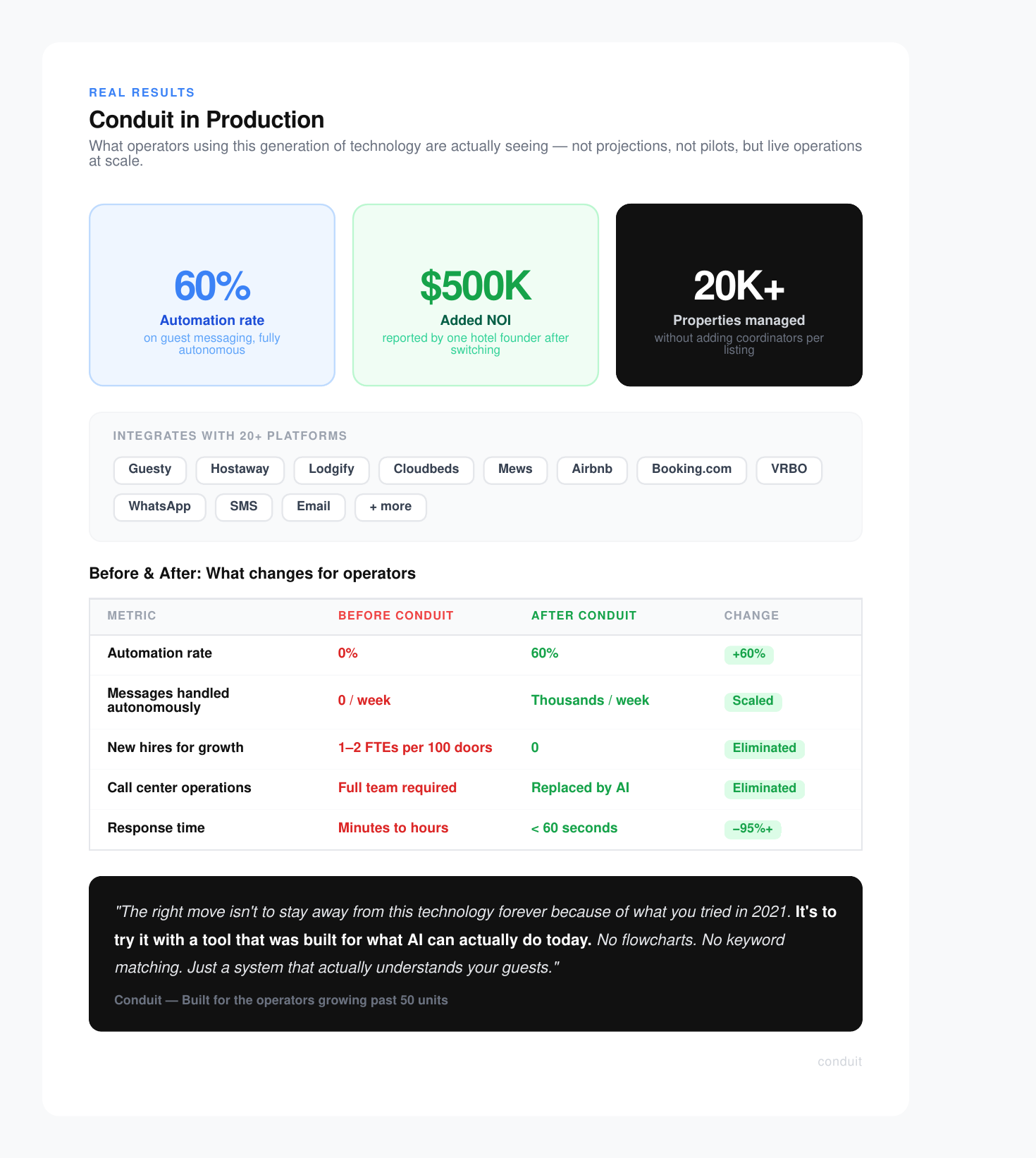
Here's what operators using Conduit are seeing in production:
- 60% automation rates on guest messaging, with teams sending thousands of messages fully autonomously
- Staff replacement of entire call center operations , with one hotel founder reporting an added $500,000 in NOI after switching
- Scalability without headcount growth , handling 20,000+ properties and tens of millions of messages without adding coordinators for every new listing
We also know that scaling guest operations without scaling headcount is the core challenge for every operator growing past 50 units. Conduit is designed specifically for that inflection point.
If your last experience left a bad taste, I get it. But the right move isn't to stay away from this technology forever. It's to try it with a tool that was built for what AI can actually do today, not what it could do in 2021.
Ready to see the difference firsthand?Book a demo with Conduit and we'll walk you through exactly how our AI agents handle the conversations your team is fielding right now. No flowcharts. No keyword matching. Just a system that actually understands your guests.
Stay in the loop
Get the latest on AI automation, product updates, and customer stories.

