The True Cost of a VA for Guest Communication (It's Not $700/Month)


The Real VA Cost
VAs cost more than $700/month
TL;DR: The typical VA invoice is $500 to $1,200/month. The fully-loaded cost, once you add onboarding, supervision, turnover, and knowledge loss, is closer to $1,500/month. On a per-message basis, that's roughly $5.00 vs. under $0.10 for AI. VAs were the best option available for guest communication until recently. They're not anymore.
For years, hiring a virtual assistant for guest communication was the smart move. It was the only way to get 24/7 coverage without burning yourself out answering "what's the wifi password?" at 11pm. VAs gave STR operators breathing room. They were a real solution to a real problem.
But "best available option" and "best option" are two different things. And the math has changed.
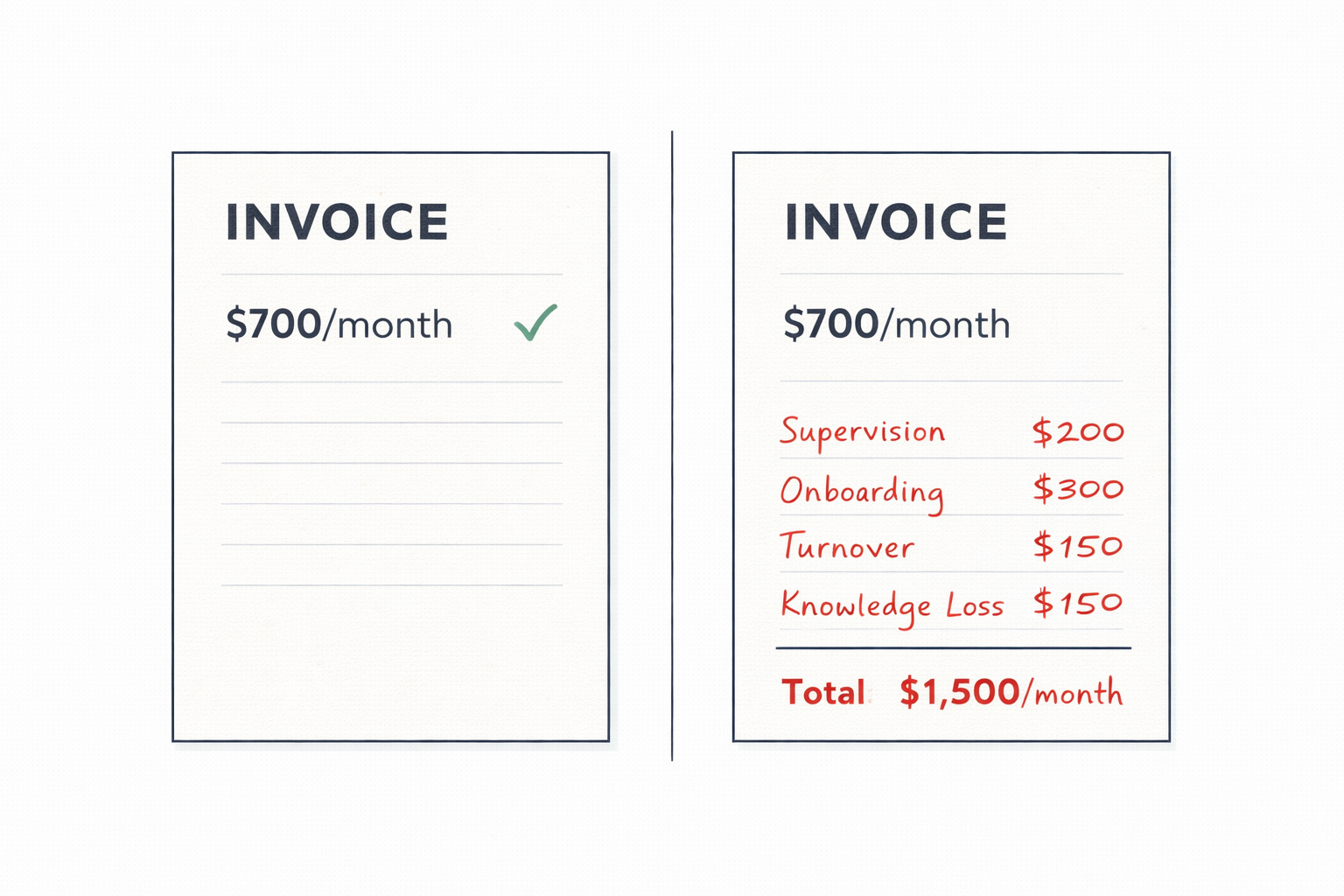
The number most operators see is the invoice: somewhere between $500 and $1,200 per month. That number feels manageable. What doesn't show up on the invoice is the training time you absorbed, the quality inconsistencies you tolerated, and the turnover you didn't see coming. Nor does it show the institutional knowledge that walked out the door with your last VA. When you add all of it up, the actual cost is usually two to three times what you think you're paying.
This is an honest look at that math.
The Invoice Price Is Just the Starting Line
Let's use a real number: $700/month. That's squarely in the middle of the typical VA range and, as it happens, exactly what Tracey Rodriguez was paying before she switched to AI-powered guest communication. Her assessment after making the switch: " I was paying a VA $700 a month. You guys blow them out of the water."
But even at $700/month, the true cost was higher than that. Here's what the invoice doesn't capture.
The Onboarding Tax
A new VA needs 2 to 4 weeks before they're operating independently. During that window, you're not just waiting. You're actively involved: writing SOPs, answering questions, reviewing their responses, correcting mistakes. If your time is worth $50/hour and you spend 10 hours a week for three weeks in onboarding mode, that's $1,500 in time cost before your VA handles a single message on their own.
That cost gets paid every time you hire a new one.
Quality Variance
Even a well-trained VA brings inconsistency. Response tone shifts depending on who's working, what time it is, and how their day is going. A guest checking in at 2am in a different timezone might get a slower, shorter, or less helpful response than one who messages at noon. You can audit for this, but auditing takes time too, and most operators don't have a systematic way to catch quality drift until a review reflects it.
Timezone Limitations
Most VA arrangements have coverage gaps. Nights, weekends, and holidays are the moments guests need the most help, and they're often the moments your VA is least available. You can pay a premium for true 24/7 coverage, but that typically pushes costs toward the top of the range or above it.
The Turnover Problem Nobody Talks About
The average VA tenure in property management is 6 to 9 months, according to industry data on remote worker retention. That means most operators are rehiring and retraining at least once a year, often twice.
Each cycle costs you:
- Recruiting time : posting, screening, interviewing (typically 5 to 10 hours)
- Onboarding time : the 2 to 4 weeks described above, every single time
- Knowledge loss : everything your previous VA learned about your properties, your guests, your quirks, your preferred phrasing, your escalation logic. Gone.
- Coverage gaps : the period between one VA leaving and the next one being ready, during which you're back on the phones yourself
The knowledge loss piece is the most underestimated. A VA who's been with you for six months has absorbed hundreds of micro-decisions. They know that the unit on the third floor gets cold at night and guests should be told to adjust the thermostat before bed. They know that your cleaning team needs 30 minutes of buffer after checkout. That institutional knowledge doesn't live in a document. It lives in their head. When they leave, it goes with them.
You then spend the next two months rebuilding it with someone new, who will also eventually leave.
The Fully-Loaded Cost: Running the Numbers
Here's what the math actually looks like when you account for everything. These figures use conservative estimates.
- Cost Component: VA base fee — Monthly Estimate: $700
- Cost Component: Supervision and QA (2 hrs/week @ $50/hr) — Monthly Estimate: $400
- Cost Component: Onboarding amortized over 8-month tenure — Monthly Estimate: $188
- Cost Component: Recruiting amortized over 8-month tenure — Monthly Estimate: $63
- Cost Component: Knowledge loss / retraining gap (est.) — Monthly Estimate: $150
- Cost Component:Fully-loaded monthly total — Monthly Estimate:~$1,500
That's more than double the invoice price. And it doesn't include the cost of a bad review from a guest who messaged at 3am and waited four hours for a reply.

Per-Listing and Per-Message
If you're running 10 listings and fielding roughly 300 guest messages per month:
- VA fully-loaded cost per listing : ~$150/month
- VA fully-loaded cost per message : ~$5.00
An AI system handling the same volume typically runs $1 to $3 per listing per month at scale, with per-message costs well under $0.10. The gap is not marginal. It's structural. (If you're evaluating your options, this breakdown of the top Airbnb automation tools is a useful starting point.)
The AI doesn't need training time. It doesn't have bad days. It doesn't give notice. And unlike a VA, it functions as a true conversation engineer: learning your property's specific rules, applying them consistently, and escalating intelligently when a human actually needs to step in.
This Isn't About VAs Being Bad at Their Jobs
It's worth being clear about something: VAs aren't the problem. Most of them work hard, care about doing a good job, and bring real value to the operators they work with. The issue isn't their effort. It's the structural limitations of the model itself.
A human being can only be in one conversation at a time. They need sleep. They have turnover rates because they have lives and careers that evolve. None of that is a character flaw. It's just reality.
For a long time, the only way to get responsive, personalized guest communication at scale was to hire people to do it. VAs were the best tool available for that job.
They're not anymore.
"I was paying a VA $700 a month. You guys blow them out of the water." — Tracey Rodriguez, STR Operator
Tracey didn't switch because her VA was bad. She switched because the alternative got better. That's the shift happening across the industry right now: not a rejection of the VA model, but an honest recognition that the technology has caught up and then some.
If you're still running guest communication through a VA, the question isn't whether you should switch eventually. It's whether the fully-loaded cost you're paying right now is worth it compared to what's available today. Run the numbers with your actual volume and your actual time investment. Most operators who do are surprised by what they find.
Book a Demo to see how Conduit's conversational AI handles guest messaging, service requests, and communication across voice, text, and chat — 24/7, without the overhead.
Stay in the loop
Get the latest on AI automation, product updates, and customer stories.

