How to Customize Your AI's Tone and Personality for Guest Communication


Tune Your AI's Voice
On-brand replies, never robotic
The most common objection I hear from hospitality operators before they deploy AI: " I don't want it to sound like a robot."
It's a fair concern. Generic, stiff AI responses can do more damage than no response at all. A guest asking about late checkout at a luxury Mayfair hotel does not want the same reply as someone booking a surf shack in Maui. The words matter. So does the tone, the formality, and the warmth behind them.
But here's the thing: that robotic quality isn't a flaw in the AI. It's a flaw in the setup.
The AI doesn 't have a personality problem. It has a training problem. Feed it your best responses and it will sound like your best agent.
The good news: you have full control over how your AI communicates. Every element of its voice is something you can design: formality level, sentence length, vocabulary, even the phrases it reaches for first. This guide walks through exactly how to do it. And given that nearly 60% of AI-drafted guest replies are now sent without any human edits, getting the voice right from the start matters more than ever.
TL;DR
- Generic AI responses come from generic setup, not generic technology
- You can engineer your AI's voice using five key levers: style prompts, knowledge base quality, brand voice guidelines, response length, and formality level
- A luxury London hotel and a beachside Maui Airbnb can run on the same platform and sound nothing alike
- The goal is to become a conversation engineer, not just an AI user
The Five Levers of AI Voice Design

Think of your AI as a new hire. You wouldn't hand them a login and say "figure it out." You'd give them a brand handbook, walk them through your best customer interactions, and coach them on tone. AI setup works the same way. There are five specific levers you control.
1. Style Prompts
The style prompt is your AI's foundational instruction set. It tells the AI not just what to say, but how to say it. This is where you encode personality.

A well-engineered style prompt might include:
- Persona framing : "You are a warm, knowledgeable concierge at a boutique hotel. You take pride in anticipating guest needs before they ask."
- Tone direction : "Respond with warmth and a touch of humor. Never be stiff or transactional."
- Prohibited patterns : "Never start a message with 'Hello!' Never use the phrase 'As per your request.'"
- Vocabulary preferences : "Use British English spelling. Prefer 'whilst' over 'while.' Say 'lift' not 'elevator.'"
The more specific your style prompt, the more consistent and on-brand your AI will be. Vague prompts produce vague responses.
2. Knowledge Base Quality
Your knowledge base is the raw material the AI works with. If it's thin, the AI will fill gaps with generic language. If it's rich, the AI sounds like it genuinely knows your property. (If you're working on automating your Airbnb guest messages, this is the single highest-leverage place to start.)
What belongs in your knowledge base:
- Your actual best responses to common questions (copy them directly from your inbox)
- Property-specific details: check-in procedures, parking quirks, neighborhood recommendations
- Frequently asked edge cases: early arrivals, noise policies, pet rules
- The language your team naturally uses when talking to guests
This last point is the most overlooked. If your team says "We'd be delighted to arrange that," put that phrase in the knowledge base. The AI will learn it and use it. If your team says "Absolutely, no worries at all," put that in instead. The AI mirrors what you give it.
3. Brand Voice Guidelines
Brand voice guidelines go one level above the style prompt. They capture the emotional register you want guests to feel after every interaction.
Ask yourself: what should a guest feel after reading a response from your AI?
- Reassured and taken care of?
- Excited and welcomed into a community?
- Respected and attended to with precision?
Document that feeling and work backward into language rules. A brand voice guideline might read: "Every response should make the guest feel like the most important person in the building. Never rush them. Never be dismissive. If in doubt, over-communicate."
4. Response Length Preferences
Length is a tone signal. Short responses feel efficient but can read as cold. Long responses feel attentive but can overwhelm a guest who just wants a quick answer.
A useful framework:
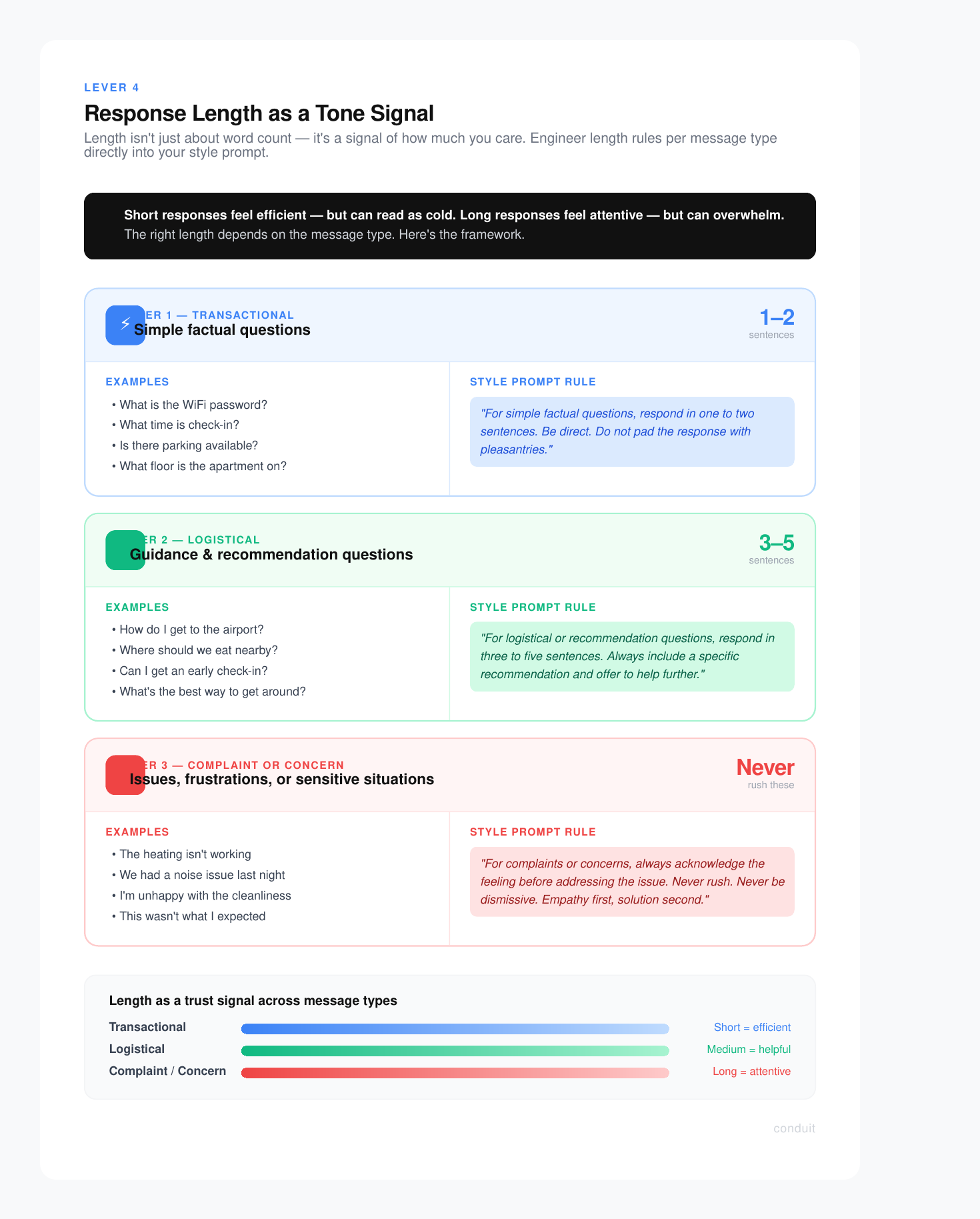
- Transactional questions (check-in time, WiFi password): 1-2 sentences, direct
- Logistical questions (how to get to the airport, where to eat): 3-5 sentences with a recommendation
- Complaint or concern messages : Longer, empathetic, never rushed
You can engineer length preferences directly into your style prompt. Something like: "For simple factual questions, respond in one to two sentences. For guest concerns or complaints, always acknowledge the feeling before addressing the issue." Short, explicit, and the AI will follow it consistently.
5. Formality Level
Formality is the single biggest differentiator between property types. And it's entirely configurable.
Consider two real scenarios:
- Property: Luxury boutique hotel, Mayfair, London — Desired Voice: Formal, polished, British English — Formality Signal: "We would be delighted to arrange..."
- Property: Beachfront Airbnb, Maui — Desired Voice: Casual, warm, relaxed — Formality Signal: "Of course! Here's everything you need..."
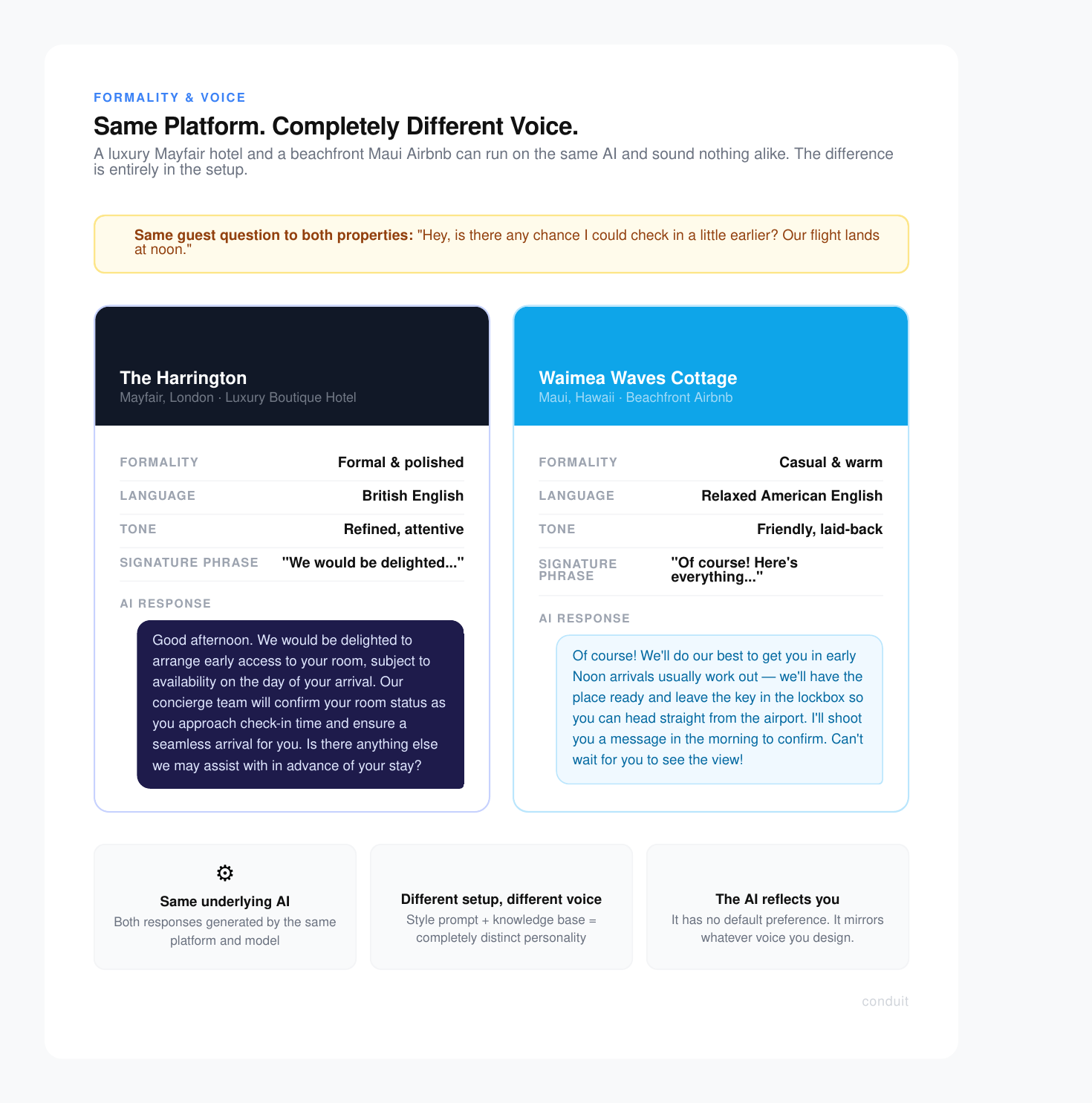
Both properties can run on the same AI platform. The difference is entirely in how each operator has engineered the setup. The AI adapts to whatever voice you design. It has no default preference. It reflects yours.
Where to Start: A Practical First Step
If this feels like a lot to configure at once, start with one exercise: pull your five best guest interactions from the last 90 days. The ones where a guest replied with a glowing compliment, or where your team handled a tricky situation with grace.
Those responses are your voice. Copy them into your knowledge base and use them as the foundation for your style prompt. You're not starting from scratch; you're teaching the AI to sound like your best agent on their best day.
That's what being a conversation engineer actually means. You're not just turning on a chatbot. You're designing a communication system that reflects your brand, scales across every channel, and never has an off day.
The operators who see the best results from AI aren 't the ones with the biggest properties or the most messages. They're the ones who invest in the setup, treat the AI like a team member worth training, and revisit the configuration as their brand evolves.
The AI will meet you where you put it. The only question is how thoughtfully you design the destination.
If you want to see how this works in practice, book a demo with Conduit. We'll walk through your specific property type, show you how to engineer your brand voice into the platform, and build a setup that sounds nothing like a robot and everything like you.
Stay in the loop
Get the latest on AI automation, product updates, and customer stories.


